Theux part 2 (and Venice):
Because I affectionately call this my Eat, Pray, Love year, I will indulge in the later two elements in this post.
As a recap, in case you missed the last post (Read here!), I was in Belgium working at a bakery for the aforementioned Pierre, who also housed me. These events take place over the second half of August.
Apologies for the delay, the holidays got in the way. (Relevant meme!) My Brother also asked for more photos, so I did my best to do that. We here at EatMarshallEat aim to please. I also apologize that this one ran a bit long, it could have ended before the On Cliches section, but it didn't.
**On extracurriculars: **
I told Pierre that I would say yes to any opportunity he brought up without knowing that Pierre is a wellspring of outings, events, parties, runs, bikes, climbs, dinners, drinks, and disciplined debauchery.
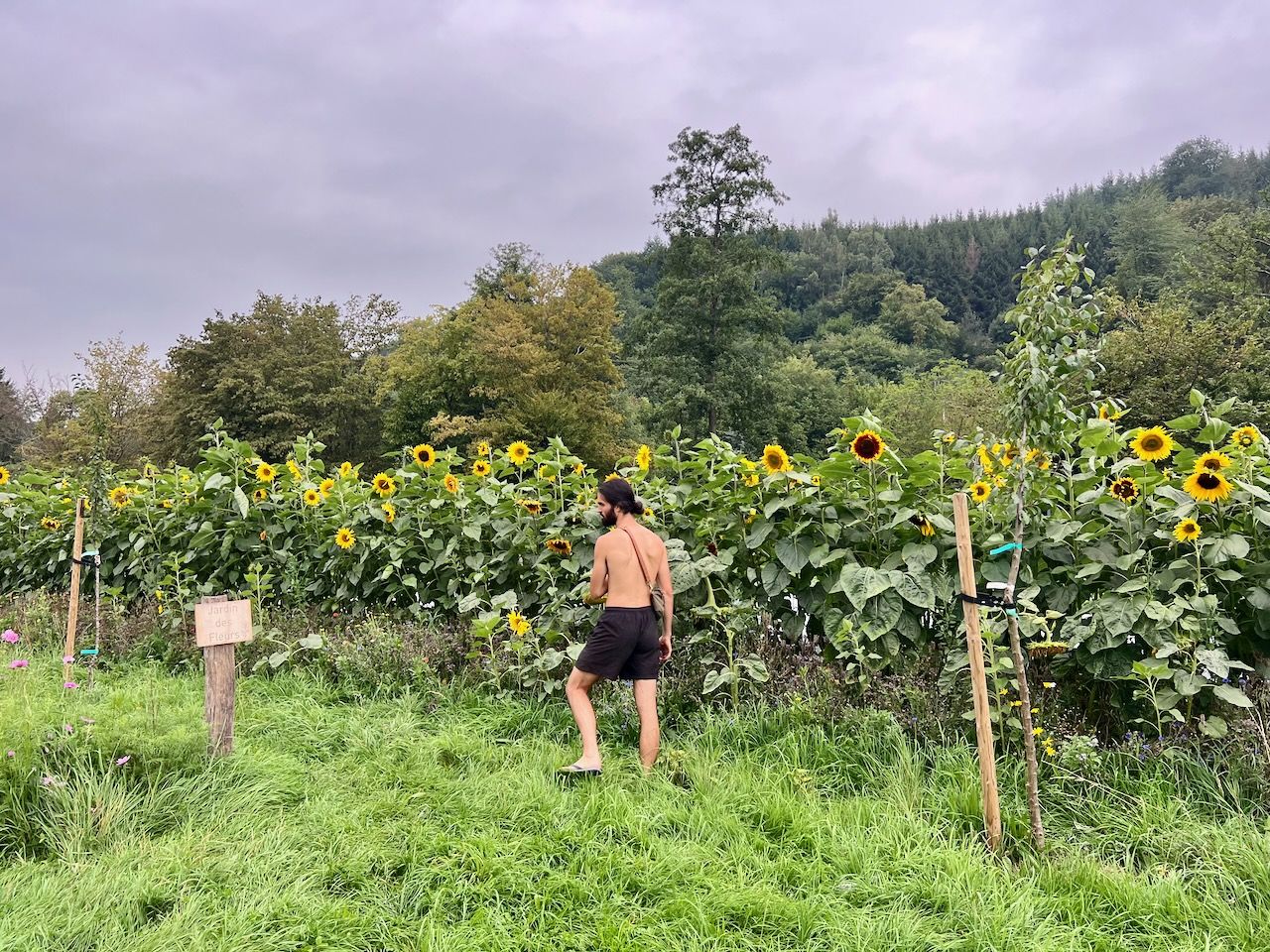
Pierre and an army of sun flowers
On a summer evening after baking we go to a community garden where that week's produce is written in chalk aside colorful numbers indicating how many carrots you could take home with you. I pluck yellow and purple tomatoes while Pierre cuts zucchini and picks basil. We're even allowed an allotment of sunflowers and azaleas. Our drawn out dinner consists of raw cauliflower (crudités) with mayonnaise and ketchup (cocktail sauce), every color of cherry tomato, pesto pasta, beet juice, and our deepest, darkest secrets.
Pierre and I had been delving deep into each other's lives each night at dinner, taking turns drawing questions from a deck of "conversations starter" cards. I was expecting, "waffles or pancakes?", "morning or night person?", "favorite city?", and instead got, "What are three things your partner taught you in your last relationship?", "What's one thing you wish you could tell your parents, but never have?", "What parts of your personality have caused issues in past relationships?" We skipped all small talk and spent our first evenings talking about our childhoods, the people who made us, the faults in our stars, words unsaid on lovelorn nights, and the importance of making mayonnaise by hand.
Not once did Pierre mention the fact that he proposed to Judith the previous week. Or that she was arriving the next day. Along with two of his friends, which then turned into four of his friends, and then eight, and so on. Peasants from all over Europe and America arriving at Pierre's doorstep with their leathers, furs, and linens stuffed into their rucksacks as if on a pilgrimage. The peasants were well-educated, worldly 20-somethings Pierre befriended at different stages of his life, all arriving to stay with him for the upcoming Middle Ages fair.
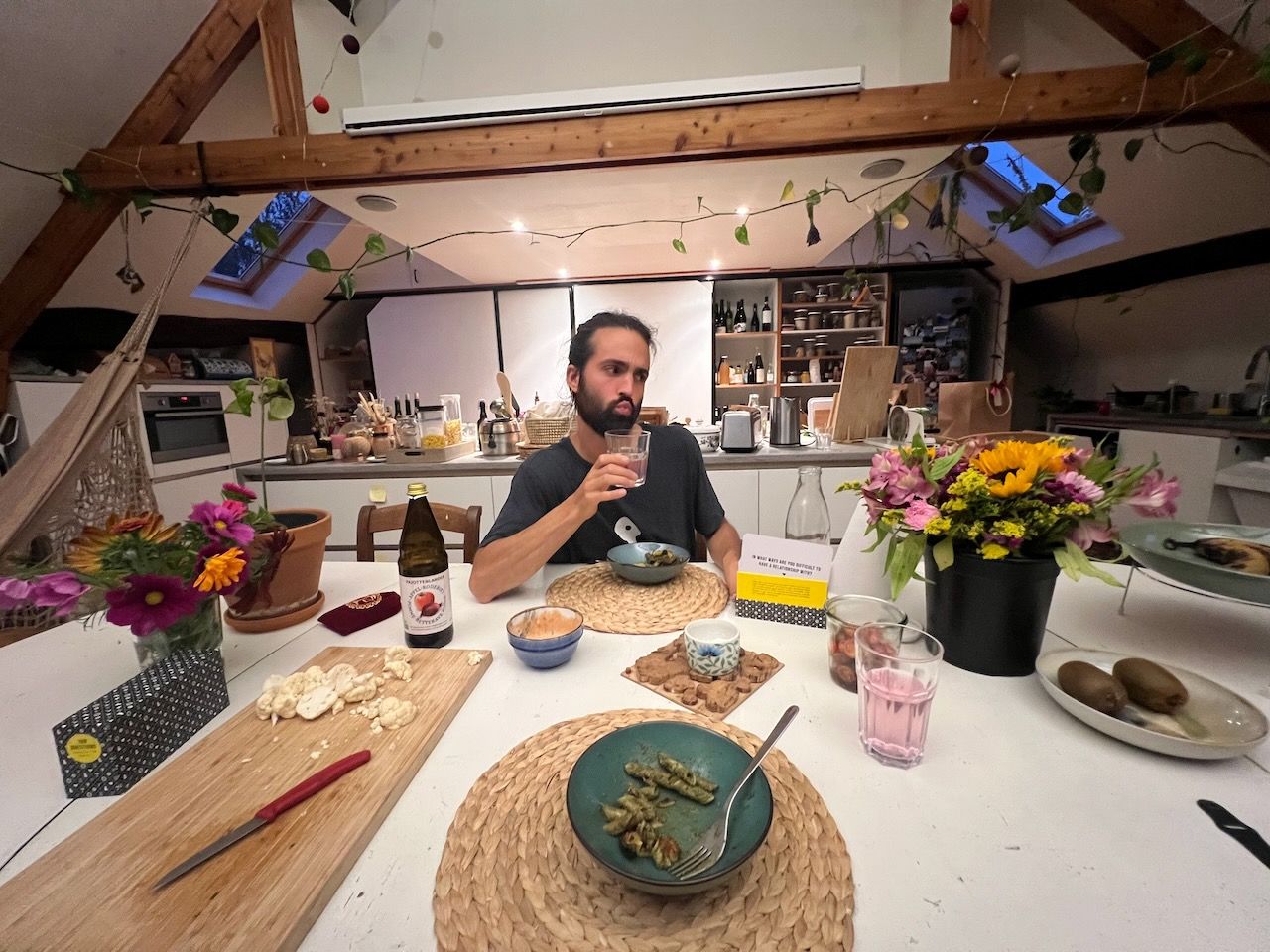
Proof we dined
I see lots of commentary (memes) online with the format: "The European Brain would not be able to comprehend this:" above a picture of a Buckees highway supercenter or a Bass Pro Shop. My equivalent moment of greatest American-in-Europe cultural shock occurred in two stores while we were shopping for the festival. The first was in a grocery store, where an open bottle of wine sat with taster cups and not a guard in sight. No one except for Pierre and the competing angels on my shoulders were to stop me from drinking 22 tasting cups of free supermarket wine. How anarchy hadn't yet befallen the store is beyond me.
The second moment came about in a drive through liquor store, which should say enough on its own. Pierre had called in an order for four crates of beer, two crates of water, and three gallons of Castle Wine. We drive into one end of a warehouse, stop in the middle, crates of booze get loaded into the trunk, and then we drive off. Bulk alcohol brought to the masses at long last. I've only heard whispers of similar concepts existing in the mythical land of New Orleans (if that place can be said to exist at all). These moments left impressions like hot wax upon my malleable American psyche: the indentations of which would soon be smoothed over by the impact of storming a castle in my finest linens and leathers.
Returning from the store, we pass four more Pierre zealots, who we put in the back of the van alongside the recently acquired crates. It's a Friday, which marks the day before the start of the festival. We pile into the bakery, le château de Pierre, and begin to drink, as one does when they are in possession of three gallons of elderflower wine. Before things get too muddled, we claim our sleeping spots in the storage room and macguiver objects together into forms that could reasonably be called beds: dust-crusted inflatable mattresses, cots that may have seen wartime, mismatched couch cushions, yoga matts stacked three high, impossibly firm play matts, well-planned sleeping bags, folded curtains of questionable origins. I slept on top of the comforter that I kept in my car, using my sheets as blankets.
To feed the masses Pierre establishes a pizza making brigade: one conscript cuts and shapes dough, another rolls them out flat, a third adorns them with sauce and an ensemble of fine cheeses, Pierre cooks them in the bread oven, and a final drizzles over honey and chopped walnuts. Fueled by handmade pizza, castle wine, and (gluten free) Belgian beers, we dance under string lights through the summer night until we're sweaty and tired enough to confront the atrocities we've built as beds. We drift off one by one, listen to a quartet of acoustic guitars and soft-voiced singers, dreaming of our imminent coronations.
In the morning we breakfast on the bakery's surplus granola and stretch our ill-rested joints in the morning sunshine, taking turns to get into costume: floor length velvet dresses, green suede tunics, veils covering hair intricately braided into Celtic knots and buckminsterfullerenes, leather waist pouches to hold scheckles and other trinkets, hemp cords sewn into shoulder stein slings for easy drinking, thick cotton shirts billowing in the breeze, faux fur, undyed linen, corsets, Robinhood tights, Scottish kilts, hobbit capes, pauper coifs, braided belts and animal pelts. The walk to the castle entrance was five minutes, which is conveniently about how long it takes to become drenched in sweat when you are wearing an elegant potato sack in the peak of summer. The walk from the entrance to the grounds proper and castle gate is another 10 minutes uphill, conveniently the amount of time it takes to melt human flesh inside an elegant potato sack in the peak of summer. I've learned many things this year, one being the corporeal limits of even the coldest elderflower wine on the hottest of days.
Upon arrival you exchange euros for tin coins which buy your grog and aliments. On the estate grounds there are cannons shot at unsuspecting hay-bales (which never stood a chance), knights dueling and all losing in turn to the high sun, black smiths hammering by stoked fires freshly minting new tin coins, saxons roasting charred mutton on spits, barefoot boys climbing wooden poles to win flower crowns and pretzels for dirt-faced girls, archers and stone carvers, trapezists and Trappists, choirs singing in caves and cloisters, men carrying around ferrets and more bag pipes than one can imagine, much less bear. Morning pipes for your arrival, afternoon pipes for your lunch, evening pipes to accompany your swill, and late night pipes to rave to. Bag pipes played by men in tartan kilts and women in luciferian black leather, atop crumbling spires on makeshift wooden stages, amped up along the castle walls, acoustic sessions by the woods, eternally droning out the rare fiddle or flute.
The king passes by at regular intervals, making his lordly rounds throughout the day. He's preceded by his court on horseback, bugles blaring and minstrels heralding fake deeds of feudal times. A bevy of tonsured monks and white-robed clergymen chant in latin before the crier announces the presences of His Elegance, and all are commanded to kneel. On a wooded hill under the shade of a long deserted, time-yellowed castle, a linened mass genuflects in unison to a man in flowing velvet, who on all other days may (might?) be an accountant. A simplified past is superimposed atop a confusing present and in the summer heat we melt into a tableau vivant oft-repeated in these parts, and on this hill, for 900 years.
Was the world ever like this? Who knows, and who knows if it matters. Authenticity is dead and we bid it adieu. Long live the accountant king and the world of flower wine, where horses are trotted between engineers and nurses and teachers and history looks exactly how we want it to when we want it to. The new world is here and, unfortunately, it looks a lot like us. In the following days and weeks I'd continue my pantomime of a baker and continue to wonder about all this. Is history a castle? Is culture a dance? Is tradition a drink? Or do we reinvent it each time we need it? How much of the past can be remembered, and how much of culture can be recreated? Do we do either of these when baking bread, or pressing waffles, or folding croissants? If so, is it in the shaping of dough, the sifting of sugar, the melting of butter, or is it exclusive to the eating of these things? The easy, cop-out answer is that it's in all of these things, and therefore should it not extend to the silly kneeling before fake kings and drinking from heavy stoneware steins.
In the castle I bounce between various cohorts of Pierre's apostles, wander a bit on my own, sit to watch a play, and decided a nap is in order. Outside the bakery I'm hosed down like a dog before crawling up to my bed in much the same manner. Dinner is leftover pizza. Life is good and dizzy.
Nursing a 6pm hangover, I sit with others as the twilight sets the fields aglow and we reminisce about old times; our various loves and lives before the fall of Constantinople, all lived out earlier that afternoon. We drink more elderflower wine and the polyjuice potion regrows our hoods, cloaks, and corsets. Once more by bugle blast we're summoned to the castle for moonlight marauding.
I find Pierre and the others by processes akin to static electricity, or biomagnification, or curdling. I would find one person who looks familiar, who'd bring me to a second, who'd bring me to a third, until eventually we'd have enough mass and inertia that we'd find Pierre. The castle tunnels led from the surrounding grounds up to the internal courtyards, sloping upwards at a relentless and perilous angle and steaming with human humidity. They had the unidirectional flow and below-ground elevation of a sewer-sytem, and must be swam through accordingly: avoiding bodily fluids and traveling in the channel's preferred direction. In crooks and hidden hovels old men sat around upturned barrels, crooning, clowning, cloying, crying. In the dimly lit vaulted walkways elective/eclectic choirs sang folksongs, beer-blitzed onlookers doing their best to join in, while sweat-drenched, opal-eyed adolescents cooed and clawed at each other. Judith and Pierre had many musician friends, Judith principle among them, and they took to singing wherever allowed. What they sang of I couldn't tell, but in my deficiencies of French I told myself they were songs of the country, ballads of forbidden love, and old exequies of forgotten kings. I bought a flagon of wine in no less than five tries and took my place in the grand dance as the bumbling outsider. At some point a few hours or days later we emerge, mole-like and cleansed, into the aboveground.
I was promised a grand culmination of DJs and dancing around midnight, but after nearly two hours of louder-than-usual bag-pipes in the main plaza I decided it was time cut my losses. Pierre bought me a sausage in a napkin and I bid my bonne nuit and bisous. On my way out I pass beers being ferried down to the great unwashed via a wood-and-rope gondola from on-high barkeepers tucked away in towers. Some of Pierre's apostles are among the crowd, dancing circles in the dirt, elbows locked together.
The next day the stage is set all the same, the curtain is drawn, and history repeats itself. The big difference, of course, is that you are now heroically hungover and the shrill wailing of bagpipes is prone to induce bleeding.
Floating Beer Contraption (Above); Men singing in chamber (Below)
Venice Interlude:
As an unexpected detour, I found myself in Italy for a short few days. To summarize the city in the words of my former Italian roommate, "Venice is beautiful - although not a representation of Italy as it's all touristy and not much is left of its authentic spirit." I wish I could say I went to learn about Italian cuisine, or about authenticity, or about the effects of climate change on historical monuments, or even tourism, canals, doges, islands, empires, berets, pasta, or boat-taxis. The city was interesting for all those reasons and many more, but I went to Venice to see a girl, and the city just happened to be there too.
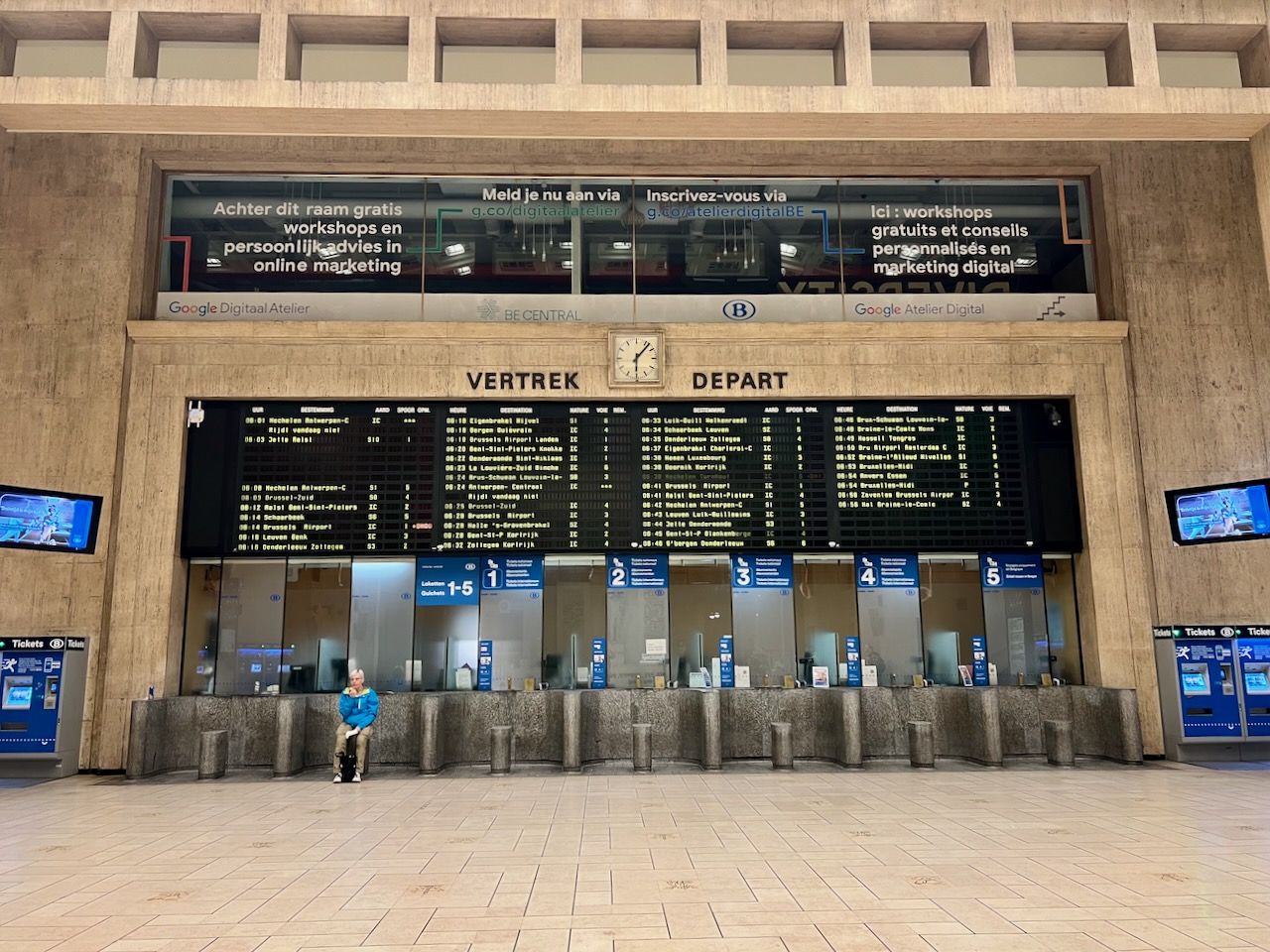
Pierre saw me off at the train station with a half a loaf of seeded bread and two waffles rolled up in wax paper. This is the first stage of a multi-day journey which would take trains, busses, boats, and a fair deal of running. Before Sunrise is a movie about two young adults who meet on a train and spend the next twenty four hours falling in love before an uncertain goodbye. Maybe there are other train love stories, maybe it's even a trope, but to me this movie is the canonical example, asking the question: What's in store for me in the direction I don't take?
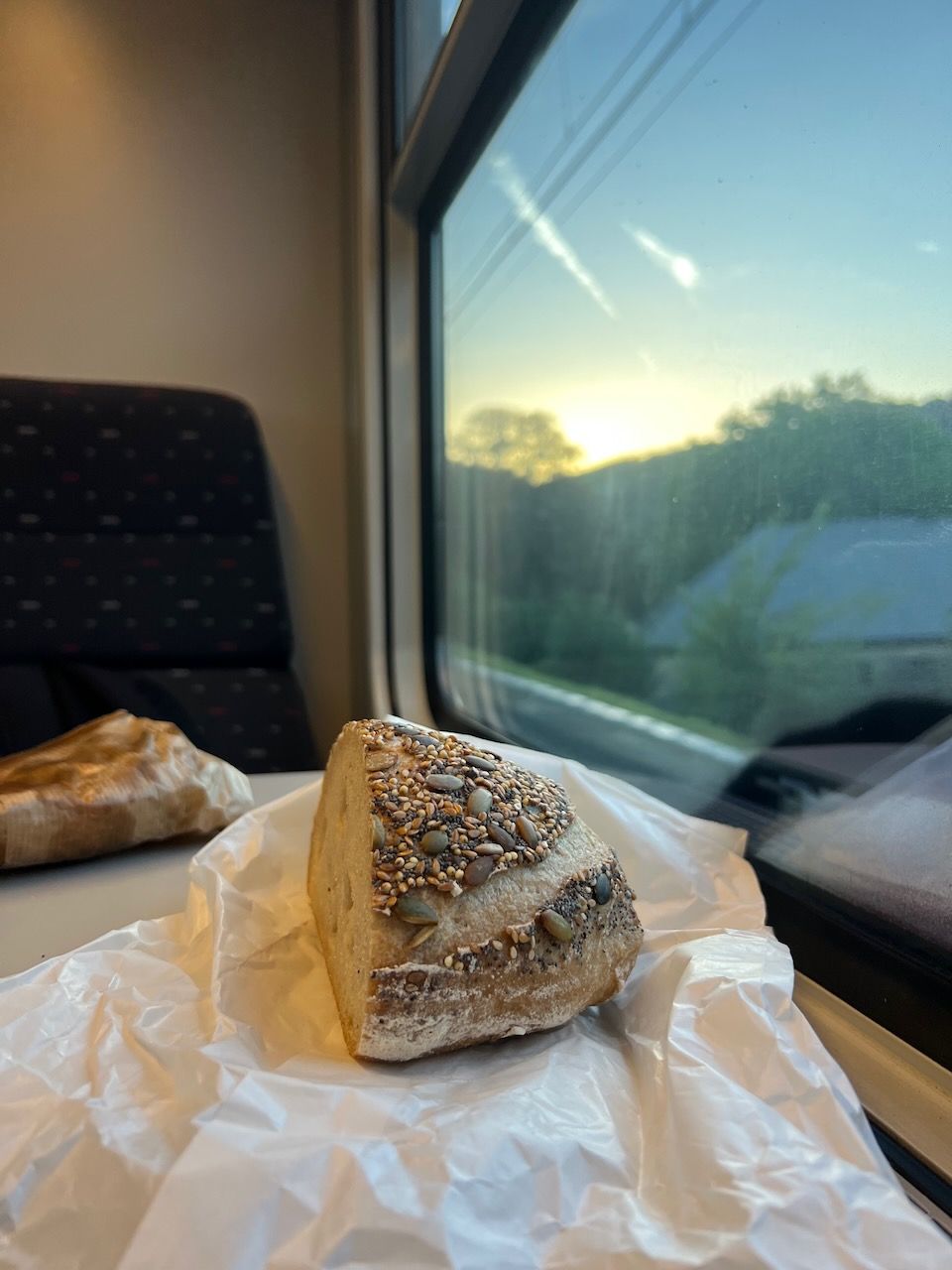
Bread and Waffles on the train
Roger Ebert says it best in his review:
"This is Linklater's third film, after "Slacker' (1991) and "Dazed and Confused" (1993). He's onto something. He likes the way ordinary time unfolds for people, as they cross paths, start talking, share their thoughts and uncertain philosophies. His first movie, set in Austin, Texas, followed one character until he met a second, then the second until he met a third, and so on, eavesdropping on one life and conversation after another. The second film was a long night at the end of a high school year, as the students regarded their futures. Now there's "Before Sunrise," about two nice kids, literate, sensitive, tentative, intoxicated by the fact that their lives stretch out before them, filled with mystery and hope, and maybe love."
I like to think I'm a nice kid, and I also like to think that I am intoxicated by the fact that my life stretches out before me, and I do hope it's filled with mystery, hope, and especially love. You can see where this is going. I saw the movie a few months ago, and now it was my turn to explore what was in that untaken direction.
A week earlier I got to dress up and pretend I was a peasant exploring a medieval castle. Now, I was exploring a city roleplaying the past and caricaturing itself, all the while acting out something I'd seen in a movie. As mentioned, authenticity is dead and I kissed it goodbye. Long live cliches and the world of $2 wines, where tourists and weekend lovers trot side by side along the canals that will one day swallow the city, which sank long ago. The new world is here and it is what you make it; memory without the burden of a past. If life imitates art, then I am its most eager Impressionist and most willing Romantic.
I was solo on my first day, so I walked, saw, watched, drank, ate, and did my best to enjoy my imitation dolce far niente. I saw and promptly forgot the great cathedrals, I sat in the plaza of the Jewish ghetto and thought about how I forget about my Jewish upbringing, and stared at forgotten washing blowing on the lines. The rest of my first day was filled with sitting, staring, sweating, drinking espresso, and doing little doodles of other people sitting, staring, sweating, and drinking their espressos.
I went to the nearby island of Burano so I could get the most usage out of my unlimited sea-taxi ticket and because going to an island with a vineyard seemed in theme with my fellowship. I was close to yet another island, which had yet another church, and so I went there and found a stone shed which provided lots of intellectual staring time. Back on the main island I got on a traghetto crossing the main canal and smiled my way across as another family unknowingly paid for me. Who am I to question the favors of the gods. I proceed to do some more sitting, some more drinking, some more doodling, and marginally less sweating until my friend arrived.
The window of the airbnb looked out a canal where boaters would dock while getting dinner nearby. In the kitchen there was a framed poster of a Chicken eating out of a KFC box on a skateboard with the quote: " 'I have done that' says my memory. 'I cannot have done that', says my pride, and remains inexorable. Eventually - memory yields." It was a stuffy attic with two fans that needed to be on full blast to permit sleeping. Over the sweltering weekend and she had to remind me frequently that one can't jump in the canals.
We walked up spiral towers and counted belfries, missed water-taxis and took brunch while it rained, laughed with squid ink in our teeth, drank spritzes in piazzas, watched the waters rise and alleyways flood, talked of pasts and futures and our unknown but mutual love of Before Sunrise. By the end of the movie they don't come to any grand conclusions, going their separate ways to maybe meet again. Being Romantics, we did the same.
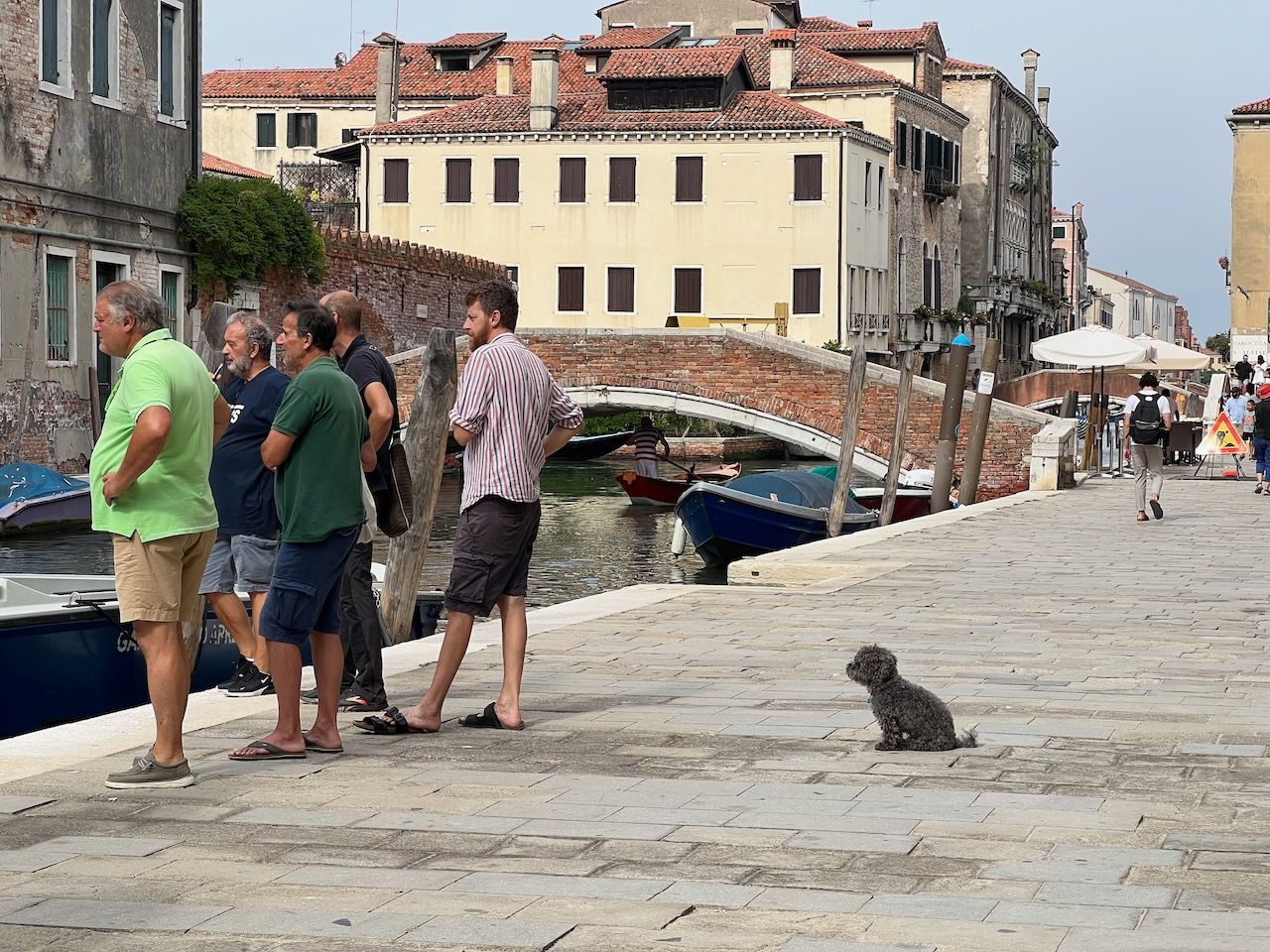
Me watching a dog watching men watching something (a boat)
On Cliches
Yes, it's cliche, I know, but don't my open eyes absolve me in some way? Absolve me from what, you may ask? I don't really know, maybe the fact that I felt like a dirty little tourist doing dirty little tourist things (in case you have forgotten, I'm both of these things).
During the summer I read an article called "The Case Against Travel." The author, Agnes Callard, argues that traveling turns us into the worst versions of ourselves for three reason:
First, we do things we don't usually enjoy: "At home or abroad, one tends to avoid 'touristy' activities. 'Tourism' is what we call traveling when other people are doing it."
Second, we ask ourselves to feel more than usual: "Emerson confessed, 'I seek the Vatican, and the palaces. I affect to be intoxicated with sights and suggestions, but I am not intoxicated.' He speaks for every tourist who has stood before a monument, or a painting, or a falcon, and demanded herself to feel something."
Third, we embrace movement and the collection of sights above all else: "Tourism is marked by its locomotive character. "I went to France." O.K., but what did you do there? "I went to the Louvre." O.K., but what did you do there? "I went to see the 'Mona Lisa.' " That is, before quickly moving on... you are experiencing, you are connecting, you are being transformed, and you have the trinkets and photos to prove it."
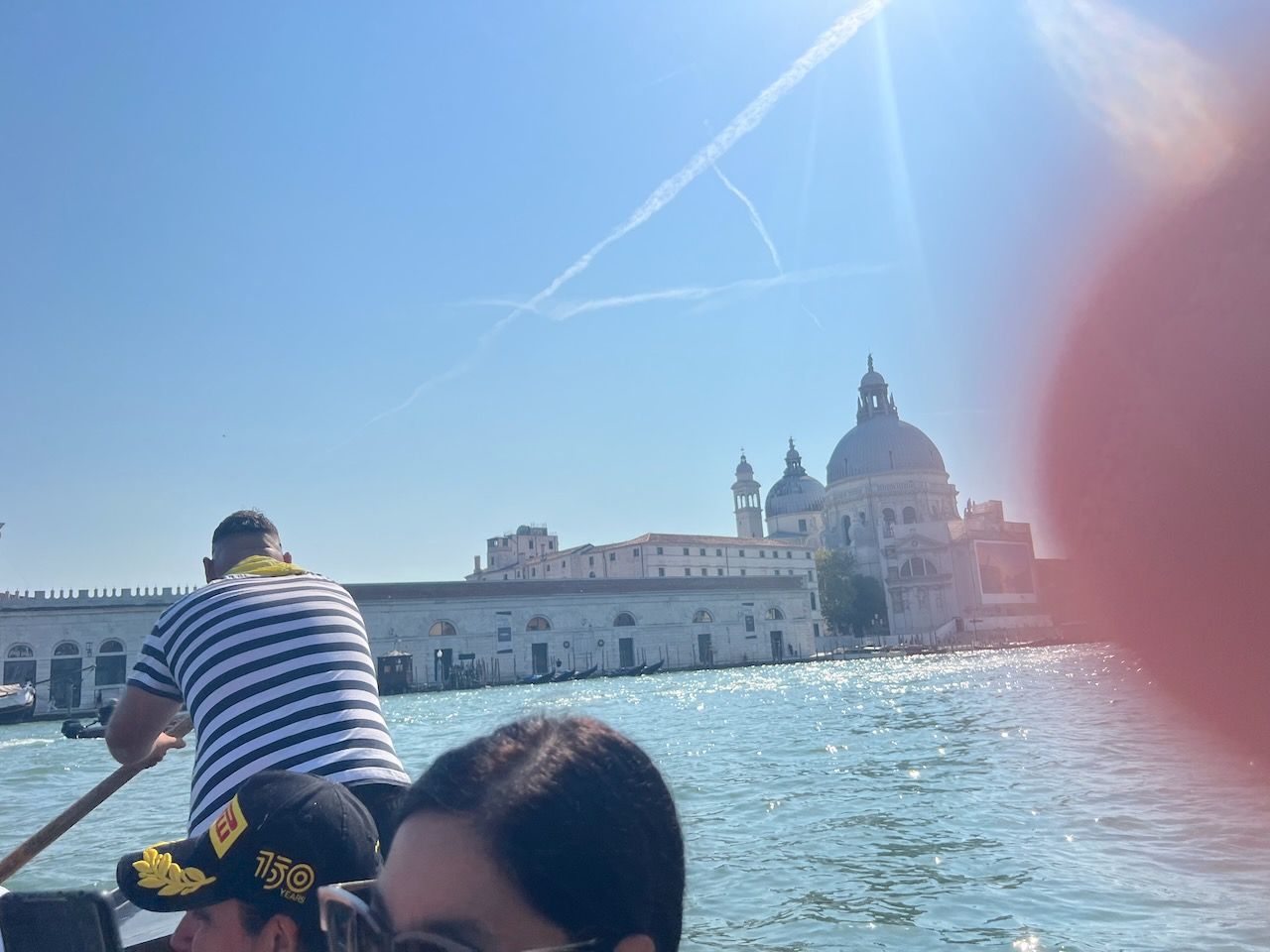
Me, on a traghetto, with the photo to prove it, a cliched finger in front of lens
It was a very fun read, and if you've read my complaints about museums in the past you will know I feel similarly to the author in many regards. That said, I also got a good kick out of the NYT response to this article which had two main thrusts (see, The Case for Tourism, by Roth Douthat):
First, Callard (the original author) touched on only one form of travel, which Douthat labels as tourism:
"the passive tour bus prisoner, the hyperactive monument collector --- is a peril for the modern traveler, but not something inevitable or universal... But the other truth is that any sufficiently elaborate trip contains within itself a range of modes and experiences, some educational and elevating, some disappointing and clichéd, some empty and some brimful."
Second, and of more interest to me, is the reason why Douthat agrees with Callard's sentiment:
"she was identifying a real problem --- one especially associated with the forces of secularization and disenchantment, which have transformed the promise of travel by making mere tourists out of people who would have once been pilgrims instead... The longtime reader of Jane Austen who wanders the grounds of a Georgian mansion, the history buff who touches the crumbling stones of Hadrian's Wall... are enjoying an extension of their education, a deepening of their knowledge, which is less than a conversion but more than just a bit of harmless fun."
Like Callard's tourist, like Emerson, and like Douthat's pilgrim, I affect to be intoxicated. I do not find it ironic that there's a double meaning to this, or that at times it has been the subject of my pilgrimage. I am Callardian when I take photos of my food before I eat it and when I write these letters, I am Emersonian when I visit museums and stare wantonly at the faces of small stone men, and I am Douthian when I kneed dough or press cider, for I, like them, contain multitudes. Douthat writes, and I aspire to believe, that the sublime needs no justification, that majesty and the unexplainable still exist in abundance, and it can all be found where you look for it. I, in my own way, am looking for it in the crust of bread, in the bowing to accountant kings, and one Hollywood inspired getaway to a sinking city. Unlike the sublime, however, sometimes my cliche actions feel like they do need justification, and whether that's right or wrong, this is my attempt at that.
It's for these reasons that I pronounce, with a pinch of absurdism and a sprinkle of satire, authenticity dead. Experiences, viewed by others, are valued and weighed by their distance from cliche and their proximity to authenticity. The former is clear, it's the stuff of movies and glossy photos, while the latter is obscure, if it can be said to exist at all. What in my daily life gives me authenticity? Does my adoration of the Detroit Lions shape my Americanness? If not, what does? Does my propensity for yiddish words give credibility to my Jewishness? If not, what does? I am a superposition of identities, each of which can only be well defined from a distance (cogito, ergo sum). Moreover, the qualities which are the quickest to come to mind are those I'd label the most cliche. How far, then, are the two? And how far should we tip the scales in favor of one over the other, if they're not already on the same side? If I cannot define authenticity for myself, the person I know best, why do I think I can do it elsewhere. And so it is for Venetian tchotchkes and Belgian bakeries; I'd like to believe things and places are imbued with the value I choose to allot them, knowingly or not, and I'd like to believe that is enough.
To end with a line from the movie that inspired my going to Venice:
"I believe if there's any kind of God it wouldn't be in any of us, not you or me but just this little space in between. If there's any kind of magic in this world it must be in the attempt of understanding someone, sharing something. I know, it's almost impossible to succeed but who cares really? The answer must be in the attempt."