The Golden Age of Mezcal
On The Flow
I've been staying with Demetrio for nearly a month now: living with him, his cat Thomas, the suffocating heat of Oaxaca, an unending stream of mosquitos, and boxes upon boxes of mezcal. As a recap, Demetrio is a man who owns a mezcal brand that I met through an acquaintance of friend's friend. He's in his late 50's, so I'm helping him with technology, and I'm a gringo, so he's helping me navigate the mezcal world.
The typical day includes me waking up in the middle of the night, with a thick layer of sweat, to move my fan close enough to chap my lips by the morning. I wake up, Demetrio has made a pot of coffee and is blending his 'magic orange juice', Thomas is lazing in a corner somewhere playing with a dead lizard, and the mosquitos are still sleeping until they see we're nice and comfortable to begin attacking. The pot of coffee is quite literally a pot with boiling water into which we add coffee and wait. A while ago, a friend shared this video about 'cowboy coffee', and now I get to drink it every day. What a life.
Around 10 we start our work, which for me means writing my silly little thoughts into my silly little book to make these silly little letters. It makes me look busy, and I think there's value in that. Around 11, I begin my work in earnest, until 11:10, when Demetrio asks me for something. Sometimes we need to ship some boxes, sometimes I need to help him with instagram, sometimes I pretend I know Adobe Illustrator to help him with his marketing materials, and a lot of times I am an email translator. Very rarely do I build the website he wants me to build, but I'm here to go with the flow.
Around 2-3pm I call it a day, usually because I get stir crazy sitting inside when there's a whole country I could be exploring. I'll go on a little walk, I'll nap in the hammock and feed the mosquitos to replace the ones I've killed, and occasionally I'll scroll for a few hours on TikTok. I am working on the subject of mezcal, but many days it feels a bit tangential, but I'm here to go with the flow, and who am I to question that.
I wanted to know this topic intimately, and I think some of my disillusionment comes from the fact that there are fewer surprises the more intimate it becomes. I wanted to have purpose, and now I have it, but I've learned moving forward I find more joy being closer to production: the fields, the farms, and the cellars. Writing this so that the flow knows and can adjust accordingly.
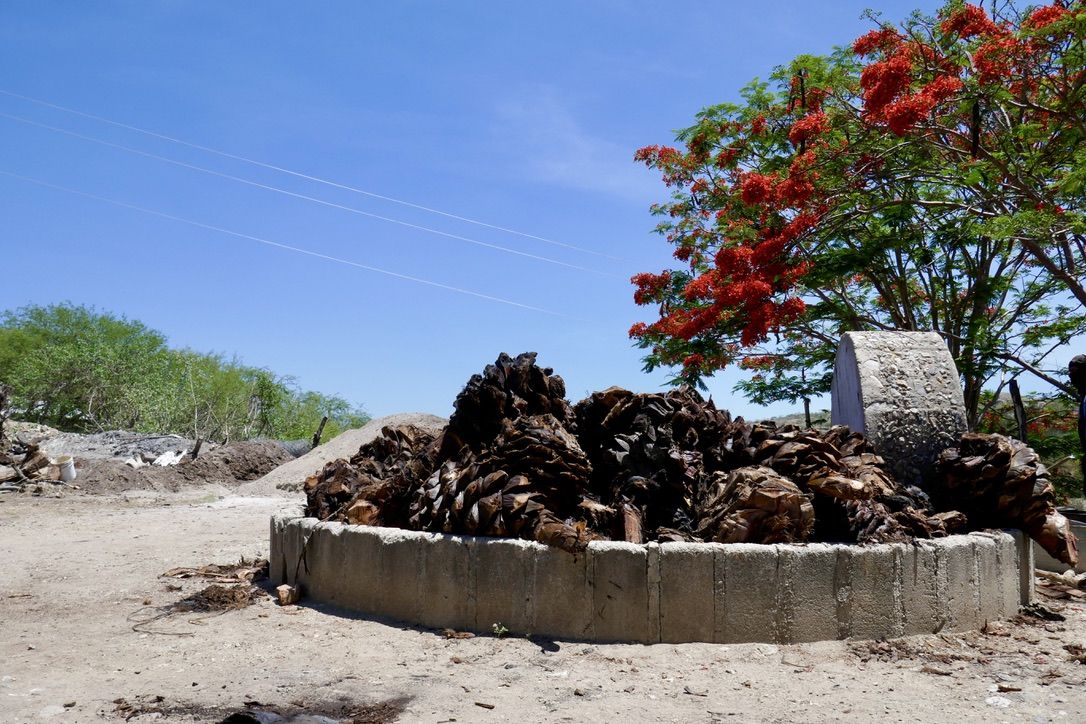
The pretty scene from the palenque, with cooked agaves in the crushing area
On Palenques
A palenque is a mezcal distillery, where the agave is cooked, pulped, fermented, and distilled. Often, the Mezcalero and his family live there, with fields of agave around them.
Demetrio exported a pallet of mezcal to Italy, where it was denied by Italian customs for having above the acceptable limit of copper (among other differences). The legal limit in Italy is 5 mg/L, and the legal limit in Mexico doesn't exist, so it wasn't tested for. Artisanal mezcal is distilled in copper stills, with the copper imparting certain distinct flavors and a characteristic mouth feel ("organoleptic effects"). This is why it's so common in tequila, in scotch, and in mezcal. Unfortunately, artisanal spirits can have incredibly high levels of copper from corrosion of the still. You get a smooth mouthfeel and fewer sulfury smells, but you're also poisoning yourself (more than you thought at least). Some tequilas, when tested, were as high as >11 mg/L copper.
Demetrio had to meet with Maestro Culberto to explain this issue to him and ask for new batches, and I "the scientist" had to come up with suggestions to reduce the copper. According to one paper (here), "at higher temperatures the copper corrosion rate decreased due to the depletion of diluted oxygen concentration in tequila." Which is the opposite of what I'd expect, with chemical reactions usually increasing with temperature, so it's a bit of a pickle. Let me know if you've got answers here, lots of mezcal is on the line...
The palenque is in community of about 200 people in Miahuatlán, Oaxaca. You get on the new highway to Puerto Escondido and after about an hour and a half you turn onto a dirt road and take a series of lucky guesses as to which unmarked turn to take until you see the blue house on the hill and you know you're there. In this town of ~200, there's one school and 18 palenques. It's a mezcal town, and there's a steady stream of wood smoke rising in the hills from the different stills running that day. Culberto works with his son Gilberto and 6-7 others who are either uncles and cousins, or are affectionately called so. I didn't want to ask. Every family has their own still, and there's no other business here, save for a small general store.
On the drive in you're surrounded on both sides by rows and rows of Espadín agaves: pointy, orderly, brutal, rigid, defensive. If aliens were to fly in they'd think this was incredibly well fortified land, defending unassuming cinderblock houses from no-one in particular. As you get further in, you begin to pass other forms of wild agaves, madrecuishe and bicuishe, which are tall and look like shrunken palm trees which went a little overboard on growing fronds. They have yet to be cultivated, and so these pop up like urchins along the horizon. Every so often you'd see a flower shooting up from a mature agave: 10 feet in the area on a green stalk, with bright yellow flowers in an otherwise brown and green desert. These indicate this particular agave is past its prime for mezcal, but are used as canaries to signal the rest of the field is ready to harvest. The flowers are sometimes cut off and planted in the ground like flags (or rather set like a fence post, given their height) for decoration. Or maybe to harvest the seeds, I'm not too sure.
The first time we went up was to have this meeting about the new batch of mezcal. It was just Demetrio and I, and after a long conversation about the topic at hand, someone brought out tacos dorados (or flautas) and I got to ask Maestro Cutberto any questions I wanted about mezcal, agave, life, his pet peacocks, you name it. We were all eating our flautas and drinking our mezcalitos, me asking away, and Cutberto responding with a mouthful of flauta, so the responses were a bit muffled for me.
Cutberto has a very traditional mezcal maestro story - he learned from his father who learned from his father who, I'll guess, learned from his father. He's already taught his son, Maestro Gilberto, and I'll also guess Gilberto's sons will be Mezcaleros as well. I asked Cutberto whether the growth of the mezcal industry had been positive or negative for small producers like him. "Yes, before the popularity we didn't have anyone to sell to outside of our community, and that was just enough to get by. With more people interested in mezcal, we can sell more, increase the size of our palenque and make more mezcal."
What's your biggest difficulty with Mezcal at the moment? "Selling it. We need someone like Demetrio to find buyers and make deals for us so we can work here." Which reminded me of a vineyard owner I worked with in Oregon who said, "making wine is easy, selling it is hard."
Have you noticed any changes in the climate or the weather? "Yes, it's hotter some days, the rains are changing. Agave like the heat, and we don't grow anything else here, so it doesn't affect us too much. Changes in the rain don't affect us because the agave takes at least 8 years, so one bad year doesn't change that."
Are there any issues with bigger companies or industrial mezcal in this area? "No, they grow their agave in a different areas, so we don't have any interaction with them. They make a different kind of mezcal, and there's enough land, so there are no issues.
Do you replant wild agave or do you have any concerns about finding agave in the future? "No, look at the hills, there's no problem finding agave. It grows naturally and there's lots of space for it."
It was true, the hills were full of agave, planted and wild, with nothing else growing there. Maestro Cutberto was, in summary, pretty hopeful about the future and rather worry free. Things are going well, he is making more mezcal than ever and he has plans to double and then triple the size of his production. He's keeping the profits from his work, he's having no problem finding agave, and no problems with his 'competitors'. Him, his family, and his peacocks, turkeys, and goats are living a happy life. For these reasons, I believe we are in the Golden Age of Mezcal.
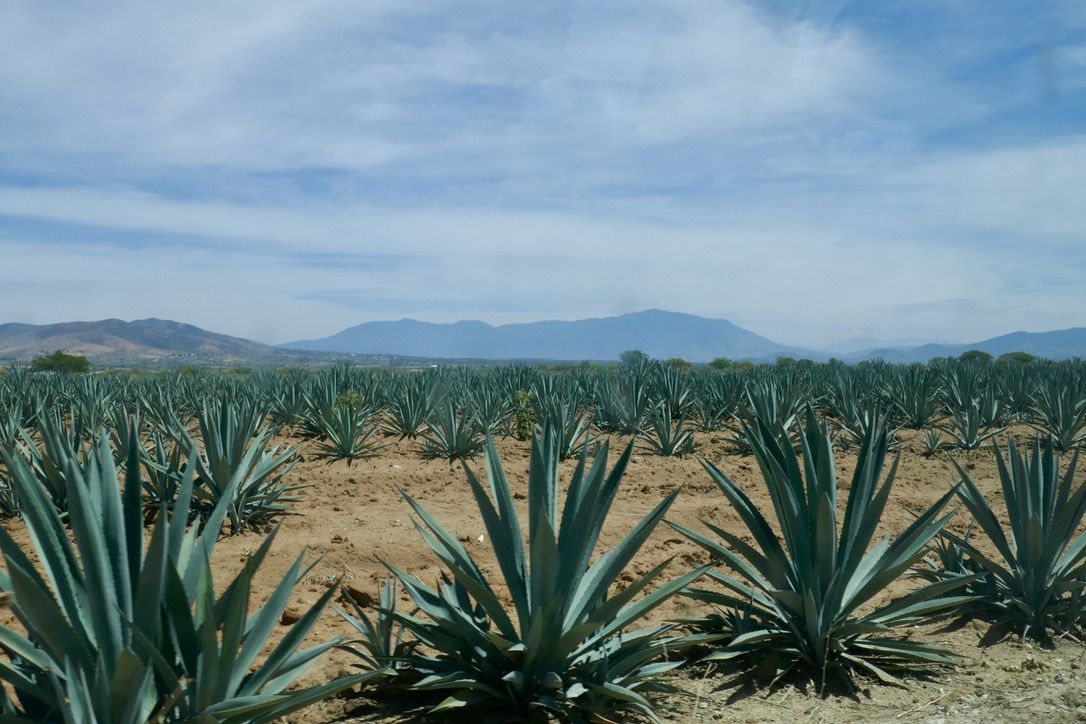
Rows and rows of Espadin
**On the Golden Age of Mezcal: **
What does this mean? For the mezcaleros, it means they're happy and doing better than ever. For the land, it means there's no want for agave, and no damage being done. For the consumer, it means they can find all types of artisanal and ancestral mezcals which they wouldn't have been able to find 15 years ago. For the Mezcal, it means the story is being preserved while mezcaleros can experiment creatively with different varieties, methods, and techniques. For Mexico, it means the world is introduced to a drink which is thoroughly Mexican, entirely unique, and culturally important.
Golden ages are usually defined in retrospect, so this is a bit of a hypothesis on my part which we won't know the answer to for another decade or so. I hope I'm wrong, and things just keep on getting better from here, but it's hard to look past the 'gold rush' factor. There are three factors which I worry about in particular: the assimilation/adoption of mezcal abroad, the longevity of agave, and the sustainability of other resources.
First, making artisanal mezcal is a labor intensive, and therefore expensive, activity. You need to wait nearly a decade or more to harvest your agave, you need to harvest and move piñas weighing nearly 100 pounds, you need to cook the piñas for over a week with hard to find wood, then you need to ferment and distill the mezcal. All of this happens deep in the hills of Oaxaca, meaning you often need to drive for multiple hours to transport it to where it can be bottled and stored. To export and import the bottles internationally costs even more (~$10-$15).
Traditional mezcal is also a bit abrasive to people who have not tried it. You usually find it between 45-50%, which means it's noticeably stronger than other spirits. It can burn your lips and make your tongue feel numb. The high proof aspect is sought after and distinct in mezcal, but also a bit painful if you're not ready for it. If someone introduces you to artisanal mezcal and you like the way it hurts on the first try I'd be a little surprised. It requires a bit of coaching to get to appreciation, and even then it's not guaranteed you'll like it. The smokiness, the minerality, the herbalness are all new flavors you rarely find elsewhere. I like learning about new flavors, but that doesn't always mean I like the flavors.
In Cooked, Micheal Pollen explains this is in a nice way: "One of the things a food can do for a people is to help define them as a group - we are the people who like to eat rotten shark... If a food is going to help forge cultural identity, it must be an acquired taste, not a universal one. Surely that explains why fermented foods have so often and so reliably played this role... The taste of fermented food is the taste of us, and them." Mezcal's punchiness and strength is one of the characteristics that makes it a shibboleth of Mexican (or at least Oaxacan) culture.
As such, I'll argue that artisanal mezcal is an inherently insular product. I don't need to repeat all the reasons I think it's incredible and interesting and important, but many of those same reasons make it prohibitively expensive and difficult to first try. If you're outside of Mexico, you'll need to spend a lot of money on something that will be very unfamiliar. That's not to say there's no market for it, there are whiskey bars full of bottles at price points that scare me, but who knows how many centuries of international adoption that took.
There are a lot of artisanal producers and what I imagine to be an inelastic limit of people willing to buy the product for the price it's worth abroad. Industrial mezcal is cheaper, more approachable to outsiders, mixable, and can compete at the grand scale with tequila. Should it? I don't know, not my place to say. But the limitations of artisanal mezcal mean it will occupy a different space than tequila and other spirits, which I'd argue is a good thing for the tradition of the product, but bad for producers who will soon bump into the limits of how much they can sell before they would need to change their methods. The universal artisanal dilema: How long can something grow without sacrificing its ideal? Everybody and their mother is starting a mezcal brand right now, making more and more artisanal mezcal, and I imagine we'll soon find out there are more suppliers than buyers.
Second, agave takes a really long time to grow (as I've said over and over by now). The mezcaleros I've talked to are generally pretty optimistic about the amount of agave growing in the wild and in their fields. That said, if Maestro Cutberto wants to triple his production, he'll be using 3x as much agave. It only takes a few months to build two new stills, but it'll take at least 8 years before you have two new fields of Espadín. I don't know who, if anyone, is predicting demand that far, but I don't envy them.
If you then think about wild agave on ejidal (communal) land, there's little you can do about demand here. If you need twice as much Tepeztate, you go out and find twice as much, and hope that in 20 years you'll be able to harvest more of it. Maybe I'm severely underestimating how much wild agave grows in the harvestable parts of Oaxaca, or there's a massive replanting effort that's under the radar, but as far as I can tell there's a lot more wild agave that's being harvested than is being planted.
I imagine in the near future we'll look back and say more should have been done to protect the agave and the land, but who I am to tell a Mezcalero what to do with his land and his agave. At that point it becomes a question of who and what we want to prosper more. Or, of course, we find a sustainable middle ground. Right now, it appears to be mostly honor system, and historically the honor system tends towards the tragedy of the commons. Once again, not my land, not my country, not my livelihood, only my thoughts.
Lastly, and this point mirrors the one above, but the growth of tequila came at the cost of the land in Tequila. The problems of huge monocultures of agave, with fertilizer runoff and excessive water usage is not present in Oaxaca, but with industrialization comes degradation. Given the ejidal nature of most of Oaxaca, outsiders can't purchase land outright, but they can still (and currently are) paying Oaxacan farmers to grow agave for them. On paper this seems more just, but that's about all I know of it. To grow a slow crop, you need a lot of land (you can't harvest the same field each year), and industrial agriculture doesn't have a great social or environmental track record. With more mezcal will come more industrialization and more land and resources designated to agave.
Mezcal also takes a lot of wood: both for the underground oven and during distillation. Palenques are generally located near agave, and agave usually grows in places that trees don't. As a result, the wood often comes from the coast or the Sierra Sur. Forestry can be a sustainable way to produce wood while improving the ecosystem health. That said, I've got no idea what the fire wood industry looks like in the Sierra Sur. The removal of existing trees in the hills, plains, and semi-desserts of Oaxaca will likely lead to erosion, hotter temperatures (trees help to regulate heat), and the reduction of habitable ecosystems for a rather fragile arid ecosystem. Once again, the wood problem is more at a whisper stage, where people mention it as a problem but there's no alarm bells yet.
There's no code red for the trees, there's no major concerns about the industrialization of agave farming, there's no difficulty finding wild agave, there's no fights over land or resources, and everyone is vying for the slice of the ever growing pie. This is because we're in the golden age of mezcal. One day we'll look back and realize how good we had it and talk about the things we should have done differently. Or, hopefully, I'm way off the mark, and things only get better, and we'll give even more credence to Mezcal truly being the nectar of the gods, bestowing upon Oaxaca never ending prosperity.
I bring all this up because, in the end, there's still lots of time to shape the direction of mezcal, and lots of scenarios between the two I laid out. It's a very young industry selling a very old product, and I believe it has the potential to be a global example of how a piece of culture can be bottle and sold sustainably. In a bottle of mezcal, the world can experience the history and creativity of Oaxaca, get exposed to new flavors and tastes, and pay tribute to the labor and artistry behind the process. I only hope that this doesn't come at the expense of the mezcaleros or the land. Right now, in the small slice of Oaxaca I've seen, it's not, and I hope people are cognizant of how special that is, and work to maintain it.
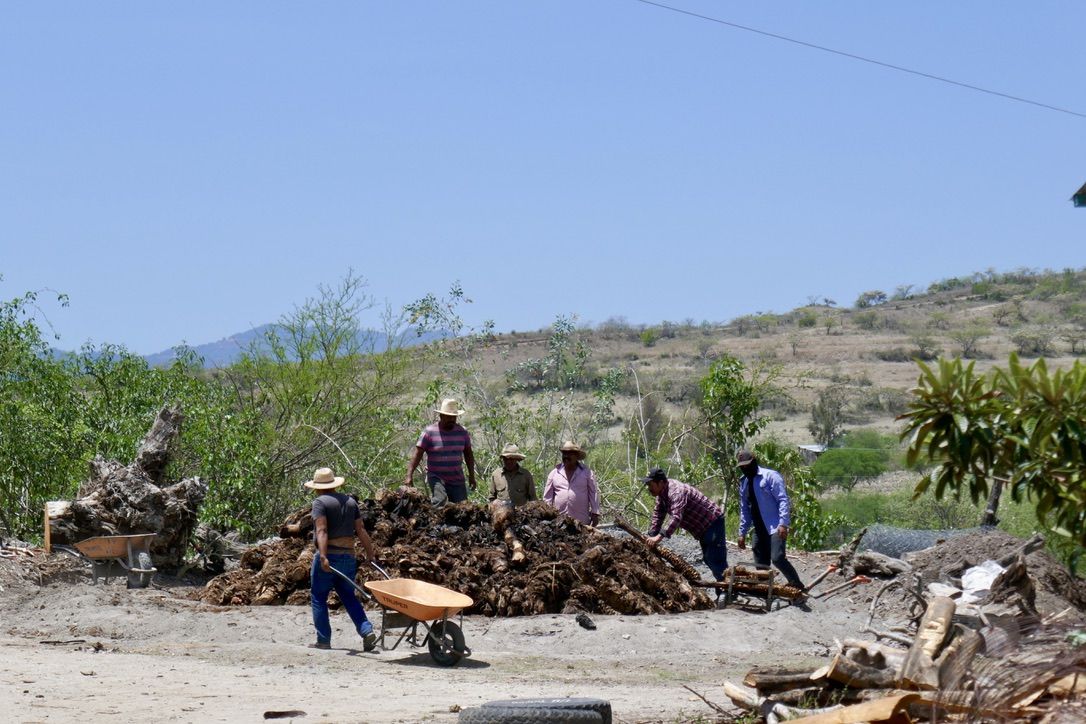
The mezcaleros unloading the oven after cooking for ~10 days. Culberto in Pink, Gilberto with the wheelbarrow
On accidental rambles and procrastinating
I had the above thought while I was listening to talks during a mezcal festival, surrounded by passionate artisanal producers and mezcaleros. It was a small event, and I was struck by how lucky I was to be there, at the start of something that felt very new. What would this look like in another 10 years? I meant to write about them, and about the festival, but now I think this has gotten a bit long to include anything else. I also meant to write about my time at the actual palenque, and some of the sights, sounds, and smells: I was invited to a celebration for Dia de Los Niños, and the next time we went back I was given so much mezcal I lost some of it on the bumpy dirt road on the drive back. High highs and low lows, but I guess that's all for another time.
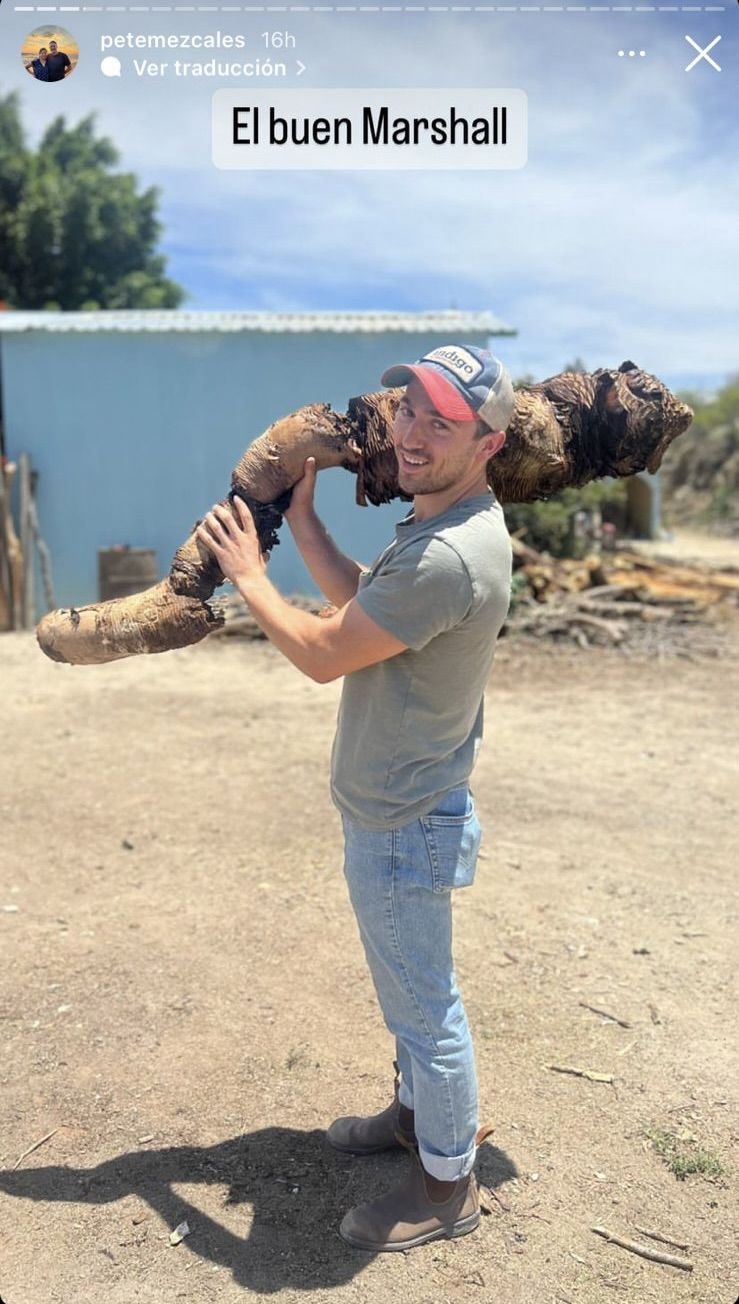
Gringo gets to play on the farm
Thanks for reading EatMarshallEat! Subscribe for free to receive new posts and support my work.