Mezcal and Me
If you're new here, welcome. I recommend you begin by reading the first two letters before this one to give you some context. They explain why I'm here, what I'm doing, and who the people I mention are. I also had a bit more fun with those, and this might be a little dry in comparison. You've been warned.
I've been in Oaxaca for one month now. I'm doing great on the friends section of my Eat, Pray, Love trinity, but struggling on the Praying and Eating sections. And the latter is what somebody gave me this money to learn about. I've eaten lots of food and have drank lots of new things, but my masterplan to take a scattershot approach to learning amount Mexican ferments has been unfulfilling. I'm craving some sort of direction.
I've got time, and I'll turn this around, but that's the general unglamorous mood at the end of week 6. In any case, this post is less philosophical and more a recollection of things I ate and read.
Eat it up or spit it out, you are free. - Anthony Burgess, kinda
On Fairs and Food
For however 'off' I'm feeling about not doing what I feel like I'm supposed to be doing, I have been good about being a yes-man and going with the flow. There are an abundance of ferias in Oaxaca, mostly centered around food. I already wrote about the taco fair, but in these two weeks I've also been to an agrobiodiversity fair, a tejate fair, and a mezcal and nieves fair.
At the agrobiodiversity fair, farms from all over Oaxaca shared heirloomed varieties of their produce: cacao, cafe, maíz, calabazas, frijoles, miel / chocolate, coffee, pumpkins, beans, honey. The coffee producers had beans at various stages of the roasting process, as well as unique methods of processing including those covered in honey prior to roasting. Rural accents are newer, and more difficult for me to understand, and vice-versa with my work-in-progress Spanish, so this was more of a 'visual and tactile experience'. Maize is the most important crop to Mexican culture in general, and thought it was present, this fair was a good display of the less-spoken about crops. This may be a stretch, but you could call it a referendum or a census on how the region represents itself through its produce.
It reminded me of the way farmers show off their giant pumpkins and blueberry jams at state fairs in the northeast - but in this case it was perfectly milled seeds and beans. The state of Oaxaca is very agricultural, but in the past few decades many farms have been unable to compete with the cheap prices of larger farms, the impacts of NAFTA, or GMO seeds. The result has been an exodus north to the factories in the frontera or beyond. With this migration, farming practices, regional products, heirloom varieties of produce, and historical methods of production and preservation are discontinued. The industries, towns, and people that rely on them disrupted and as a result more people move to cities or factories. Out of this gloomy background, it was hopeful to find a fair full of farmers proud of their work and displaying how their farming methods preserve biodiversity and improve soil health while being informed by their culture.
Plus, I got to try cacao liquor - the fruit from chocolate pods is juiced, fermented, and then distilled before it's mixed with other flavors. I tried coffee, hibiscus, and chocolate. On the bottles was written: "no hay mal que dure 100 años ni pena que el licor de cacao no alivie." There are no ills that last 100 years nor pains that chocolate liquor can't cure.

Coffee beans in various stages of coffee-ness. See note above, language was languaging for me this day, so the particulars were lost on me.
Tejate is a pre-columbian drink made with cacao, nuts, and the seed from the mamey fruit. The rosita de cacao / flower of chocolate is dried and ground into a powder/paste to create a foam which floats to the top of the drink. It originates from San Andrés Huayapam, north of the city, and I've been told it was being made before Oaxaca even had a name. It's labor intensive and uses once-seasonal ingredients, making it a drink that was reserved for royalty. Now, a chump like me can drink it every day if they so desire. It's delicious, refreshing, and I like the thought of it connecting me with royalty a thousand years back. Drinking the same drink, made the same way, in the same place, on the same rocks, separated by the rise of modern western history as I know it. Please don't fact check me on this, let me dream.
To celebrate this drink, its history, and the eternal persistence of chilled beverages under the Oaxacan sun, the town of Huayapam celebrates the Fería de Tejate where it was first made. I went with Fatima, some of her friends, and her friend's aunt, and I would not have been able to figure out how to get there, or what I was looking at once I was there, without them. As an aside, we fit 7 people in a standard taxi and drove past multiple police units - no one blinked an eye. The streets of Huayapam were packed with tejate stall after tejate stall, each from a different family. People often talk about recipes getting passed down from grandmother to mother to daughter as a cutesy thing, and I've always thought of it, at least in the US, as a bit of an outdated cliche. At least in Huayapam, this is alive and well. Every stall had some combination of mother, grandmother, daughter, stirring, making, and selling tejate, Chilacayote agua frescas (pumpkin fruit-water), and flan. I tried tejate, roasted agave heart, mangoes in vinegar with chili, tejate flan, memelas, and probably other forgotten samples that were handed to me. As I said, I'm trying to be a yes-man.
In the heat of the fair, someone suggested Micheladas - beer with chili, salt, salsa, and lime. The bar we went to was really just someone's house, and we sat at a table in the middle of their garage as the grandma passed by doing her errands. As riffs on the drink, someone had a Yakulita (beer and a fermented Japanese yogurt-milk drink), and I got an Azulita, because I've always wanted a fish-bowl drink, and this one had a shark in it. It turned out to be blue Powerade, red bull, rum, shark gummies, blue sugar, and a surprise Halls menthol lozenge.
An ancestral drink that has existed for a time longer than I can conceive of, and a drink where five of the ingredients probably didn't exist 100 years ago, all in a days work.

Tejate booth: coco tejate (left), tejate (center), and agua de chilacayota (right)
The last fair, this past Saturday, combined nieves and mezcal. Nieves are traditional ice-creams in Oaxaca - some with milk, some with water - mixed with local fruits, nuts, and other flavors. They're good, but the fair turned out to be mostly about mezcal, which was fine with me. I went with Osvaldo who helped me get to Tlaclula via another confusing bus. Bigger than the taco fair, less dirt-road-bumpin-elbows than the tejate fair, with somewhere around 30 mezcal booths. Osvaldo and I sample some nieves (cherimoya and cactus pear), walked around the market, then dove into the mezcals, stopping at the first stall to offer us a sample.
Mezcal is distilled one, two, or three times, increasing in alcohol each time from ~37% after the first distillation, to >45% the second distillation, and >50% the third distillation. Two distillations is the standard, and the high proof (between 45-50%) is an important, traditional characteristic for the creators (mezcaleros). It is also an important factor in how quickly it debilitates me. Distilled alcohol can be called aguardiente here*,* which translates to burning water, which I find particularly apt here.
Each stall would let you sample as many mezcals as you wanted, but after three or four stalls my stomach was in turmoil, my tongue couldn't distinguish any differences, and my brain couldn't form any more sentences. This was maybe 15-20 minutes. We found a place to sit and ordered lunch. Barbacoa is the specialty of Tlaclula, which I assumed just meant slow-cooked meat, indicated by all the vats of slow-cooking meats. Turns out Barbacoa in Oaxaca refers to slow-cooked sheep and goat. The woman making our food explained they cook the sheep and goat separately, starting them at midnight in a below ground oven and roasting for 6 hours before they're packed up in the morning to be sold in the market where I was eating them now. She was also nice enough to pull up a chunk from each pot and let me taste, which felt like her little reward to me for being brave and asking a question.
As another aside, when talking about politics in rural areas of Mexico, I've had friends tell me that votes are occasionally purchased with cash or, more interestingly, livestock. I don't think the goat I ate was a part of a bribe, but someone somewhere has eaten the goat that bought a vote.

Por todo mal, Mezcal / For everything bad, Mezcal
In my mind, there are three sets of distinctions in mezcal: joven vs aged*, espadín vs* others, farmed vs wild.
Joven (young) refers to mezcal that hasn't been aged, and reposado (rested) refers to mezcal that has been 'rested' in barrels (anejo to represent 1 year). Reposado and older mezcals usually have a brownish tint to them from being aged in wooden barrels, similar to whiskey or scotch (sometimes the barrels are old whiskey barrels). These are usually smoother (less alcohol as a result of aging) and have more what I like to call brown flavors: vanilla*,* tobacco*,* chocolate, caramel, clove. If it's brown, you can probably convince yourself that it tastes like other brown things. Prove me wrong.
Espadín is the main type of domesticated agave used in mezcal (A. Angustifolia) - it's big and is grown all around Oaxaca in long pointy fields, taking 7-8 years to mature. When harvested the blades are cut off until just the heart is left, which looks like a giant pineapple. The hearts are cooked in an underground oven for multiple days before they're pulped, fermented, distilled, barreled, bottled, and then, if it's lucky, sampled by lil ole me. Espadín is the most popular for mezcal because it's domesticated, but there are around 30 different varieties of agave that can be used in mezcal. I like to think of them as varietals, like wines, but I don't know what the mezcal word for that is just yet: there's Tobalá, Cuishe, Madre Cuishe, Coyote, and so on. They're all unique, taking a different number of years to mature, having different sugar levels, and different flavors. In the same way that winemakers use different grapes, mezcaleros use different agaves. To me, as a rookie-novice, they're very very very earthy and taste like an herbal tea or an alpenbitter. More testing needed.
The last distinction (in these categories that I made up) is between farmed vs wild. Which is what it sounds like, and is, more or less, a copy and paste of above. Most agave for mezcal is farmed as rows of Espadín, in the same way you grow a really slow crop. This produces a mezcal with a predictable and more controllable flavor, as you know the age, the potential sugar content and taste profile, and how much water they've received. They are the theoretical grapes on the vineyard, if only one type of grape was grown. Where mezcal departs from wine, in a way that really gets me going, is with wild agaves (silvestres). Mezcaleros drive into the hills onto communal lands, find mature agaves to harvest, and cut, cook, and process them as before. In winemaking all pinot noir grapes are clones off a single, original pinot noir grape, made from the cuttings of some monk somewhere a thousand years ago who liked the taste. Mezcaleros here choose instead to drive into the mountains until they find a particularly gnarly agave where it's been growing for the past who knows how long under who knows what conditions. I find that beautiful. That said, I don't love the taste. More testing needed here as well.
There are three legal categories for mezcal: Mezcal, Mezcal Artesanal, and Mezcal Ancestral. The label for each mezcal is based on the process, and it's a really interesting topic, but for another time.
Mezcal is everywhere in Oaxaca - in every bar, on every wall, in every store, in the art, in the sayings, in the water, in the blood. For its prominence and cultural strength, you'd think it would have a story as old as time. However, the only part of the mezcal process that's pre-columbian is the oven and the agave. Everything else comes from the Spanish.

A convenience store in Tlaclula that had mezcal on tap. Left to right: ensamble/mix of six, Jabalí, Espadín, Cuishe
On Reading, Confidence, and Identity
To paraphrase something I read in my On the Plain of Snakes book: 'if you've ever had a unique thought about Mexican culture, it's probably been said more elegantly by Octavio Paz in The Labyrinth of Solitude'. I like to think thoughts, but apparently Paz has already thought all my thoughts for me, so I may as well take the shortcut. Train smarter not harder.
The book turned out to be 200 pages of twisting, tangling, strangling prose about personal identity, national identity, the creation of culture, the history of Mexico, and the role of gender, thinkers, workers, fiestas, and dictators in weaving the web we live in.
What Paz writes on these topics has already helped to color my time here, but my favorite part of the book is the new motto he has given me for writing: "I am not interested in discussing whether this attitude is justified by reason and reality; I simply want to point out it exists"
I don't remember what attitude he's referring to, and it doesn't matter, because what matters is that this Nobel prize winner states an observation as fact and moves on, simply pointing it out. No justification, just onto the next thought. I would like to do that more. Maybe I'm simplifying it, but I don't need to justify myself here, Paz said so. I am not interested in discussing it, because I know it's there. Say it and believe it. What matters to Paz is not that what he is saying is eternally or globally true, only that it is to him, and that is enough to justify saying it.
This allowed me to do two things: to state as fact what I believe to be true, and to know that what Paz states as fact need not be. I struggle sometimes with confidence in my own thoughts and beliefs, and it feels good to dissolve the lines between what I think, what I know, and what I believe, at least in writing. There are limits here, and one can't create facts wherever they want, but I am not interested in discussing whether this attitude is justified by reason and reality; I simply want to point out it exists. On struggling with what are my own thoughts, this gave me the liberty to feel justified to disagree with what Paz was saying - he removed the veneer of absolute truth in his words, and allowed me to feel that mine are as valid as his. His word is not the law to anyone beyond himself, as mine are to me.
This was important because Paz wrote this in 1961. Some of his ideas are eternal, but he wrote The Labyrinth of Solitude as an experiment to construct a 'national character' of Mexico. What do they look like, how do they act, what do they believe, why do they believe it. I say they because the national character is both a person and an idea. Today, however, the world is different, Mexico is different, and the national character he created, if born the year he birthed it, would be 63 years old today. In any case, they're still beautiful thoughts, and that which is no longer true still acts as a portrait of the national character as a young man. Enough of my thoughts though, it's all been said more elegantly by Paz.
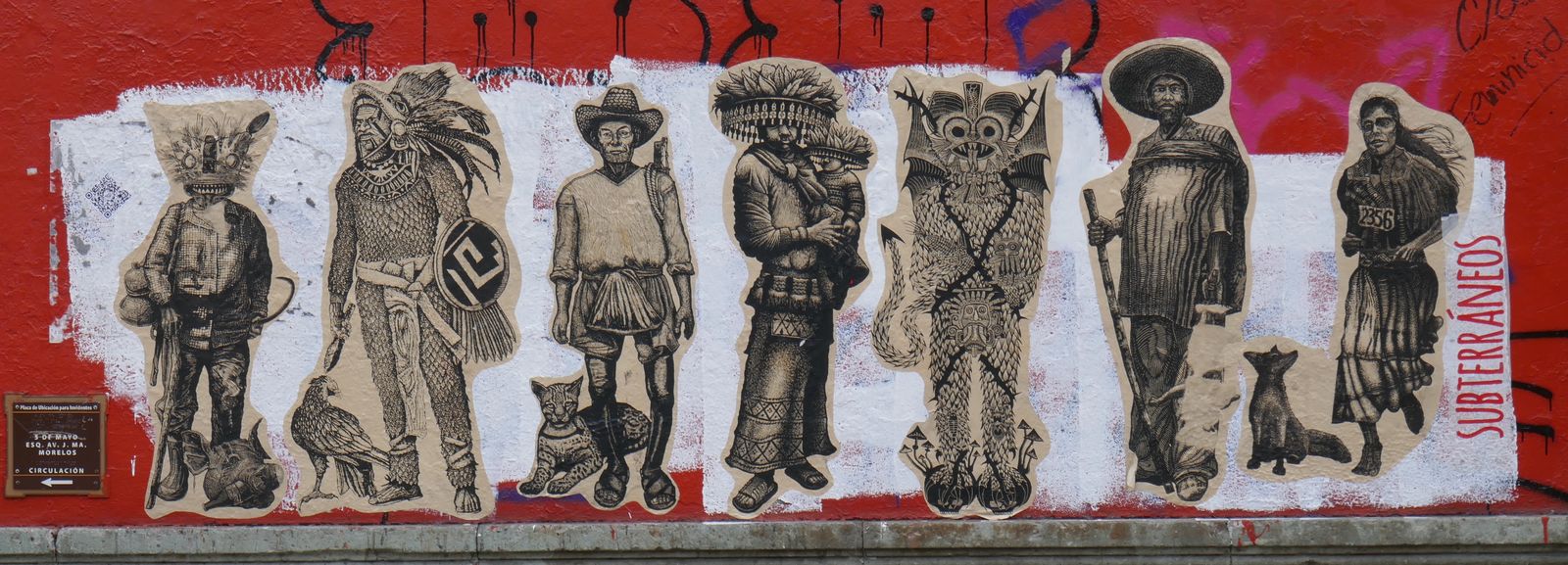
The type of street art on every wall in Oaxaca
There are two topics that were interesting to my gringo mind which Paz addresses directly.
1. The first was on how Mexico remembers the spaniards and colonization. Mexico speaks its colonizer's language, but indigenous art is everywhere. Spanish catholicism was imposed over indigenous gods, but catholic faith remains incredible strong here. I was expecting a black-and-white story of colonialism as is present in US history: Spaniards bad, Aztecs good. Paz, along with many of the people I've talked with here, have much more nuanced views of the history.
"The Mexican condemns all his traditions at once, the whole set of gestures, attitudes and tendencies in which it is difficult to distinguish the Spanish from the Indian... The Mexican does not want to be either an Indian or a Spaniard. Nor does he want to be descended from them. He denies them. And he does not affirm himself as a mixture, but rather as an abstraction: he is a man. He becomes the son of Nothingness. His beginnings are in his own self image... This separation was a necessary and inevitable act, because every life that is truly autonomous begins as a break with its family and its past. But the separation still hurts. We still suffer from that wound."
This would answer the question I had regarding the seemingly contradictory importance of mezcal: it is neither pre-columbian nor Spanish, it is a product of the new Mexico, and therefore a symbol of identity. This difference was also a big topic for my first Spanish teacher, Aris. When I asked about La Malinche, the Nahua interpreter for Cortes during the Spanish conquest of the Aztecs, he said that, to him, she is a tragic and misremembered figure rather than a traitor. She later went on to have a child with Cortes, which is remembered as one of the first mestizos. He stressed that the Aztecs, much like the Spanish, were an empire which conquered other groups for their profit, and many of the captured cities were eager to see the Aztecs fall. He felt that he had more relation to La Malinche than to the Spanish or the Aztecs - for she gave birth to the group he identified with. Not Spanish, not Aztec, but a descendent of the history that would follow. Paz, of course, wrote on this as well, referring to her as 'The Mexican Eve'.
2. One of my motifs for this year is 'how does food act to preserve culture?' Oaxaca, as you may have gathered from this post, has a very strong food identity. It has foods it can claim as it's own, which is different from what I grew up with. Maybe you can name a uniquely Connecticut food, but it's tough for me. The Quinnipiac were established in the town where I grew up when the English arrived. They spoke their own language, had their own arts, none of which I've ever seen in the town, or around it, other than in place-names. I also can't name any of their foods. Why is this different in Oaxaca: why can I still buy tejate on the street corner here?
"The possibility of belonging to a living order, even if it was at the bottom of the social pyramid, was cruelly denied to the Indians by the Protestants of New England. It is often forgotten that to belong to the Catholic faith meant that one found a place in the cosmos. The flight of their gods and the death of their leaders had left the natives in a solitude so complete that it is difficult for a modern man to imagine... The difference between colonial Mexico and the English colonies was immense. New Spain committed many horrors, but at least it did not commit the gravest of all: that of denying a place, even at the foot of the social scale, to the people who composed it...
I am not attempting to justify the colonial society. In the strictest sense, no society can be justified while one or another form of oppression subsists in it. I want to understand it as a living and therefore contradictory whole"
It would be a simplification to say this is the only reason for the difference - I'm sure there are hundreds - but this was one that Paz gives, and a difference I didn't know about. Or maybe an equivalent exists somewhere in the US and I'm just too uncultured to know about it, let me know.
And now I'll stop talking about things I don't know about.
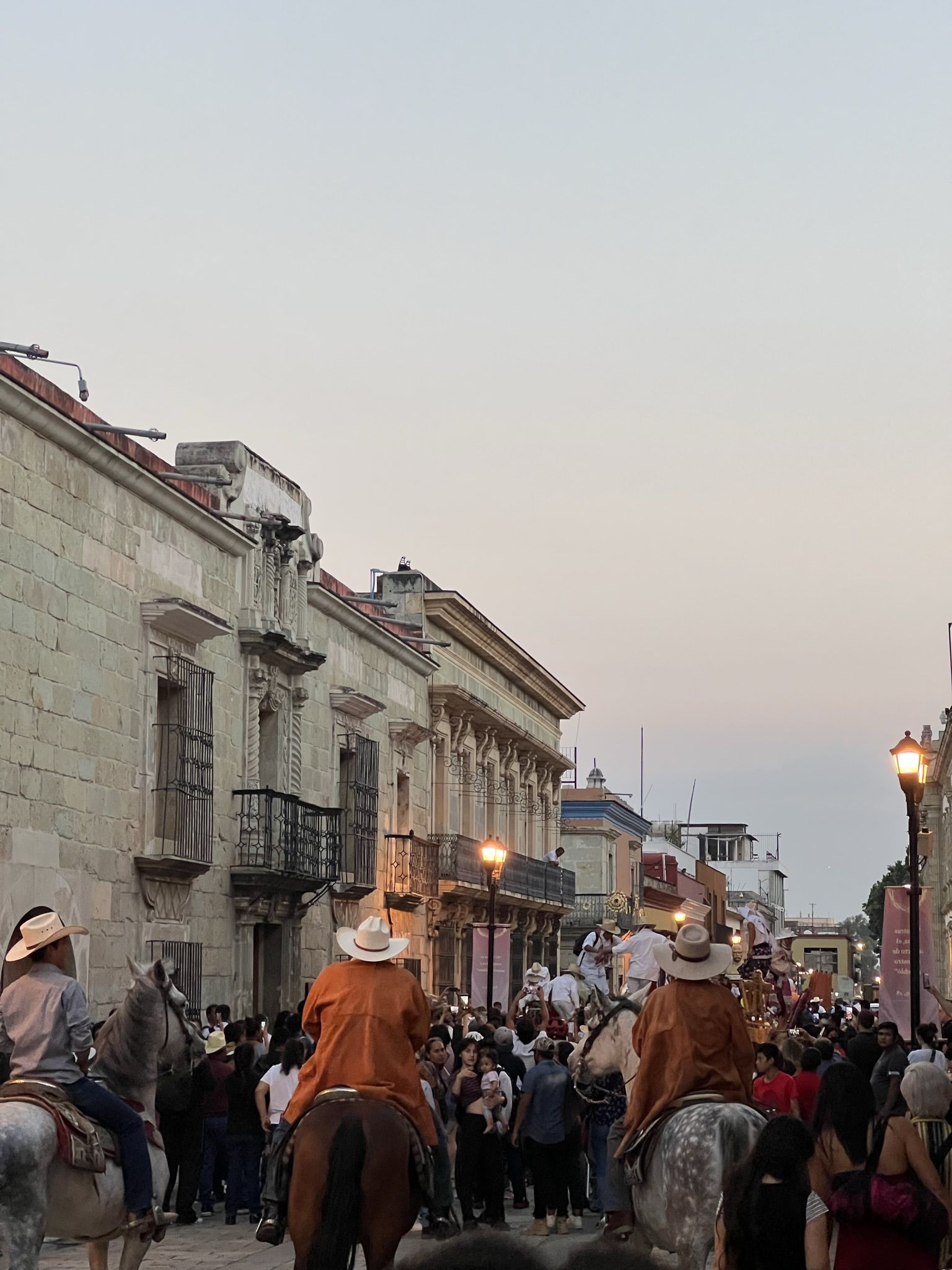
Una calenda - a street parade, for reasons beyond me
On being a tourist:
In my last letter I mentioned how I've been a bit embarrassed to be a tourist. Since then, I've been leaning into a bit more, and It's given me a bit more bandwidth to ask more questions, look dumb, and learn more. I call it my form of exposure therapy.
My family visited to deliver me some medicine I couldn't find here, and we did all the touristy things that I'd been avoiding: we took a bus to a 2,000 year old tree (the stoutest tree in the world), a weaving town (Teotitlan de Valle), an archeological site (Mitla, the land of the dead), and a petrified waterfall (Hierve el Agua).
No more musings here, just wanted to say I've been having fun, thanks for asking.
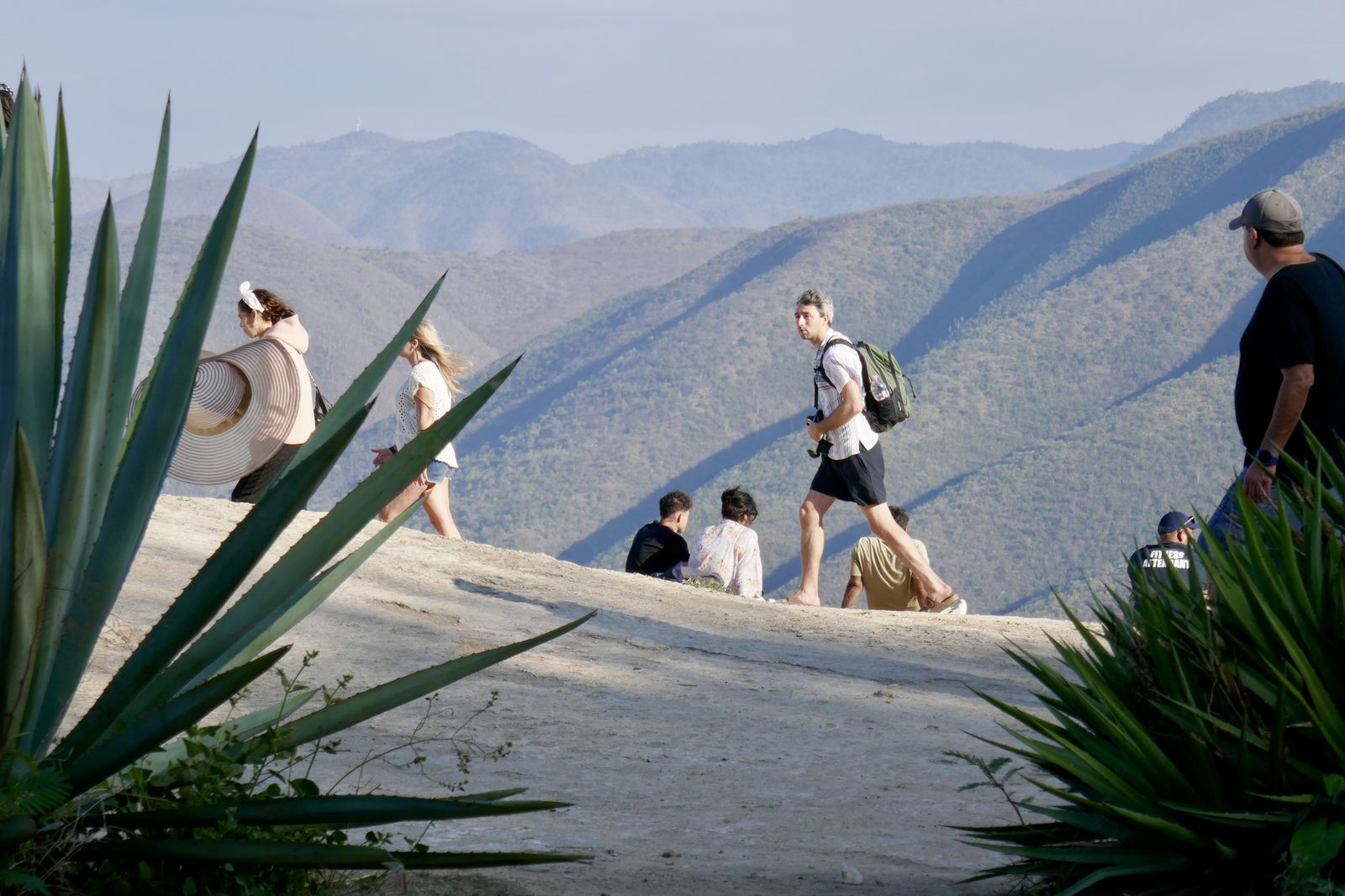
Dan, in motion in the mountains
On other quotes I liked:
"The history of Mexico is the history of a man seeking his parentage, his origins... he crosses history like a jade comet, now and then giving off flashes of lightning" (p.20)
"It seemed to me then, and it still does, that the United States is a society that wants to realize its ideals, has no wish to exchange them for others, and is confident of surviving, no matter how dark the future appears." (p.22)
"The Mexican tells lies because he delights in fantasy, or because he is desperate, or because he wants to rise above the sordid facts of his life; The North American does not tell lies, but he substitutes social truth for the real truth, which is always disagreeable." (p.23)
"It is always difficult to give oneself up; few persons anywhere ever succeed in doing so, and even fewer transcend the possessive stage to know love for what it is: a perpetual discovery, an immersion in the waters of reality, and an unending re-creation." (p.42)
"The colonial world has disappeared, but not the fear, the mistrust, the suspicion." (p.43)
"The word death is not pronounced in New York, Paris, in London. It burns the lips. The Mexican, in contrast, is familiar with death, jokes about it, caresses it, sleeps with it, celebrates it; it is one of his favorite playthings and his most steadfast love." (p.57)
"We, however, struggle with imaginary entities, with vestiges of the past or self-engendered phantasms. These vestiges and phantasms are real, at least to us." (p.72)
"History has the cruel reality of a nightmare, and the grandeur of man consists in his making beautiful and lasting works out of the real substance of that nightmare." (p.104)
*Then passed 70-80 pages that confused me. *
"Our century is a huge cauldron in which all historical eras are boiling and mingling." (p.190)
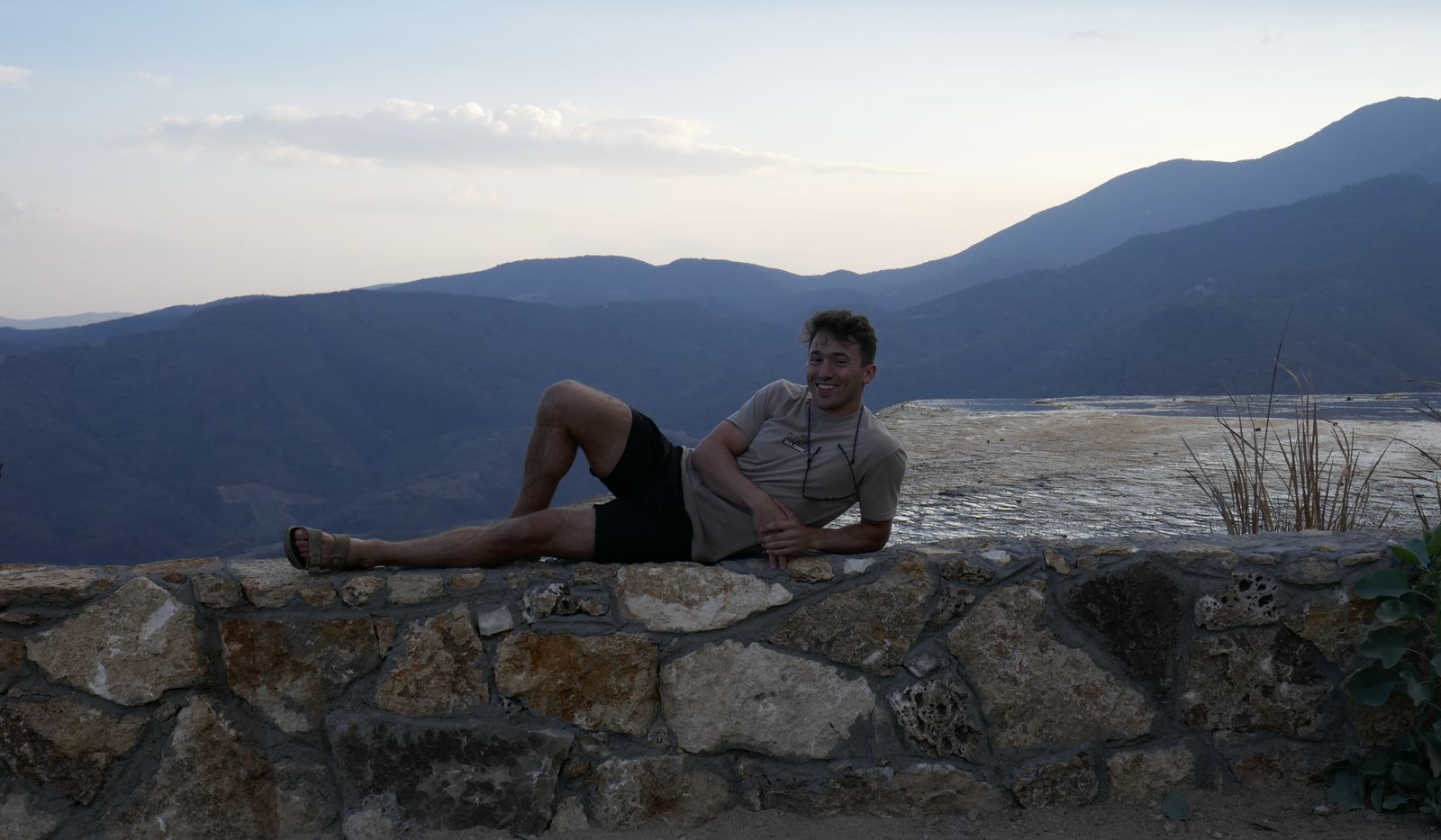
Me, in the cauldron where all historical eras are boiling, just trying to mingle.