Me, the very satisfied speck of dust, the unelected American apostle of Mezcal
On Getting up to Speed:
I've been sharing my newsletter with some new heads, and if this is your first one, you might be a little bit confused. If that's you, some background reading might help! I explain what I'm doing in Mexico in my first post (here, just the first section), and I explain what I'm doing with Mezcal in my last post (here). Catch up if you want, or don't, but you might be confused.
On Where I've Been:
For the first 45 days of my travel fellowship, I did remarkably little traveling. I went to a few nearby towns for markets, but mostly I just slowly lost my mind in the city itself. In the last two weeks I've paid off my travel debt, going to: the cacti-filled mountains of the Mixtec Alta, the giant-hippie-oven known as Tulum, the cenotes and pyramids of the Yucatan Jungle, the cozy neighborhoods of Mexico City, to the Mezcal-Mecca Miahuatlán three different times, and an ancestral palenque.
As I've written in every post so far, there's a side of Mexico and Oaxaca which you can only access through the help of a local. For how much I've complained about coming all the way to Oaxaca just to be a silly little web-developer working a silly little 9 to 5, all of the places I listed above owe some degree of thanks to Demetrio, my silly little boss, friend, roommate, and landlord.
The first day I met him we made our bargain (he teaches me about mezcal, I make his website), he offered me an open room in his house, and semi-invited him to Tulum for a mezcal festival. In my endeavor to be a Yes-Man, I said yes to it all, and on the first week of May we flew over to Tulum. Demetrio, being a social butterfly working in a very social field, has lots of friends with cool businesses in cool places. One of these friends owns a bar in Tulum and was out of town, meaning there was an open room with two beds in the center of the town. An ideal setup, couldn't ask for more.
The room did have two beds, it was attached to the bar, and it was in the center of town. Everything matched the description. The only issue was that the description kept going. The room was directly behind the bar area, and also doubled as the kitchen and bathroom. The pillows were speckled with black mold, the sheets were speckled with black mold, the walls of the bathroom were speckled with black mold, the shower, luckily, opted for a greenish mold instead. Being a bar, the music didn't stop until past midnight, and the windows didn't close as the room also doubled as the main power outlet hub, with a river of extension cords running through the windows keeping the bar alive. There was a single fan to share between the two of us to disperse the 90+ degrees of stagnant Tulum air. Other than that though, it was great. And free. It took me two sleepless nights to break down and move to a hostel.
We were in Tulum for the first annual Tulum Mezcal Festival where Demetrio was one of the vendors. The first two days consisted of industry talks and social events, followed by two days of public tastings and mezcal-focused trips. It was during the industry talks that I hatched up my Golden Age of Mezcal hypothesis (read it here), surrounded by passionate producers talking about the future of the industry. Outside of the organizer (who now subscribes, thanks Justin!), I was the only other gringo. It was a surreal feeling to think about how I got there, and even more surreal to feeling accepted as part of the group by the end of it. For a culture where masculinity is very strong, the men seem to really love hugging. While getting embraced by old Mexican men after four days of drinking mezcal together was not something I had on my Mexico bingo card, it was incredibly special to check it off.
One of my favorite quotes from the talks (poorly translated), which set the tone for the event, was: "We are all brothers on the same road. I don't know where it ends, but when it does, we'll still be friends and companions." There was very little competitiveness or secrecy amongst what amounts to competitors. To paraphrase (and again poorly translate) a theme which came up a few times:
"Mezcal is not an economical activity, it was born expensive. Each bottle is at least 7 years old, and an excellent mezcal is inherently limited in how much can be made. It's a limited drink, where we'll never be able to make enough for everyone in the world. In order to change these things, we would need to industrialize, which some people do, but in doing so you change the drink. How do we tell someone that artisanal mezcal is worth it? We have to educate them that it's not the same to drink a bottle from our ancestors as it is to drink a bottle from a factory. We're delivering something that's akin to artwork, with history and labor that's entirely Mexican and Mestizo."

Luiz, evangelizing on the importance and relevance of mezcal
To break the festival into three parts, there were talks, events, and tastings. The events were mostly a small group of industry people where we took a lot of fancy photos of our bottles and did some networking. As Demetrio's gringo, my job was to chat with the English speakers to give our story and do tastings. When I wasn't needed, I was in my own world, soaking in the craziness of the path that brought me from making banana wine under my bed in Williamstown Massachusetts, to applying for a fellowship I had never heard of on a topic I thought sounded too fun to be taken seriously, to feeding my interviewers watermelon pickles, to sipping mezcalitas on a hammock in a cenote somewhere in Tulum with artisanal mezcal producers. In between the last two, there was ~four years, a pandemic, 5 jobs, and 3 states.
Beyond the surreal moments though, I wasn't a huge fan of Tulum. Just know it's too hot, too expensive, and too confused. Beyond the people who work at the hotels and bars, it's mostly composed of short-term and long-term visitors, people who have a lot of money seeking the fastest ways to spend it, and life-coaches who teach yoga-teachers who teach spirit-guides who consult people who claim to be Mayan shamans. The word Tuluminati is thrown around a lot to describe this otherworldly mesh of characters. The line between the title expat and immigrant is blurry, but I'm sure if it was clear there would be a color attached to it. In any case, it's not discussed, so there's a lot of people who call themselves expats. For our purposes, the ven diagram of Tuluminatis and artisanal mezcal consumer has a lot of shared traits.
As an aside, I only spent four days there, so I'm sure I'm just projecting a lot of opinions, but I'm sure there's some slice of truth in them.
After the talks and the events, there were the tastings. For two nights Demetrio and I led visitors through tastings in the hope of selling bottles. There's no big product that comes out of this fellowship, but this felt like a multi-lingual pop quiz on how much I'd learned about the topic so far. I ended up selling some bottles, so that either means I knew enough to pass the test or I gave my testers enough mezcal to lead them to make some irrational purchases. To me, either constitutes success. Selling mezcal to Germans in Tulum with fire dancers in the background also was not on my Mexico bingo card, but it also got checked off, and I'm happier for it.
Following Tulum I headed to Valladolid in the center of the Yucatan peninsula. It's a small tourist town known for being close to a lot of cenotes and archeological sites. Cenotes are big sinkholes which have filled with water and were the only reliable source of potable water in the region. The Mayans built the majority of their settlements around cenotes, and many hold spiritual significance as well. They were viewed as portals to the underworld and the site of sacrifices, burials, and offerings. Now, chumps like me get to swim in them. Morally dubious, who knows, but very very unique.
In one place, Tekom, there was a cenote directly below the town green. Where you might expect a central fountain is actually a small opening in the ground which looks down to a large pool of murky water. I payed my 50 peso entrance fee, walked down the spiral staircase to a small tunnel which was carved out of the limestone, and was suddenly below the town green, alone with my thoughts, some white shrimp looking things, and possible human remains (kidding). A more built up cenote at the archeological site Ek Balam had a rope swing, a zip line, hammocks, a restaurant, a waterfall, iguanas, and schools of tiny black sucker fish. The final cenote I visited didn't have any water, and was instead used as a habitat for bees and a small honey business. The bees are kept in hollow logs, sealed except for a single opening, where they live for a few years before the log is opened and the honey extracted.
This honey is then used for eating, treating illnesses, and fermenting into a local drink called Xtabentún, named after the flower from which the bees make their honey. The honey is fermented with anise, and then mixed with rum to created the drink. I took a walking tour which included a honey section, and when I asked where to find it, they directed me to a honey farm. When I went to the honey farm, they directed me to a gas station. When I went to a gas station, they said, "Welcome to Super Willy's, go two and a half blocks south and start asking around." Lo and behold, two and a half blocks from Super Willy's there was a man standing outside of a small family-owned Mayan spirits tasting room. I tasted an unaged version, an aged version, and a version aged with nanches (a small yellow fruit). I bought travel versions (aka shooters or nips) to begin my collection of liquors-of-the-world. It's a very new idea, but I think it's got legs. I traded the man that led my tasting a sample of mezcal and, after trying it, he said with a wide smile, "Thanks, I don't like it."
Demetrio gave me the sampler as a thanks for helping (and because he couldn't fly with it). I thought it was only right to continue my campaign as self-anointed mezcal apostle to give samples to anyone who would listen to my abbreviated history of the drink. Staying at a hostel, it was very easy to find willing participants, but slightly harder to ask them to not take it as a shot. Not sure if it led to any converts, but maybe this was more about me than them, and anyways, they got a free drink.
And now here I am again, writing a bit too much on topics I'm not sure anyone else is interested in, and with not enough will-power to write any more about my time in Mexico City or the visits to the palenques. Next time, but probably not.
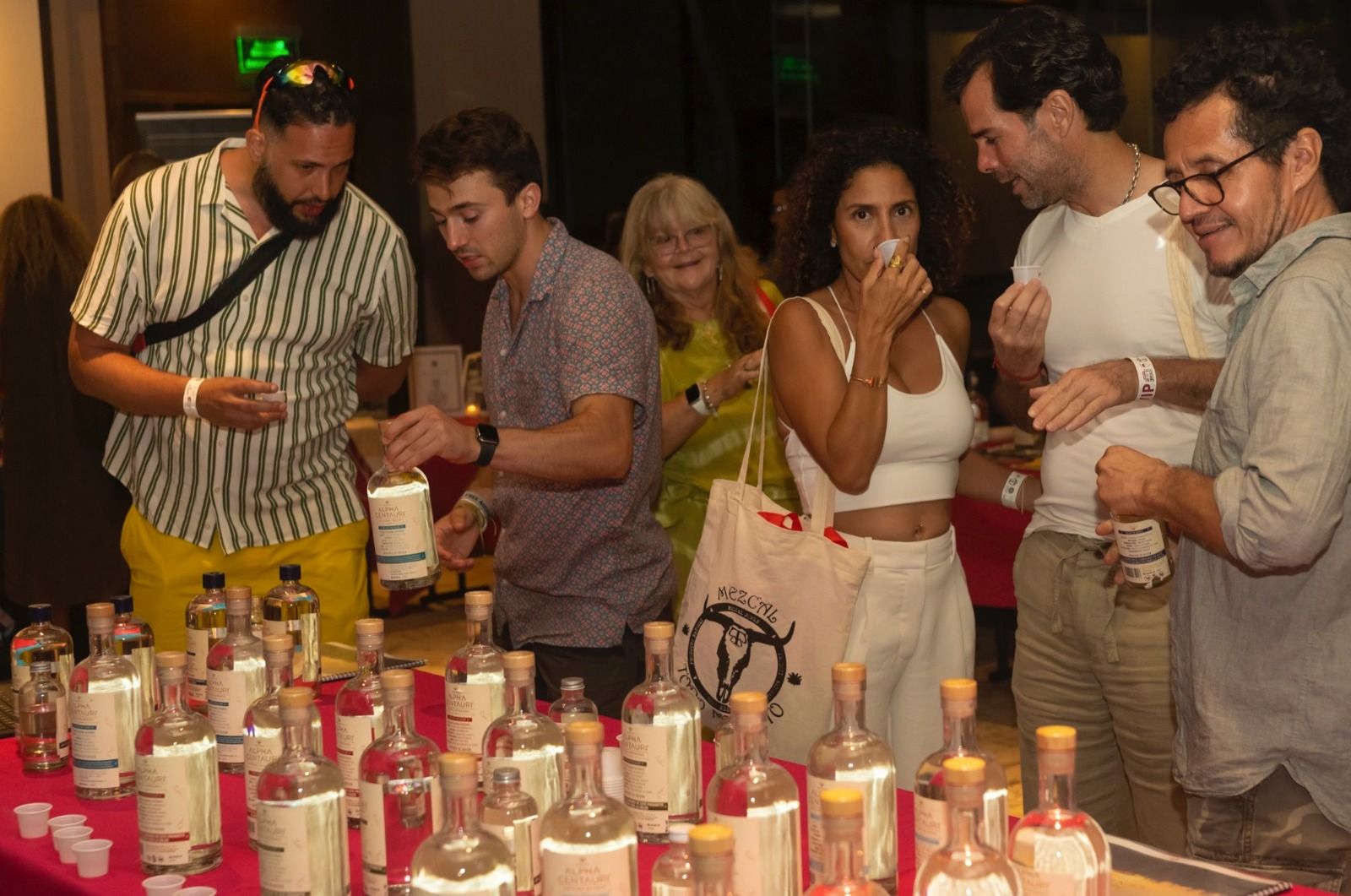
Me, Demetrio, and lots of Mezcal
On Where I Am:
When I tell people what I'm doing down here I say, "I'm traveling on a scholarship to learn about food and culture around the world through the topic of fermentation." I used to use the word fellowship, but then I'd sometimes get asked if I was a mormon, and if this was my mission, so I've switched to scholarship, to maintain the misleading degree of authority. A fellowship implies I'm a fellow, and a scholarship implies I'm a scholar. Maybe I'm both, most likely I'm neither, but both seem impressive and the optics are the important part. Sometimes I even say I'm a writer, which is where this newsletter comes in. I think people are usually confused for a number of other reasons beyond just the semantics of my title, but at the end of the day, I'm confused as well, so we're all on the same page.
Some days it does feel like I'm here to learn about food and culture through fermentation. Other days it feels like I'm on my eat, pray, love year, or it feels like this is my chance to learn about the world and my place in it, or it feels like I'm just a little amoeba responding to basic stimuli of light and sugar, and some days, when I've got enough mezcal in me, It feels like I'm part of a beautiful whole, and my purpose is just to be there. That usually wears off after a nap, as all good things do.
This is the time of year when college students graduate and begin summer break. I was reminded of this by my Instagram feed and felt a pang of nostalgia or sadness at the fact that, as far as I know, summer break doesn't exist for real-life adults. And then I realized I am technically on summer break if I want to call it that. Unlike like those college students though, I'm also coming off of a 3-month spring break, and afterwards I have fall-break and winter-break coming up as well. I'm also working a lot less than I did when I was on summer-breaks.
I've written a lot about being discontent with where I am, but at least for the last two or three weeks I've had a lot of moments where I feel like I am exactly where I need to be, which is relieving. I am on a summer-break of my creation, I am living a dream, and everything I do is the right decision, something I've only ever felt in very, very specific situations. One such situation is on airplanes, busses, or trains because you don't need to think any more, because you're going the right way. To incorrectly co-opt the uncertainty principle, you are a little electron that knows very little about your exact position, but as a compromise you know precisely your velocity, or where you're going. Recently I have been living as the very satisfied electron: I don't know exactly where I am, but I'm very happy with the direction and the journey.
When I am in traffic, I am exactly where I need to be. When I am getting driven around in unknown cities as ungodly speeds, when I am stuck in hailstorms, when I am doing my silly little computer beep-boops, when I am reading my silly little books, when I am eating mole with strangers in the countryside, I am exactly where I've needed to be. I like to romanticize the times when I was wondering around Oaxaca eating and drinking at every cafe and food stand I passed, but all I knew was where I was, and nothing of where I was going, and if you look back at previous posts I was pretty down about that.
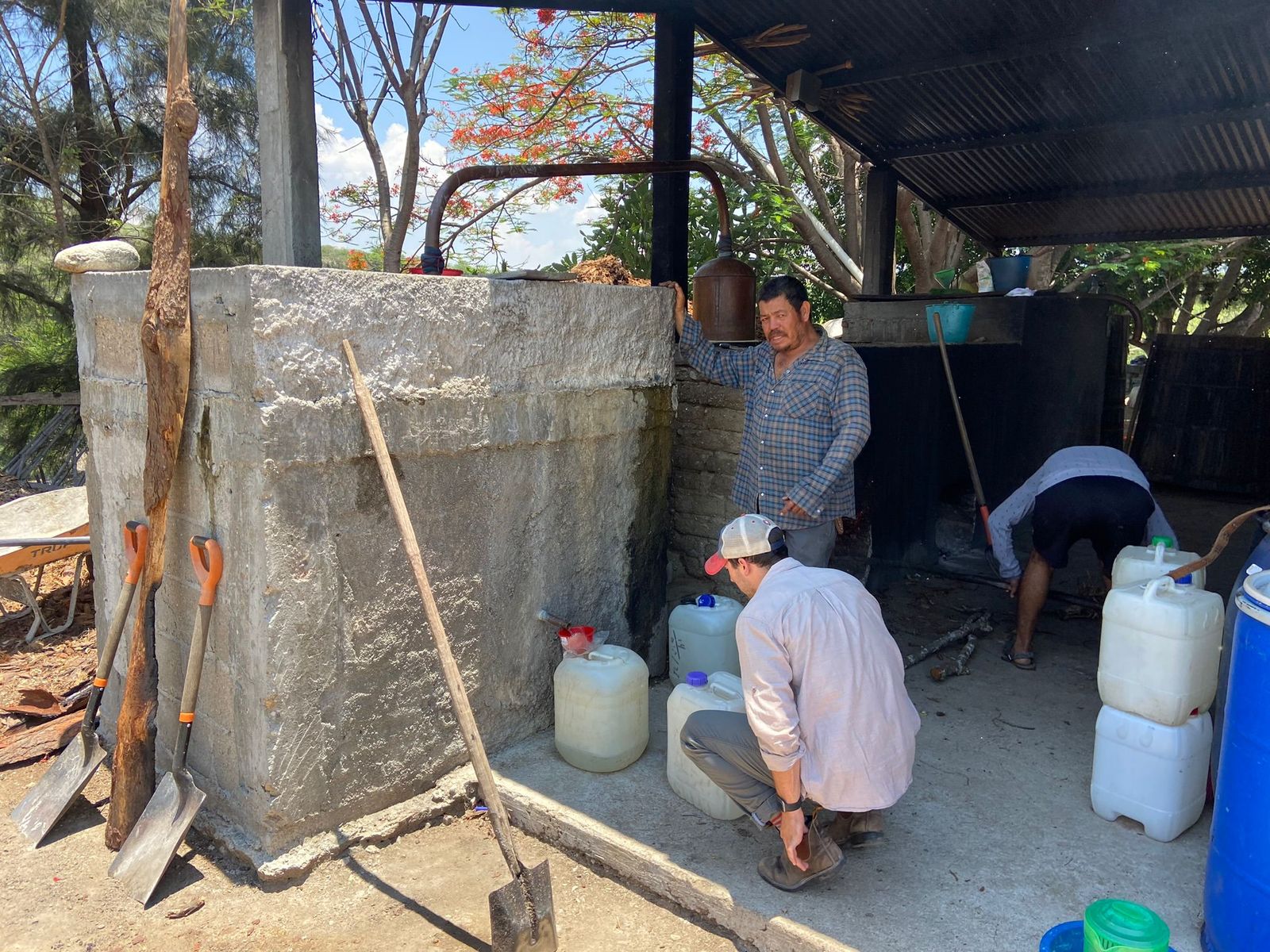
Me watching mezcal being born, happy as a clam
On Where I Am Going:
I arrived in Oaxaca with an intentionally loose plan, hoping to see and try a lot. I knew that it would be a country that would be very new to me, so how could I know in advance how I should spend my time? I'd like to have a bit more of a plan for the next places I go (see above note...), and that means I need to start planning.
The first contact I had for this trip was a guy named Max who did a similar fermentation fellowship about 10 years ago. In his first email, he wrote, "My advice, email anyone and everyone, because you never know who will respond. Then, don't be surprised/worried if none of it works out. I think this is really what the [fellowship] folks expect/hope for. They want you to get out there, get lost, and connect with anyone/everyone."
The last line has been a guiding principle for me, and I've been trying to make Max proud by connecting with anyone/everyone. American teachers who worked in Spain, Argentinians who are fleeing inflation, Dutch coffee experts sourcing beans from Oaxaca, Netherlanders who made the mistake of sitting next to me on a bus who explained herring pickling, and Englishmen who make cheese in Mexico City. As much as I'm here to learn about fermentation, I'm also here to learn about peoples relationship to it, and this is how I'm going about it. For me, this fulfills the Love requirement of my Eat, Pray, Love holy trinity. The eating comes very naturally, and the praying I'll say I did next to the human remains in the cenote.
Here are some recommendations I've gotten from the various people I've met:
From an American who sells mezcal and rum, and who wants to write a book about the history of cabbage:
-
Greece for retsina, a wine that's fermented in creosote soaked barrels, the same substance they use to preserve wood on railroads. He ran across it in Meteora, which are monasteries built into the cliffs
-
Alsace for cider. No cool story here, he just said it was tasty.
From a Barcelona man who exports mezcal to Spain:
- Spain, unsurprisingly. Rioja for the reds and Jerez for fortified wines.
A girl from Chicago I sat next to at a dinner who did a Fulbright in Spain:
- Logroño, Spain, a tiny but lovely region in northern Spain know for their wines
The Englishman who now makes and sells halloumi cheese in Mexico City:
- There's a town between England and Whales called Cheddar, known for their cheese.
A Netherlander I met in a coffee shop:
- Gouda, where they make gouda, and Amsterdam, where they make Old Amsterdam, "The best cheese in the world."
If any of you, dear readers, have suggestions, please let me know. Bonus points if your suggestion includes a château somewhere pretty, but I'm not picky.
I arrive in Europe on July 1st, but so far I don't know exactly where. My only solid plan is to work at a vineyard, but the season for that is the fall, which leaves me about 2-3 months before then to do what I want (and 2-3 months to find a vineyard). I'd be happy working on cheese, bread, beer, cider, or anything else I come across.
To disclose personal medical information to those who don't yet know, I have Celiac disease, which means I can't eat gluten. It's up to you to google the rest. The important part is to know that it dictates a lot of what I do and where I go (on this trip and in real life). I was originally planning to go to France for wine, but almost all French food has wheat sprinkled in it. I find brewing really interesting, but after a few days of research, I've learned there are few to no dedicated gluten free breweries outside of the US and Canada. I've written off almost all of Asia, despite their rich fermentation culture, for the fear of mixing a language barrier with the ubiquity of gluten-filled sauces. I didn't come to Mexico expressly for the prevalence of corn over wheat in the cuisine, but it was certainly a big draw. The first word I learn for each place I travel is wheat. On a higher level, it's one of the reasons I'm interested in food and fermentation in the first place. Fermentation is the process of externalized digestion, something I can't do internally with regards to this pesky little protein. More broadly, I've grown up having to think a lot about what goes into my food, and how it's made, and as a result the topic has become one that fascinates both my mind and my small intestine.

That was a very complicated way to say that I wanted to work at a gluten free brewery, but they don't exist. Gluten free bakeries on the other hand do exist. The evolution of the gluten free industry as viewed through the replication of its biggest enemy, bread, probably only interests those who saw and ate their way through it, but I'm lucky to be one of the select few. Gluten is the key protein in bread that leads to its airy structure. Without it, you're essentially building a house without nails. That doesn't stop people from trying, and to them I am indebted. I reached out to around two dozen gluten free bakeries all across Europe that interested me, and now I wait to see who bites. As delicious as pastries are, I tried to focus on bakeries that also make some form of artisan bread, where fermentation plays a more critical role.
The next group I'll reach out to will be cheese makers, and after that cideries, and if in a month and a half I truly have nothing, I'll just have to eat my way across Europe. Wish me luck.
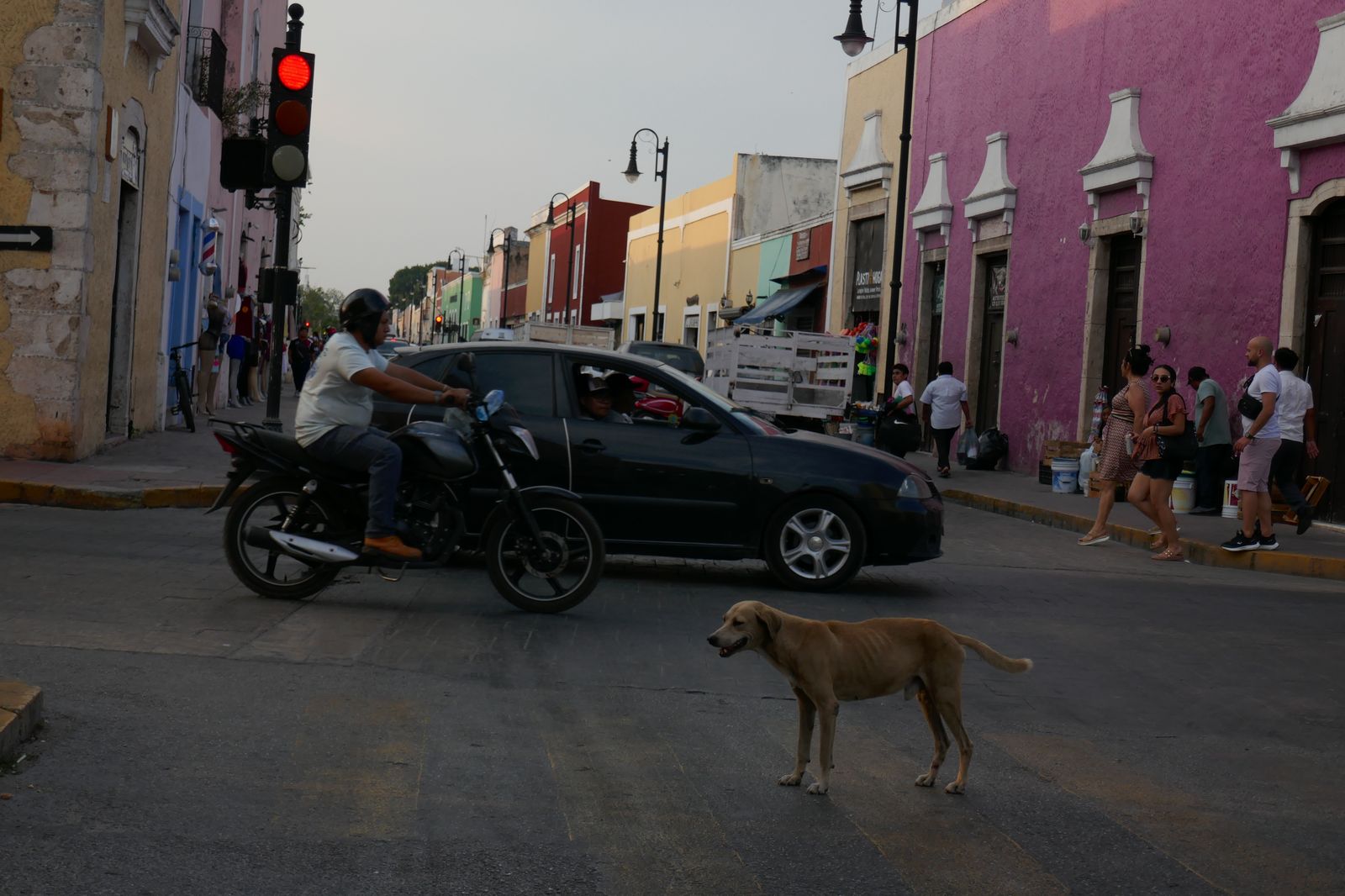
Me as represented by dog, a little confused by what "on the road" is supposed to me
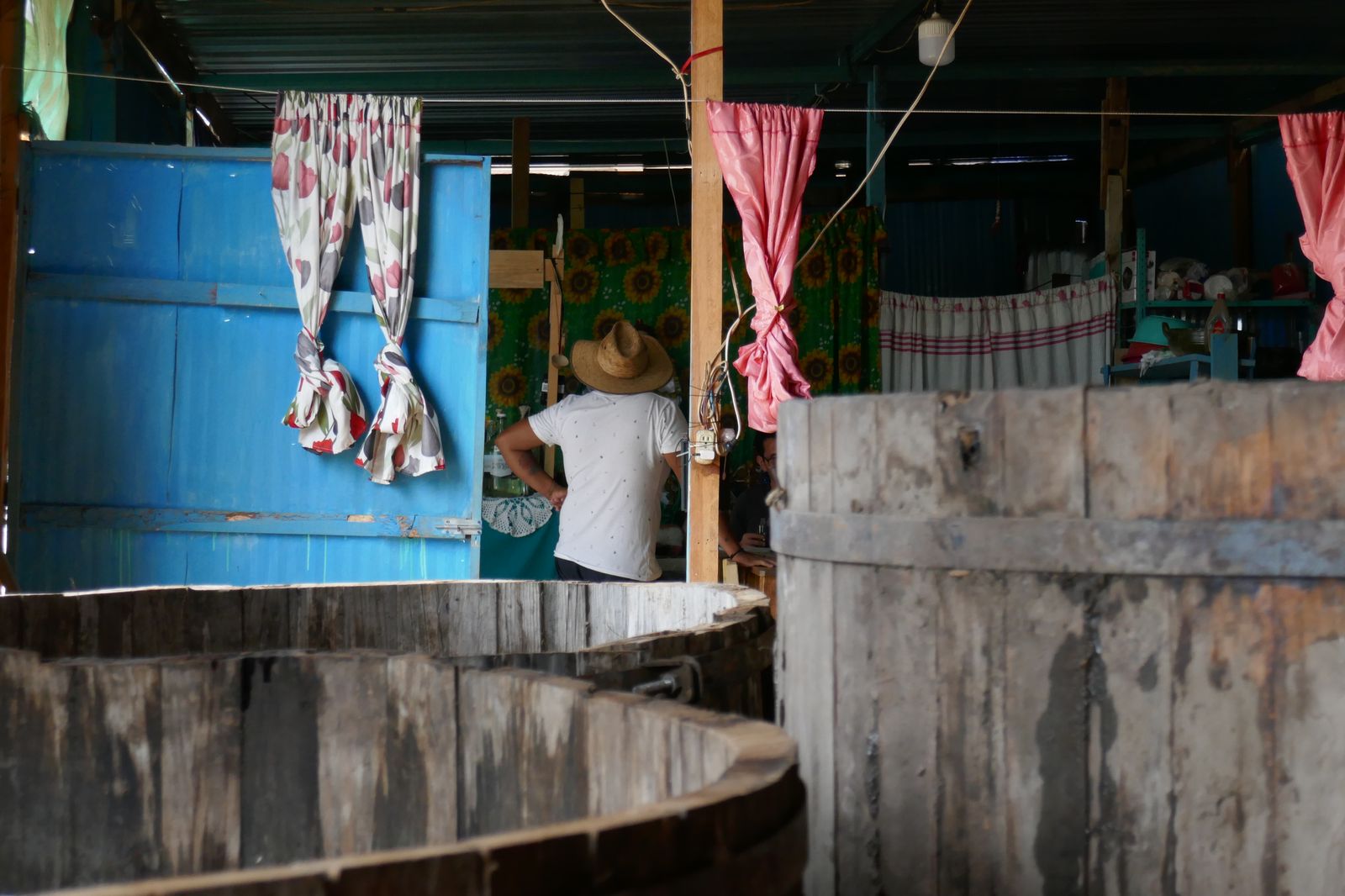
Mezcalero Juan, between the barrels
Thanks for reading EatMarshallEat! Subscribe for free to receive new posts and support my work.