Leaving the Island
Sorry for the long delay. "The vicissitudes of life strike us all" or something like that. The contents of this took place during the first half of August and it's now October. I'm working to catch up, sit tight, it's hard to write all this gibberish.
**On Arriving: **
When I arrived in the UK I started to run again with more regularity since all the easy excuses of Mexico were gone: quieter roads, cooler temperatures, fewer packs of wild dogs. Being in apple country, the miles were measured by the new trees I discovered and the days were marked by the ripening of the fruit. At the time of the Bristol Cider Salon, where I ended my last post, I started to see the first apples on the ground. This unofficial start of the season aligned with my last week in the UK, which I spent at Hollow Ash Orchard.
Hollow Ash is a smallholding in Herefordshire with about 3 acres of orchard, run by a very sweet couple, Claire and Jeremy. They first started making juice for their children, which led them to cider, which eventually led to them to perry. They label their cider and perry under Cwm Maddoc, using the name of the estate upon which the the smallholding now stands. The estate is referenced in documents from 1503 and a 1698 survey shows orchards planted around the threshing barn Claire and Jeremy have converted into their home. They've since replanted parts of these orchards with their own menagerie of apple and pear trees.
I will link their self-recorded history (Our Story) as well as Adam Wells, again, who covered their work last year (Meet You Perrymaker: Cwm Maddoc), for those who want to learn more.
I mention all this history because it seems to be the life force of the region they're based in. Claire can provide the provenance of every historic home in a 20 miles radius and build you an itinerary of the best castles and estates to visit in any region of England based on your own personal likes and dislikes. Search engine algorithms could and should be trained off of her knowledge of landmarks, place-names, dates, and hyperlocal history. (Artistic liberties were taken in these statements, but I take them to be no less true).
Upon arriving I was brought to my new digs: a shepherds hut sitting in the grassy section of a small orchard. Jeremy and a friend had a small business of building these caravans, which were modeled after what shepherds would use to move around with their flock and sleep in during lambing. It has a bed in one corner, a wood burning stove in the other, and a chair and a small dresser in between the two. Under the bed there's a cutout with sliding trays where one could keep weak or injured lambs, if one happened to have any, to keep warm, monitor, and bottle feed during the cold nights. I know life was much harder back in the day, but shepherds don't earn much of my sympathy with what cosy abodes they kept.
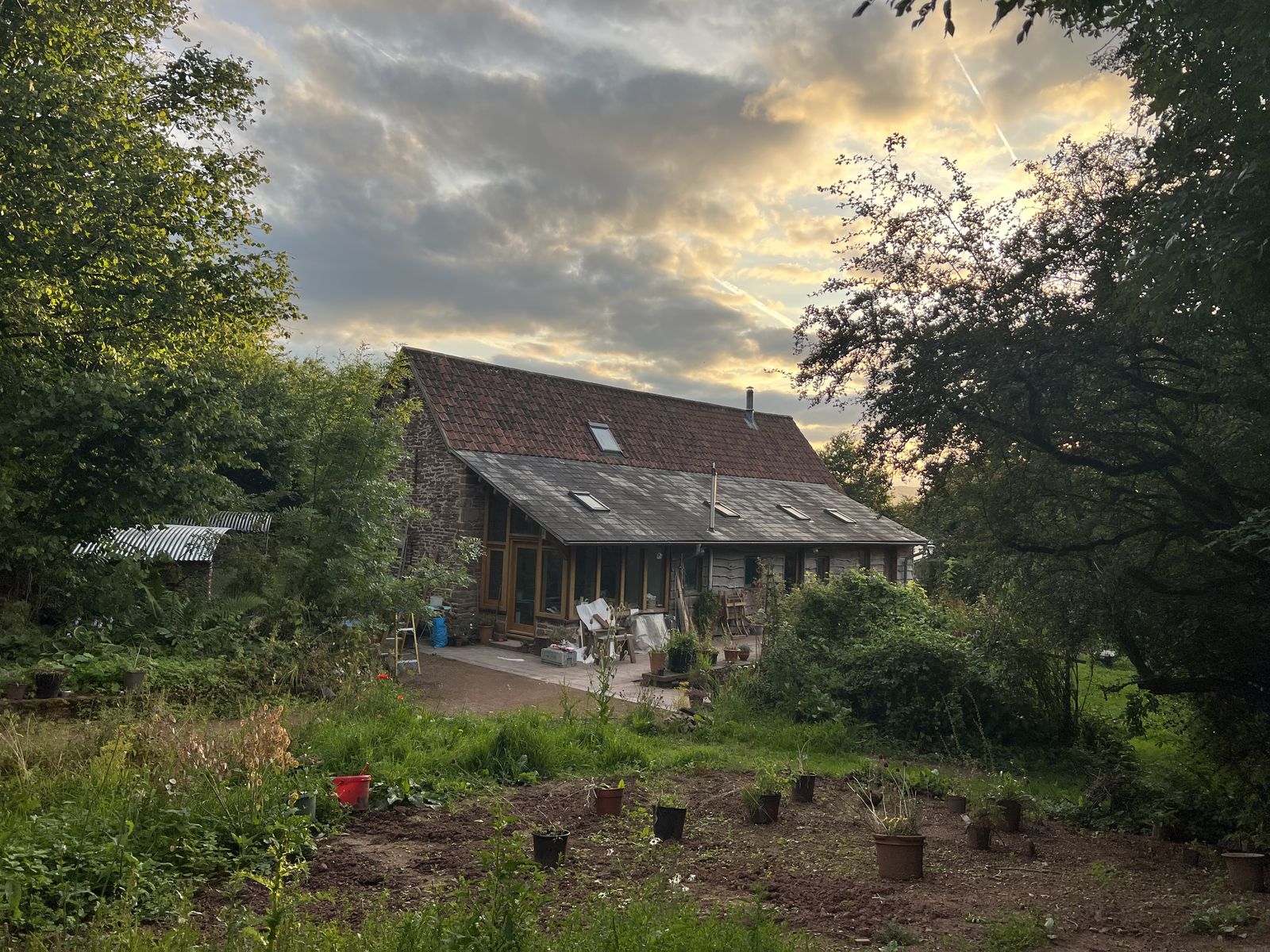
A poor photo of a very pretty barn, well lived in
On Working and Not Working:
I was informed I could come over for breakfast as I pleased; work would start around 9ish. Come morning, I make my commute from my shepherd's hut to the house and placed on the table, in front of my chair, was a finely laid-out spread of abundance that would put a hotel to shame. I ate my buttered bread with blueberries, yogurt, and cereal as Claire made coffee. Maybe there wasn't that much to do, maybe they felt bad working me too hard, or maybe through decades of experience they had no desire to rush what they knew would get done eventually. No matter the cause, the days were a mosaic comprised of meals taken in leisure, coffees in the sun, and flapjacks eaten while watching birds and talking of hedgehogs. Work was just the thinly visible mortar in between these peacefully placed tiles.
With breakfast over, we would set out for a task - cleaning tiles for the new floor, moving or breaking down boxes, puttering in the fields - and be called in for coffee and biscuits before it felt like the task actually started. More often than not, I hadn't yet finished my first coffee. Biscuit break over, we'd set out to pick up our previously started task, assume our positions and get ready to get down and dirty, at which point we'd hear that lunch would be out soon, and that we should wash up.
In one of the moments when it could be said I was actually working, I got to light a fire out of old apple tree branches leftover from the winter's pruning. The objective was simple enough: build a fire in the field, and bring any stick or branch you see to the fire. As a suburbanite and a child of the smoky-the-bear generation, building a fire in a grass field seemed like a fool's errand, but all's well that ends well. I got to use a pitchfork to prod the fire, which, being a man raised in stereotypical male ways, I got immense pleasure out of.
Walking up and down the orchard, ferrying branches, I got to become acquainted with the early season apples. Discovery apples are one of these, with a seemingly fitting name. Impossibly red and adorably squat, they're 'dessert apples', meaning they're tasty enough to be eaten alone, which I confirmed numerous times while admiring my fire. Tightly bunched, their abundance straining the branches, they looked as if it was their life's mission to pull the tree back down to the ground. Wasps had found the fallen fruit and were busy at work with so many apples to eat. The harvest must weigh heavy on their consciouses as well.
The pruned branches needed to be cleared so that the grass could be cut. The saying 'make hay while the sun shines' comes from the idea that rain turns making hay from a fun, bucolic activity into a cumbersome, slightly dangerous slog. "Oddly enough, wet hay is more likely to lead to a spontaneous combustion fire than dry hay. If hay is put into a barn or stack when it has more than about 22 percent moisture, not only does the hay lose forage quality, but it has an increased risk of spontaneous combustion." [South Wales Fire and Rescue Service]
The grass was cut and the sun was shining until it wasn't, at which point it started to rain for the next few days. Me, the world's worst weatherman, stayed silent. Jeremy has a tractor attachment which spins over the wet hay and fluffs it to aid in the drying. I'm not sure if I was actually needed, but twice per day I got to follow along and turn the big piles it made. I was again handed the large metal pitchfork which, again, being biologically conditioned to enjoy, I got immense pleasure out of. Laurie Lee wrote about holding hay as, "a whole summer embalmed in our arms". A season's worth of sunshine in a light fluffy package. If I wasn't having so much fun with my metal fork it would have been nice to think about that.
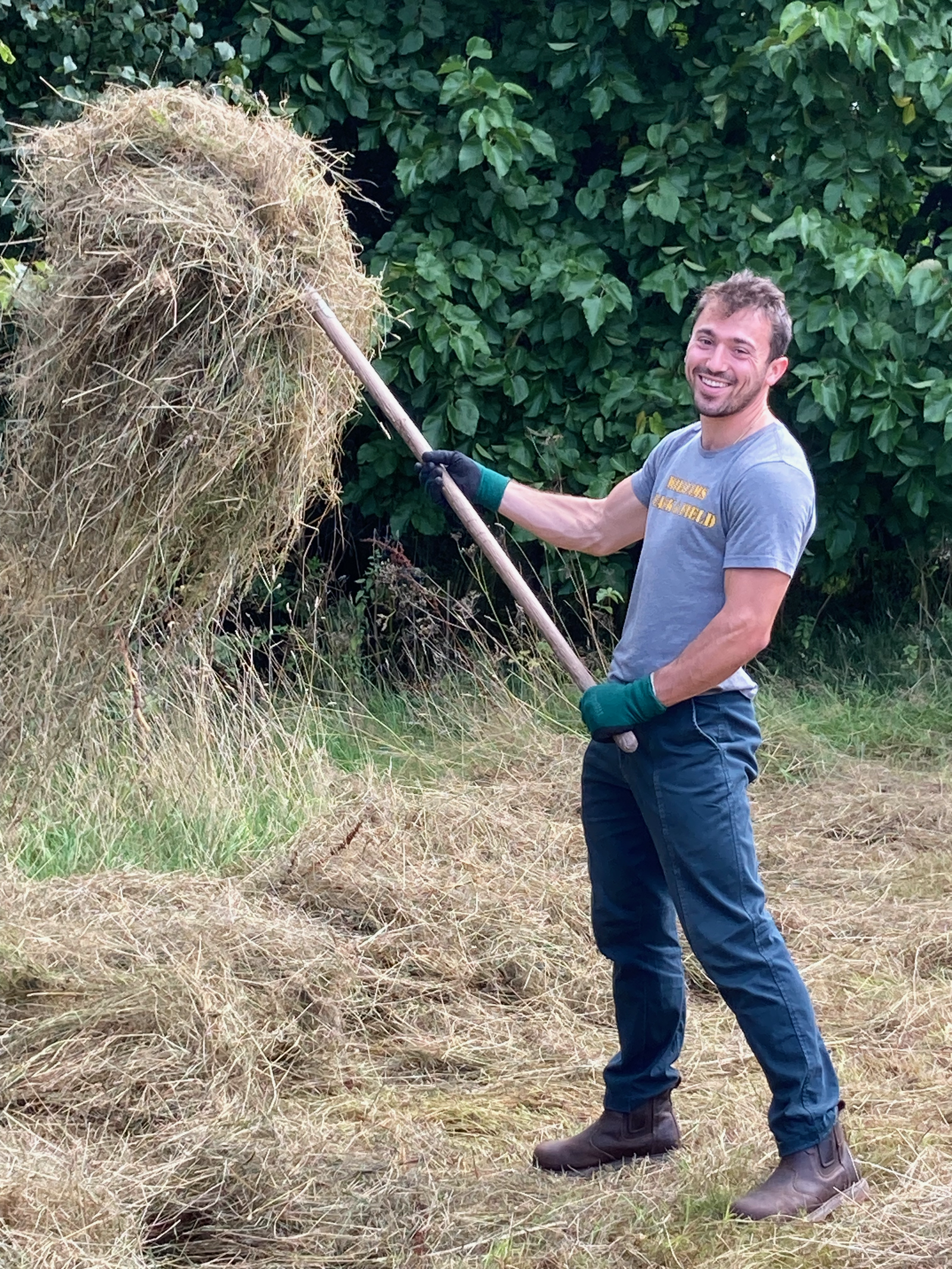
Me with the pitchfork, visibly pleased
During this time Jeremy received his first apples of the season from a client. When pressing apples for juice you want to avoid using apples with bruises and mold. Generally, if they've fallen to the ground on their own they're best left there if you want clear juice. You also want to wait to press until you have enough apples to make the juice worth the squeeze. Pressing works on the economies of scale: provided they all fit on the platfrom, there's not a huge difference between pressing 100 apples or a 1000. This assumes the apples are free of bruises and mold, which turns out to be an important stipulation. The client, who I gathered is someone you say "bless his heart" after mentioning, provided a few baskets of moldy, bruised apples he collected from the ground. Jeremy, because he's a saint or because he wanted me to be able to see the process, pressed them all the same.
We took the apples one by one and cut out the molded sections before placing them into a large basin to wash. Sporting cut-proof gloves, wielding my knife in one hand and my bruised patient in the other, I was an apple butcher performing triage on an autumnal battlefield, fighting wasps and the moldy decay of microorganisms. At least that's what I told myself in my search for purpose. After a quick bath in the basin, the cleaned apples were fed through the scratter (shredder) and then folded into cloth mesh to be pressed. We bottled the juice, about 15 liters in total, before pasteurizing it in a hot water bath. There were maybe 24 bottles, which was maybe $40, which maybe took a little over 2 hours of 2 people's time, which reaffirms that Jeremy is a saint.
One day, when I have my little orchard somewhere in New England, I would like to be the Jeremy of my town. The town apple presser surpasses the esteem of any lord or lady.
Related to these odd jobs, I was lucky enough to receive my first and only Wwoof review, which stands as the highest praise I've ever received: "Marshall was charming and very helpful. He was happy to take on any task and worked very thoroughly, even the most menial jobs. We enjoyed his company." I would like to formally request this be etched upon my headstone.
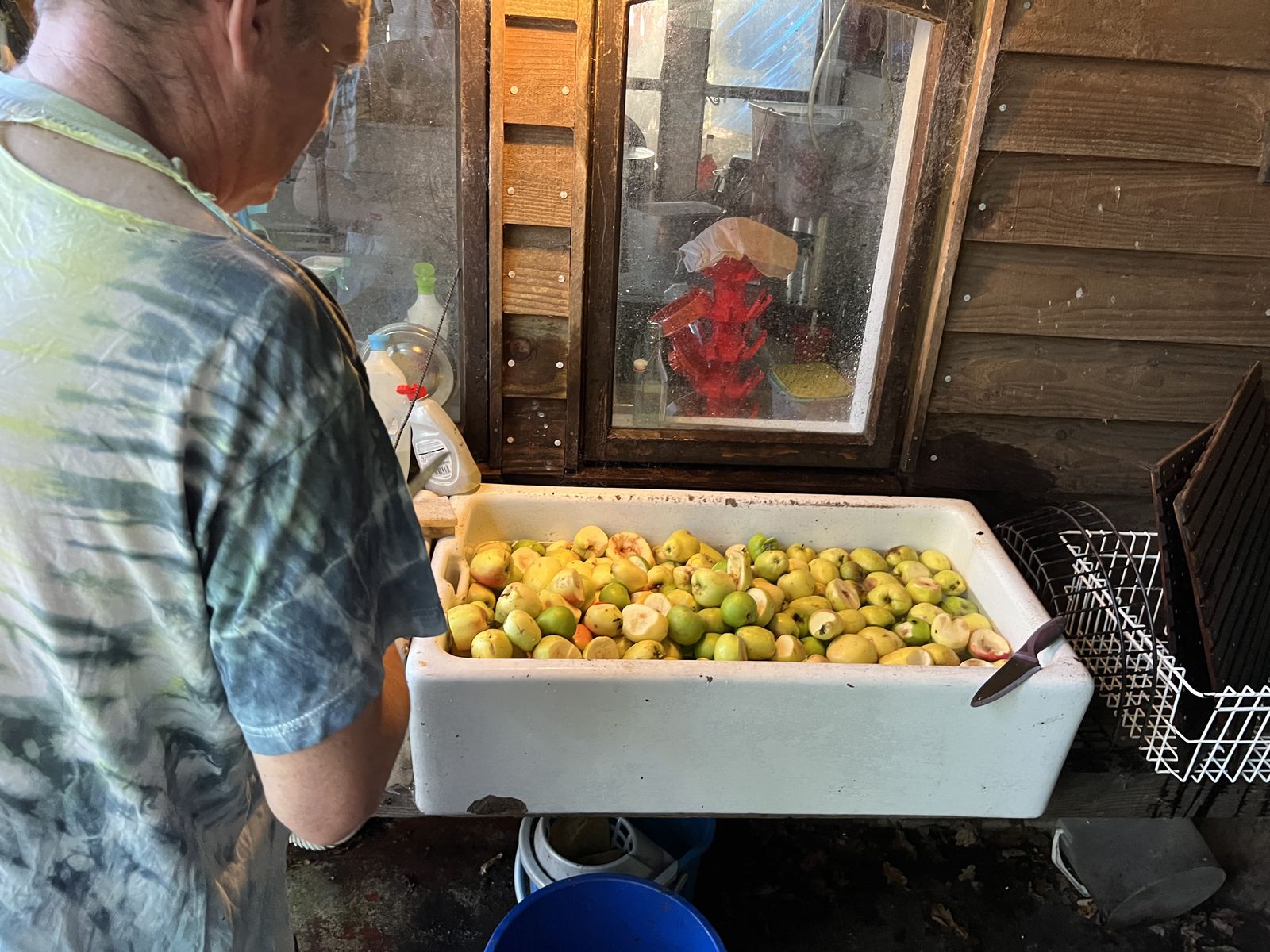
Apples cleaned and cut ready for a bath
On Neighbors and Country Homes:
One afternoon Jeremy and Claire were invited over to a neighbor's house to have coffee and they were kind enough to take me along. On the way over we looked at the pear trees in their neighbor's yard: old, stately, gnarled, storied, in need of work. I can't tell if Jeremy feels envy, pity, or simply knows every pear tree this side of the river Wye, and upon passing one he updates the pear rolodex in his head with the tree's current size and weight, his stares those of a man maintaining generational knowledge for the noble cause of making great juice and perry. I'm speculating. Maybe he's like me and just likes the way they look: how pleasant their leaves are and how stubborn their twisted branches look.
The neighbor's house was another converted-ancient-stone-barn which now had all the trappings of a proper English country home: cast iron gutters, exposed beams, a well kept garden, the remnants of an old orchard. I didn't look but I assume they had the mandatory amount of stained glass stashed away somewhere. In short, it was the incredible type of house that makes you question what other hidden wonders exist in this world.
A different afternoon, Tim, who I met at the cider trials a few weeks prior, invited us over to see his orchard, now in bloom, and to ask about Jeremy about a pear pest problem. His house, like a proper English country home, had a garden which felt like it belonged at a castle: a statuary recreation of Botticelli's Birth of Venus, trimmed hedges which reach over your head, walkways shaded by trellised vines, a topiary arch built of four carefully molded plump-leafed trees, flowers I don't know the name of (which isn't saying much) which one might reasonably guess only exist in this garden alone, and a little gnome who came out and gently guided you around by hand. At one end of the garden was an octagonal shed where he kept his barrels and carboys. On the wall in a half-faded chalk was written the notes from the 2020 pressage: "3 lonely people filled this barrel (even if they had quite good fun doing it - but were quite tired after 4 days of washing, scratting, and pressing - on their own...)"
In the orchard, Tim had recently mowed circles around the base each tree with walkways leading each to each, as if you were in a really easy to solve corn maze. From the sky one would wonder why aliens chose this specific English hamlet for their crop circle practice. He gave us a tour of each tree. The majority were ladened with fruit, branches stretching to the ground, each seeming quite pleased with what Tim's done with the place. Having picked up cider making in France, Tim had brought over a few pear and apple trees from the Lisieux Tree Fair, which has been running for nearly 600 years.
In an extra dining room in his house, Tim had boxed cider stacked up to form a sort of tap room - each box bearing the initials of the apples, the year pressed, and the percentage. In a china cabinet he had a collection of fine glass drinking vessels (or maybe they were crystal, the difference is a bit lost on me, a simpleton who owns nary a single glass nor crystal collectable). Some he made, some stood out to him for their unique reasons, and at least one was from the 1860's, which he let me drink out of. Thanks Tim!
If heaven is a place, some corner of it would be modeled after Tim's garden and orchard. You would be able to spend the rest of your eternities wandering through the grassy labrythn of his orchard, freshly mowed, until you care to sit, at which point Tim, the gentleman farmer, would come out, straw hat and tattered madras shirt, and hand you cider after cider, each time in a different shining crystal goblet.
The final run in with neighbors came when Claire and Jeremy took me along to the weekly Garway Croquet Club scrimmage. Two courts were painted onto the sprawling lawn in the center of the village with hoops hammered into the soft ground. I was given the basic rules, told how the hold the mallet, handed a cider, and assigned to a team.
Sports historian Jon Sterngass starts his essay Cheating, Gender Roles, and the Nineteenth-Century Croquet Craze by saying*:* "Croquet is usually stereotyped as a genteel game, less a sport than a social function, and more suited to genial conversation and unfettered flirtation than strident competition." As the leading cause of my team's demise, I came to the same conclusion as Sterngrass in that the game is far more competitive than it looked. After any ball was hit a heated debate would arise, which grew longer and more heated as the game neared its end. The unfettered flirting came in the form of witty banter between two neighbors. Wins and losses were celebrated equally in the pub across the street, where the idea for the club was born.
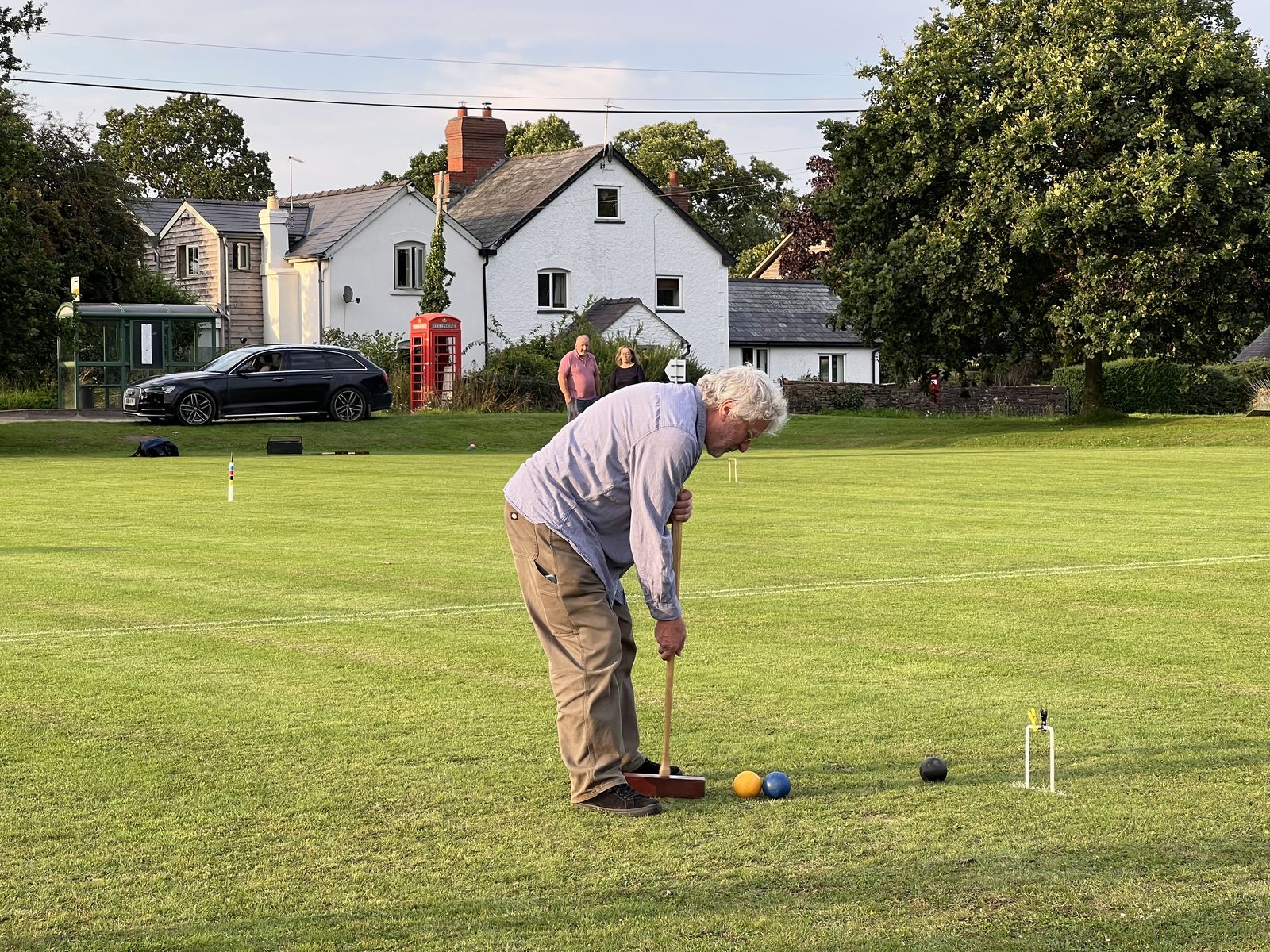
A shark in the water
**On Leaving and The Landed Aristocracy: **
And now for a very biased review of England from the eye of an American who only saw a small sliver of the country.
I've mentioned all the stately homes, the converted barns, the gardens and croquet playing, because I've never been to a place where heritage exists in such an apparent way. England has one thing that the United States, for all its wealth and power, is incapable of purchasing or acquiring: a genealogical ledger which goes back to before the big bang. This ledger runs though its buildings, its families, its towns, and its national identity. I'm not sure if the United States would want to have one of these if they could, but that's besides the point.
Part of this is fun, like passing a church from the 12th century, once belonging to the knights templar. I always thought that group was made up for movies like National Treasure. There are other parts which tend to rub you the wrong way, like estates which have been lived in by the same family since the 13th century. Class, as a whole, was worn on one's sleeve.
I'm not alone in thinking this, because I also saw it on TikTok, which makes it true. The video I'm referring to defined a Posh Index, broken down into: Actual Aristocrat, Family Seat, Old Money, Rah Rah (Daddy's money), Nouveau Riche (Successful Parents), Well Spoken. I had trouble decoding exactly what he said, because his posh accent included a lot of posh-only words, but I think that's part of the point. For example: "The difference between Old Money and Family Seat is that [Old Money] likes shooting while [Family Seat] likes shooting on their own property." Maybe I haven't seen enough of America to know what the equivalent is, but part of me questions if it exists in the same way. The sentence, even in American vernacular, wouldn't make sense. If any of you, dear readers, happen to fall into one of these castes, please let me know so I can finally meet some landed aristocracy.
You get the feeling that the idea of moving to the countryside flirts dangerously with imitating some degree of ascension up the posh scale. You may not have been gifted a country home by the king, but you can make yourself a duke with enough croquet and the right attitude. I will go so far as to say this is the British equivalent of the American Dream (i.e. the belief in social mobility).
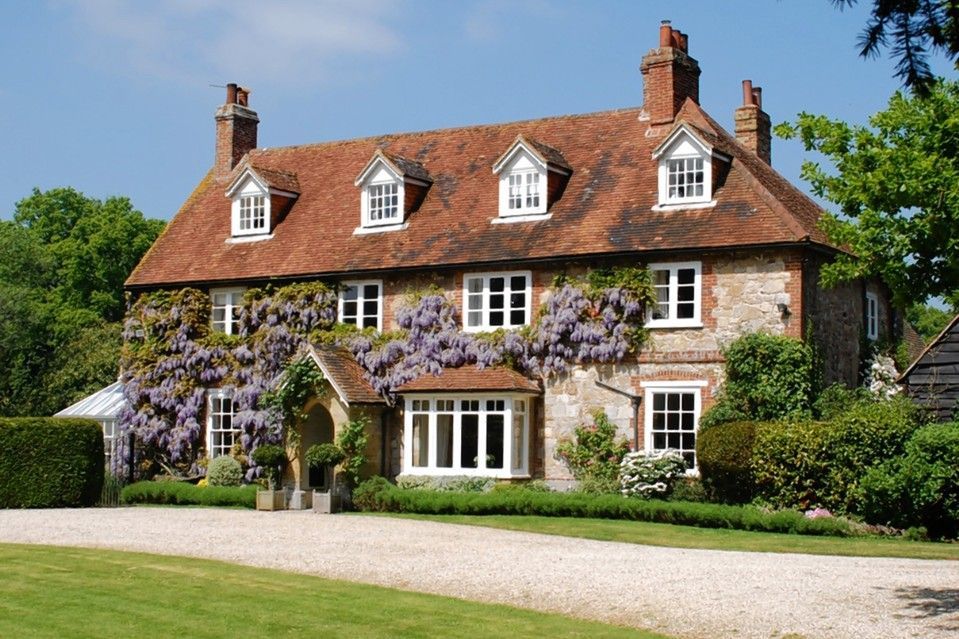
I didn't take many photos from this time, so take this photo of a country home I stole from Pinterest that someone else stole from the WSJ.
Put another way, one gets the sense that it's a country yearning for the days of yore. A place where old men who have never left their island inform you, unprompted, that America is both a ripoff and a scam before going on to mention the days and dreams of empire. No where else have I ever been met by the someone saying, "Ahh an erstwhile colonial." I have a theory that if you enter any pub and talk long enough on any subject someone will eventually use the words, "the empire". Maybe this is the British equivalent of "Make America Great Again", who am I to say.
It's fun and easy to generalize, however inaccurate, but in truth every person I worked with was incredibly generous with their time and openness to share their passion and their knowledge, and that shouldn't be tainted by the few empire-lovers I mentioned above. Further, I can't blame anyone for a desire to do back to that lost village.
Someone somewhere once said that the fantasy of living in the country, and the country existing as a unique space, only began to exist once people left it (and so they made country music and invented the cowboy or something, I forget). Laurie Lee ends his book Cider with Rosie with a description of the end of the village, as he saw it, so that's how I'll end this post.
"The last days of my childhood were also the last days of the village. I belonged to that generation which saw, by chance, the end of a thousand years' life. The change came late to our Cotswold valley, didn't really show itself till the late 1920s; I was twelve by then, but during that handful of years I witnessed the whole thing happen.
Myself, my family, my generation, were born in a world of silence; a world of hard work and necessary patience, of backs bent to the ground, hands massaging the crops, of waiting on weather and growth; of villages like ships in the empty landscapes and the long walking distances between them; of white narrow roads, rutted by hooves and cartwheels, innocent of oil or petrol, down which people passed rarely, and almost never for pleasure, and the horse was the fastest thing moving. Man and horse were all the power we had -- abetted by levers and pulleys.
But the horse was king, and almost everything grew around him: fodder, smithies, stables, paddocks, distances, and the rhythm of our days. His eight miles an hour was the limit of our movements, as it had been since the days of the Romans. That eight miles an hour was life and death, the size of our world, our prison.
...
Soon the village would break, dissolve, and scatter, become no more than a place for pensioners. It had a few years left, the last of its thousand, and they passed almost without our knowing. They passed quickly, painlessly, in motor-bike jaunts, in the shadows of the new picture-palace, in quick trips to Gloucester (once a foreign city) to gape at the jazzy shops. Yet right to the end, like the false strength that precedes death, the old life seemed as lusty as ever."
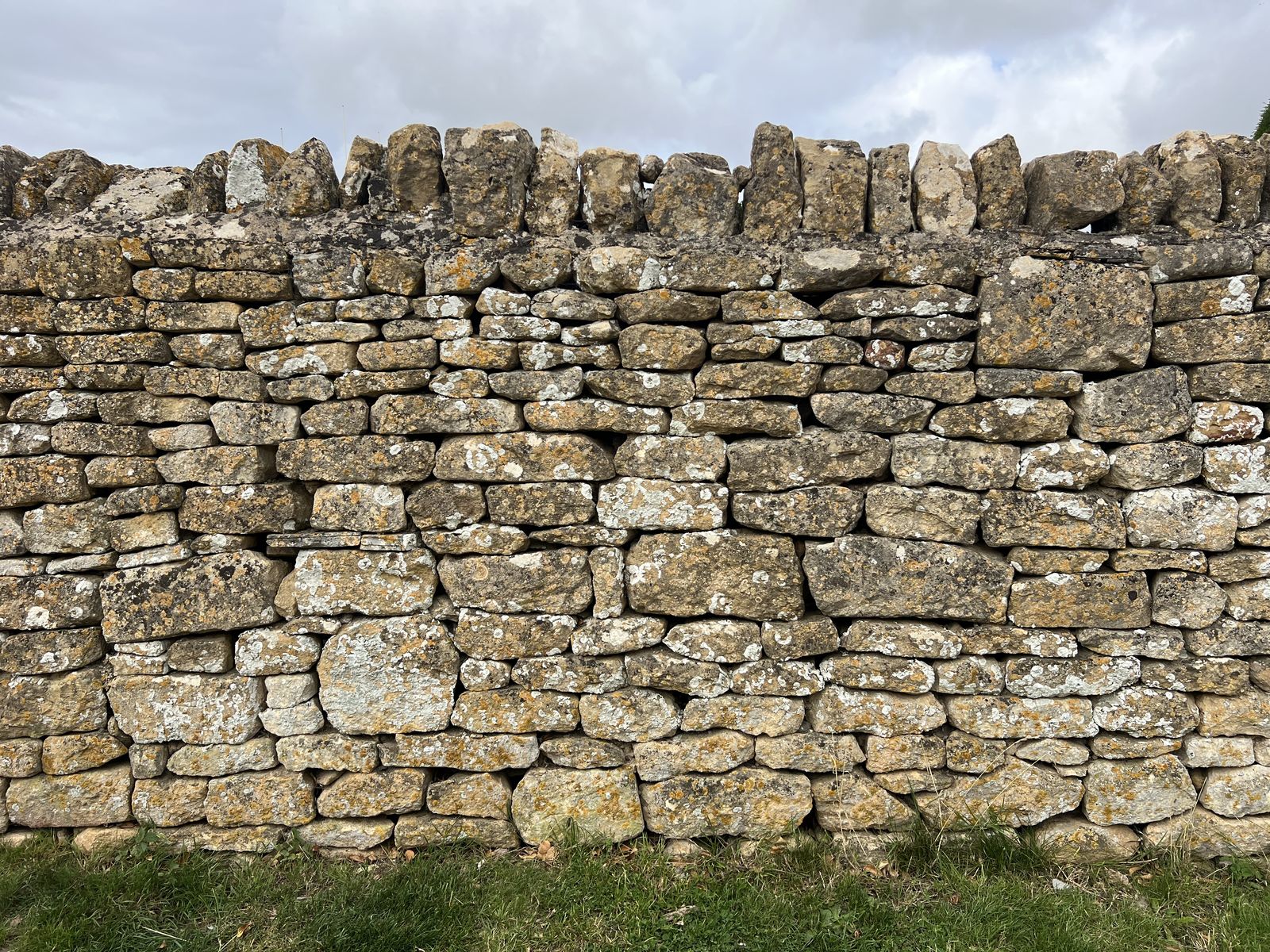
I'm a sucker for stone walls
I'm a sucker for good quotes, so here's two more:
Reflections on empire, regarding his uncles:
"They were the horsemen and brawlers of another age, and their lives spoke its long farewell. Spoke, too, of campaigns on desert marches, of Kruger's cannon, and Flanders mud; of a world that still moved at the same pace as Caesar's, and of that Empire greater than his -- through which they had fought, sharp-eyed and anonymous, and seen the first outposts crumble..."
My favorite lines, once shouted only a few towns over from where I was, some 100 years ago:
"What is the smallest room in the world?' [the vicar] asked.
'A mushroom!' we bawled, without hesitation.
'And the largest, may I ask?'
'ROOM FOR IMPROVEMENT!"