If I take one more step, I’ll be the farthest away from home I’ve ever been
Four years after writing my initial fellowship proposal, I've arrived in Mexico.
I'm in Mexico for the next four months to learn about how both globalization and climate change are affecting Mexican culture and society through the lens of food and fermentation. Why Mexico, and why fermentation?
Pre-Columbian Mexican history is composed of thousands of years of complex societies and diverse cultures, much of which is flattened outside of Mexico to the image of the blood-thirsty, barbarous Aztecs. Following the arrival of the Spanish, there was three hundred years of colonialism and cultural erasure, a war of independence, two republics, and a civil war, before the current state of stability beginning in the 1920. The Mexico of today is composed of a diverse mix of indigenous cultures persisting in the rural countryside, modern and cosmopolitan urbanites in Mexico City, everything in between. What interested me about Mexico was the unique persistence of many pre-columbian food traditions through centuries of turmoil.
In my time here, I hope to learn about how Mexican traditions have been preserved through food, and how contemporary Mexicans have responded to globalization and climate change: what culturally significant foods are being commodified, who benefits when they are, how is The New accepted, how is The Past honored, and how does one juggle the adaptation, preservation, and transmission of one's culture.
Food cultures around the world are being homogenized, and local knowledge of traditional food practices, such as preservation and fermentation, are being lost in the wake. Nearly every culture has a history of utilizing fermentation, being one of the earliest forms of food processing. During my Chandler year, I'll explore the ways that globalization and climate change has influenced community-scale fermentation. Or... how cultures are preserving their cultures. (*cue laugh track*)
I wrote a lofty proposal on this which I'll share another time, but in short:
How are we affected by the things we make, how do we in turn affect them, and how far out do those ripples reach? In food this is called *terroir *--- the dual relationship or double entanglement of place on food, and food on place --- and with fermentation it occurs on a macroscopic (human-interaction) and microscopic (bacterial-interaction) level. Everything we eat, drink, and make falls into a nexus of every way those foods, and the materials which compose it, have been used in the past. When we think about what we eat and drink, we get to taste this baggage. At its grandest, to make wine or to eat chocolate offers us the opportunity to question and negotiate the contradictions of modern life: tradition versus innovation, consumer versus creator, global versus local, passive versus active, slow versus fast.
But life is rarely at its grandest, and I'm hoping by sharing my daily trials, tribulations, and musings from this year I'll be able to look back and be able to see some of these themes playing out. In On the Plain of Snakes, Paul Theroux relates the Zapotec practice of weaving to his process of writing,
"the weavers sitting, thrusting the shuttles at right angles through the tight threads, pulling the beams down, working the treadles, and in all that effort --- lengthening the cloth by one thread. ... It seems a fit image for what I am doing now, fussing with my fingers and hesitating, then tightening the line and starting again, minutes passing, this memory of weaving enlarged by one sentence."
I'm on TikTok now, and if you've talked to me in the last few months I've probably already told you this. In a real duality-of-man moment, and in honor of exploring the ideas of fast and slow, this blog is my response to the app I love and hate, allowing me to weave my memories at a different pace, one sentence at a time.
So, here's what I've been up to.
My last weeks, maybe months, in San Francisco were a blur of work, planning, packing, and tying up loose ends: at my job, in my apartment, with friends, with relationships.
Once I realized I was going to leave, I tried to call everyone I knew who had lived or currently lives in Mexico: my friend's brother, my brother's friend's mom, my other friend's brother, my high school teacher's friend. I got book recommendations, suggestions for courses, was told how many days to ask for on your passport (180), the optimal amount of cash to walk around with at any time (500 pesos), what states to avoid at all costs (the north), how long a bus needs to be before it turns from a cheap option to a risky option (any time it gets dark or goes north...), and what tacos to try (all of them). In the end there's only so much you can learn from calling before you reach that wall of 'you've just got to do it'.
The original plan (day dream) I developed back in January when I realized my job wouldn't exist in a few weeks was:
1. Fly to San Diego
2. Buy a used truck in Tijuana
3. Drive down the coast
4. Learn to surf and refresh my Spanish
5. Make my way to Oaxaca and 'start' my fellowship
After the advice of all the calls, I only did the last two. Turns out I can't buy a car without residency, and turns out I shouldn't drive in Tijuana (or any of the surrounding states), and also turns out pickups are stolen most frequently because they're used for cartel activities... A boy can dream. In any case, good to know beforehand.
But now I'm in Puerto Escondido, like most of my fellow tourists, for vacation. My plan was to take my first week to brush up on my Spanish and my second week to plan what I'd do in Oaxaca (and beyond?). Swing and a miss. After one week of Spanish classes it was abundantly clear that I needed much more practice and that not using the language for six years set me back a bit... After my second week of classes, despite improving, I still had the skills of a first grader (generous). Classes, plus surfing, plus the sun, meant that no planning got done. "The woes of a student athlete" a friend relayed to me.
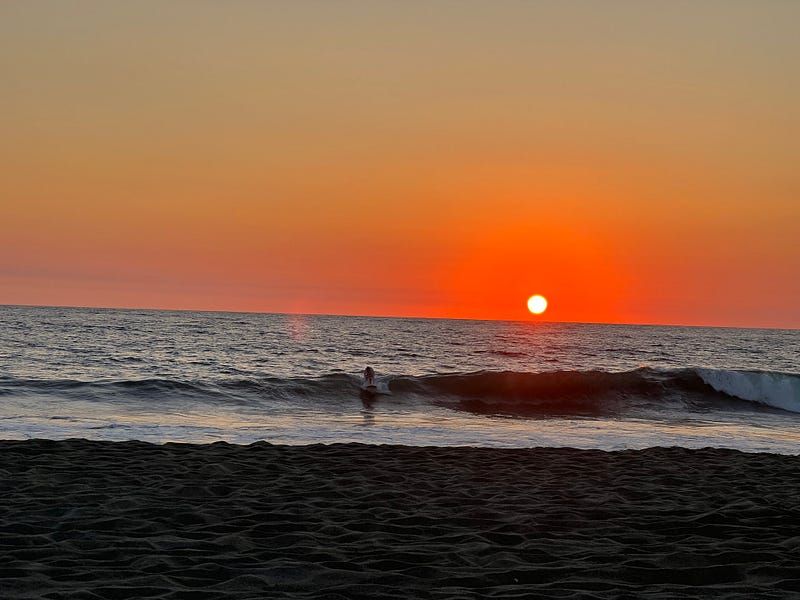
Someone much better at surfing than I was, Puerto Escondido
When I left the US, I didn't have any cash in peso. Partly because I forgot, and partly because I assumed I could just convert it at the airport. The airport I landed in had one convenience store, four lines for rental cars, and that was it. I paid for my taxi in USDs with an exchange rate that still hurts to think about.
I checked into my room and was determined to get cash as my first big task in Mexico. I set off to the nearest ATM at the supermarket, a 20 minute walk away. It was 85 degrees and there was not an inch of shade. I was dehydrated, I was travel-lagged, it was all a blur. I get to the ATM and quickly learn I can't use my credit card. The cashless utopia of San Francisco had not prepared me for this. I go grocery shopping to distract myself from the fact that I'm going to need to repeat this death march a second time later today. On my way home it's still 85 degrees, my shoes have given my blisters, and I've become consigned to my new role of shriveled road-side raisin, to forever bake under the glare of the Oaxacan sun.
The second attempt went so well I don't ever remember it happening. I ended the day by writing, "very tired, very sweaty, very hungry."
On day two, Spanish and surf classes began. Aris, my Spanish teacher, was a nice man of maybe 50 who only spoke Spanish. Not sure what I was expecting, because they were Spanish classes after all, but it was a bit of trial by fire. The surfing classes took a very similar trial-by-water approach, where the only instructions you received were, "stand up!". I fought the waves and, more often than not, the waves won. After drinking gallons of sea water, as we were getting out of the water, my instructor said, "this was the worst day all year." This added some color to his earlier comment, "listos para la guerra?" Ready for the war? Every day to follow was much calmer, but it was a rude awakening to a very friendly place.
In between classes I spent time at the beach tanning, the canonical act of vacationing. To tan is to devote time to cooking oneself ever so slightly. If that doesn't define leisure, I don't know what does. I ate, maybe I prayed, and I longed for love --- everyone in this beach town is required to be beautiful or else you must get kicked out or something. Or maybe it's all the tanning. Either way, I was just glad I had made the cut.
In both of my classes my instructors got onto the topic of inflation and changes in Puerto Escondido over the last few decades and during Covid. Twenty years ago this town didn't have a single traffic light, and now techies work for Microsoft from the coffee shops down the street. Rents rise, families move, space is made for remote workings and myself. This is apparent in the plentiful vacant lots in the town, each with a sign stating if it was or wasn't for sale, and the innumerable half-built hotels and hostels already accepting guests. Concrete was being poured everywhere you looked, and you get the feeling that these new neighborhoods were planted yesterday, sprouting from the now overgrown casitas of former residents. Not new or novel, but a visual reminder of the parasitic side of tourism and remote work, playing out across the entire Mexican coast.
The next few days were more of the same, tired days in paradise. My journal from this time is a collection of vignettes, both high and low, with differing levels of clarity:
"At a very small pulpo hut. One thing of mezcal, one of Corona, very spicy salsa, empty brain, sweating body"
"Baking in the heat, I annotated the newspaper, practicing my pronunciation and reading out loud --- feeling the syllables, swishing them around in my mouth, teaching my tired tongue, and sounding out real sentences. All while sweating through the pages. Read, sunscreen, swim, read, sunscreen, swim."
"Just tried my first Mexican Gatorade!" (In reference to a suero: lime, salt, seltzer)
"Then comes Sunday morning, with the peculiar looseness of its sunshine" --- D.H. Lawrence, Mornings in Mexico
"Powerful thoughts from today: I've never felt good walking away from a rotisserie chicken. I wonder if anyone has?"
"Learning to move a little slower to survive the heat... In the setting sun, practicingly slow, I strolled down cobbles streets following the dusk."
"Tried Chilaquiles. They were like nachos swimming in a pool without cheese. I can live without them."
"Ordered a coffee drink I didn't understand while bungling my Spanish. Above the toilet there was a sign of a poop emoji with a big X through it. In a coffee shop of all places. Feels symbolic?"
"I've been on a cleanse since 4pm. I either need poké or ayahuasca. --- women in the hostle kitchen at 8pm"
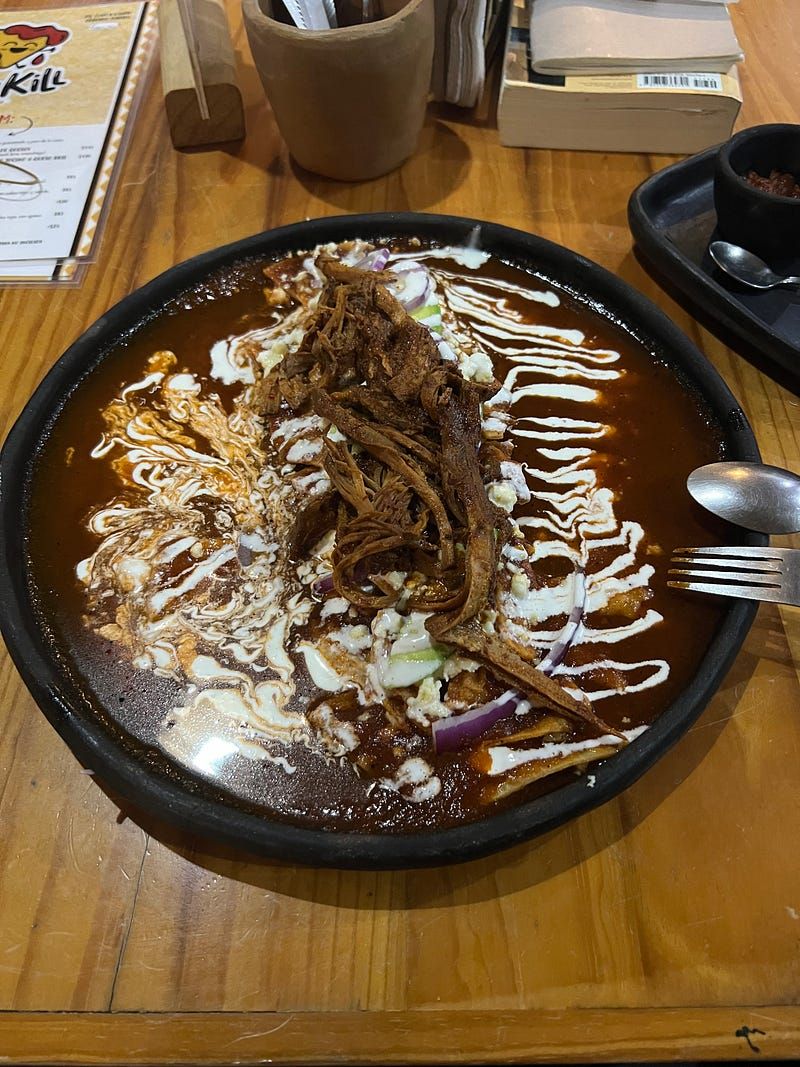
Chilaquiles in action
I had a lot more thoughts on buying drinks at restaurants, Europeans, Yoga teachers from Mazunte, Cashew trees, markets, and foods I've tried, but if these topics are important, maybe they'll come up again. Since this is a food blog at its core, I'll end with a recap of a conversation I had with my first Spanish teacher, Aris.
We begin every class with a discussion of what you did yesterday and how you're feeling today. I am always feeling bien because at 9am I can only think of the word bien. I think Aris sees through my charade but he is kind. On one morning, Aris is not feeling bien because he didn't sleep well, too much noise outside while he was trying to sleep. This is a recap of our conversation, but keep in mind it all happened in Spanish at the conversation level of a first grader.
M: "Was it your neighbors or traffic that kept you up"
A: "No, it was the rabbits"
M: "Animals in your garden?"
A: "Yes, the rabbits were eating all night"
M: "You have a pet rabbit?"
A: "I have 43 rabbits."
M: "Why do you have 43 rabbits?"
A: "For food."
M: "Is this common? Do your neighbors care?"
A: "It's traditional in some places, but not really. My neighbors weren't happy at first but then I gave them rabbit."
M: "How did you start?"
A: "My daughter wanted a pet rabbit, so we got her one. Soon we had two, and soon they had babies, and then the babies had babies. We would feed them our scraps. Eventually, Instead of throwing away produce, the grocery store would give it to me, to give to my rabbits. We had so many we decided to start eating them, now every weekend we have rabbit tamales. At one point we had 81 rabbits. We had to start killing the males because they are aggressive and will bite. We couldn't go into our back yard without being swarmed. We've kept the first rabbit, but now my daughter hates them. Have you tried rabbit?"
M: "Not yet."
A: "They sell them in the market, along with iguana and tortoise."
M: "Is that legal?"
A: "No, but they do it"
M: "Interesting"
A: "So how did you sleep last night?"
M: "Bien."
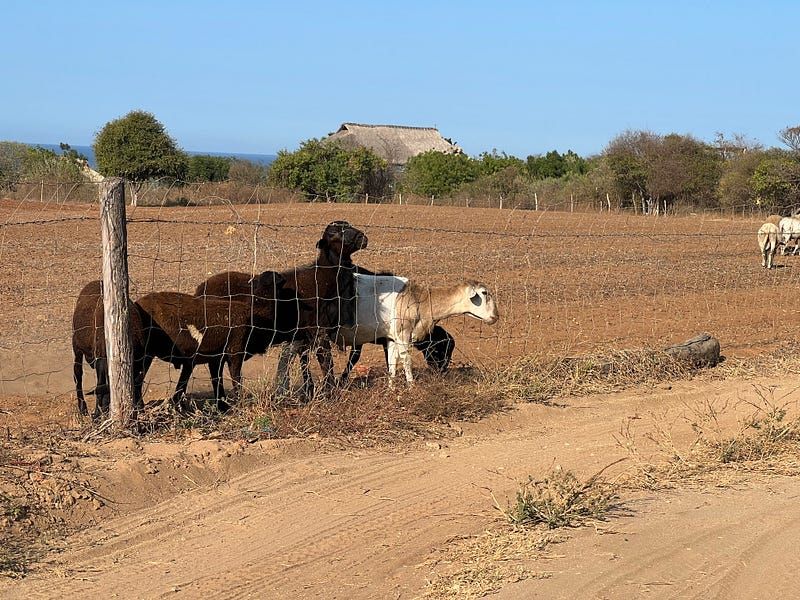
"The Eternal Mexico" --- Paul Theroux, probably
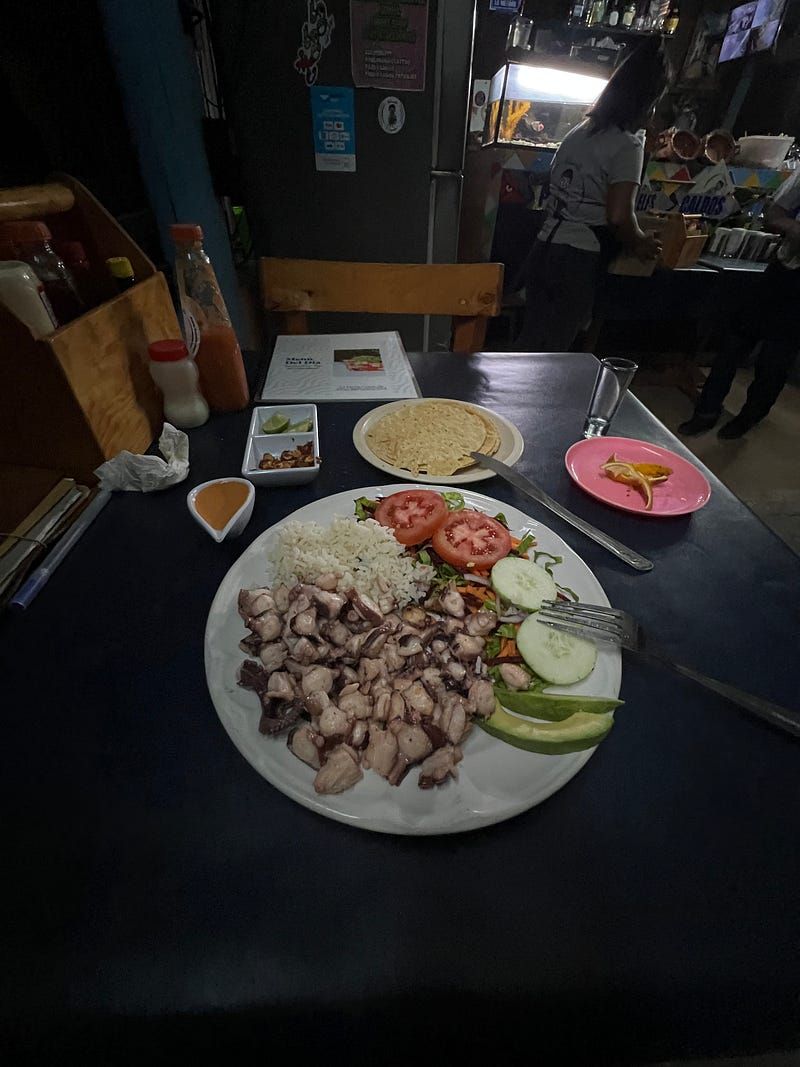
Octopus in the octopus hut --- not pictured is me drenched in sweat
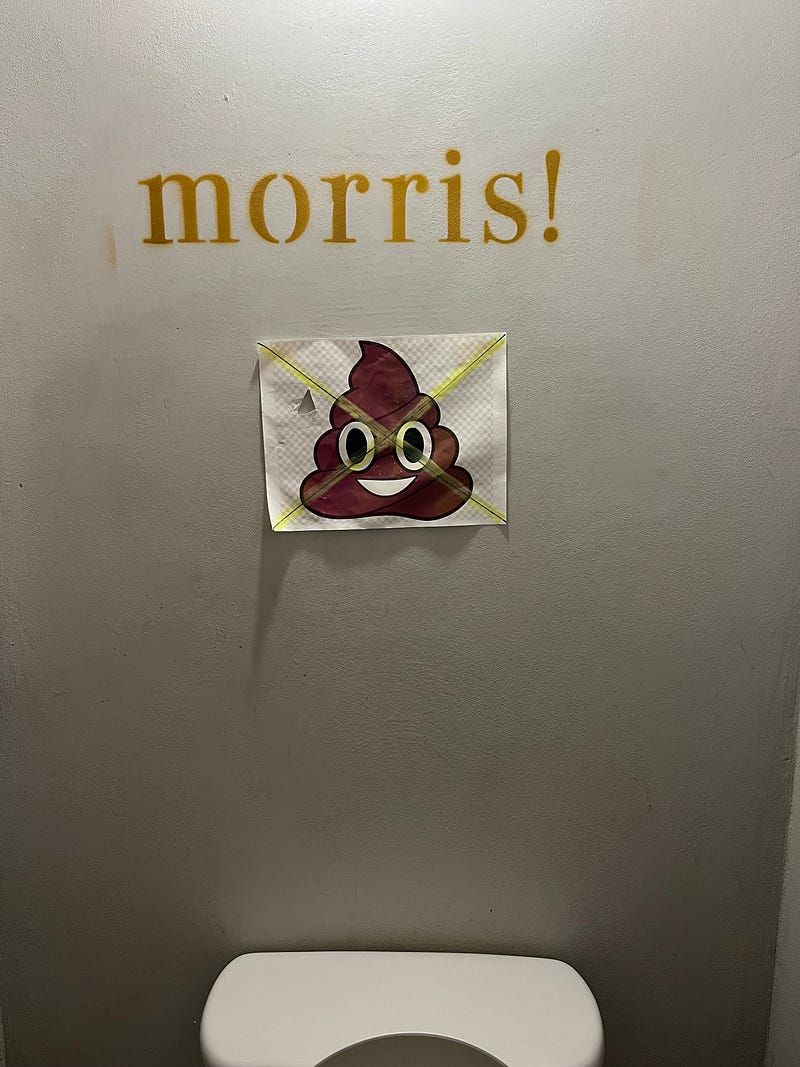
Morris, the coffee shop with cruel rules