Bread, Pastries, and Sweet Treats (Belgium pt 3)
This post marks the halfway point in my fellowship! I'm writing it a week before my year ends, but I was too busy fellowshipping and fermenting to keep up. Now that I'm done, I'm hoping I'll be able to catch up once and for all.
This post covers all the small little details of what I helped make, in Belgium, in late August, into early September. As a recap, I was working with a baker (Pierre) in southern Belgium (Theux).
To hear how I got there: Part 1
To hear what I did while there: Part 2
To hear how my thoughts on yeast and croissants (important!), read on:

Busy Bakery with new breads on shelves
All the small pleasures I could have had on Earth
My return from Venice included a 6am morning train from Brussels, which got me to the bakery around 8am. Terribly late in bread-making terms. I arrived in time for the mixing of flours and shaping of doughs, so all was forgiven. I somnambulantly shaped macaroons, squishing eggy coconut shavings into a scooper as the day melted away. The French name for macaroons is rochers coco, or coconut rocks, which means, as a geology major, I was particularly well suited for the job.
I can't say that Pierre made that connection, because I don't think he thought of me as someone who knew anything about rocks. Although I haven't asked, I think he thought of me as a mysterious little gnome who popped out of nowhere and performs bakery labors and small dances if fed enough snacks. I have met a lot of people this year, in a lot of different places, doing a lot of different things. Each time I'm afforded the opportunity to reinvent myself; they know nothing about me, my past, my personality, my predispositions, and so I get to remake all these things. To Demetrio, I was Marcelo the tech guru, to Welsh Mountain Cider I was the boy obsessed with Indian pickles and apple chutney, to Hollow Ash I was the quiet man with an affinity for shoveling hay. To the people I went to college with, or met in San Francisco, I'm none of these things. To myself, I'm just a confused man seeking warmth and the simple pleasures of the world.

The number of self-help books, motivation quotes, and philosophical aphorisms answering the question of "What defines oneself" leads one to believe we're still working on a universal theory. You are what you do, you are what you eat, you are what you love, you are what you think, you choose. In some ways it's a liberating feeling to recreate myself in each new place I go, leaving behind the parts of myself I don't like. In some new places I'm loud and bold and brave, not quiet and reserved, in other places I'm eloquent and worldly, not mumbling and worrying. What parts are the real me? I'm not sure, and the answer doesn't interest me much in this moment, less that they were all, at one point, me. In the same way there were moments this year where I got to galavant around Venice, drink with mezcaleros in Mexican deserts, and traipse around Belgian castles in pauper garb, there were also the innumerable more mundane moments, all of which were at one point me as well.
In between moments of pushing pistachios into the top of almond butter cookies, three small green nuts apiece, I thought of the start of this poem by Hanif Abdurraqib:
Text within this block will maintain its original spacing when published
“If Life Is As Short As Our Ancestors Insist It Is, Why Isn't Everything I Want Already At My FeetText within this block will maintain its original spacing when published
if I make it to heaven, I will ask for all of the small pleasures
I could have had on earth. And I'm sure this will upset
the divine order…”
[continues here]
Maybe we're defined by the things we wish for? Just in case that's true, I will describe all the small, mundane pleasures I took part in at the bakery, from powdering cookies to cutting croissants. Those that defined my experience in Belgium, which may define me as well, and which I will one day wish for more of.
On sweating while doing the small stuff:
Packaging:
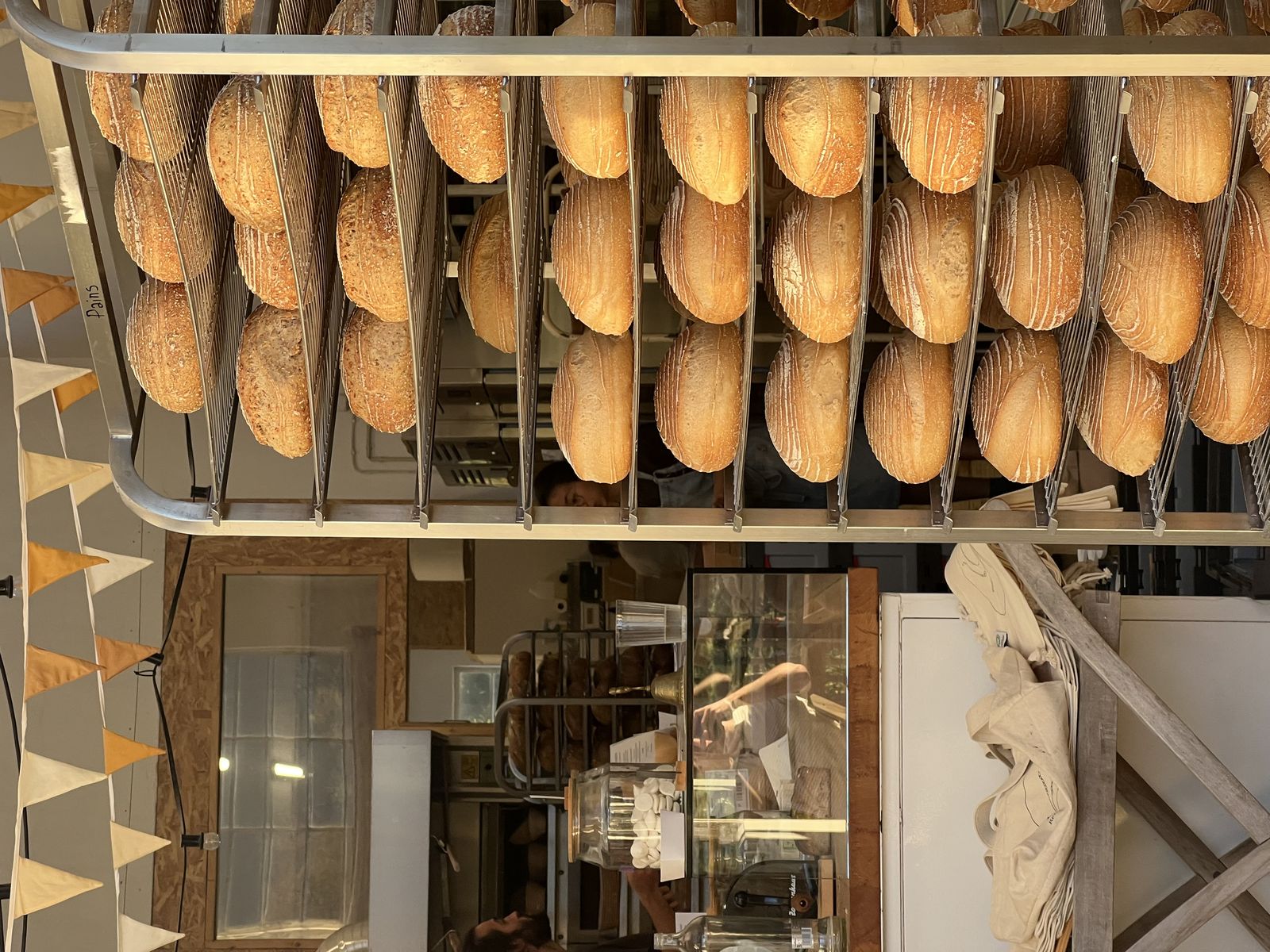
One of my favorite weekly activities was the bagging of bread and packaging of pastries.Each type of bread - Sarrasin, millet, graines, avoine, spécial, nordique, sarrasin pronouncé - has its own number which gets rubber stamped onto blank bags. Each Wednesday and Thursday after the bread had cooled, they'd be placed into their stamped bags. Some days, when the morning fatigue had caught up to me, I'd find myself passing my hand over the rough skins of the breads, gauging their warmth and proximity to bagging.
I'm not sure the exact source of my affinity for bagging but I'll cite, first, the thrill of holding every loaf. I got to admire the conflicting uniformity and uniqueness of each boule: Their satisfying weight and airiness, their smoothly-rough golden crust, their flaking flour, their hint of residual warmth. It was also a moment to enjoy the final moments of their fresh baked aromas, their toasted nuttiness and yeasty tang soon to be lost from this world ["Haven't you goaded yourself, to balance just a bit longer, chew on some fugitive scents, forget what a ditch the earth is." - Self as Goat in Tree].
The second point of enjoyment came from the feeling of completing the bread-loop. At one moment I may have measured out the flours for this loaf, or brought to life the sourdough starter, and now I get to tuck it into a paper bed, curling and crimping the edges the way you would a sheet under a cozy body. This must have been how Dr. Frankenstein felt, despite the horrors.
"How can I describe my emotions at this catastrophe, or how delineate the wretch whom with such infinite pains and care I had endeavoured to form? His limbs were in proportion, and I had selected his features as beautiful. Beautiful! Great God!" - Frankenstein the hypocrite
Packaging orders, Pierre and I would stand on opposite sides of an antique wooden table. Behind him on a shelf were books about gluten free baking in three different languages: The Sourdough School, Gluten Free Artisan Bread in Five Minutes a Day, Food for a Happy Gut, Cannelle et Vanille, Alternative Baker, Promise and Fulfillment, Helt Uden Gluten. Behind me, cooling racks, lots of them. He would read off from his list what each customer needed, and I, his retriever, would grab from the cooling racks the newly packaged breads and various pastries.
Pies would be glued with a sugar paste to fancy square boxes for shipping. Holding the pies above my head I was Michelangelo painting the sistine ceiling, sugar-glue falling down upon my face; a small cost in the creation of timeless beauty. Perfectly rectangular slices of pistachio-raspberry and mango-cream cakes, in neat rows like soldiers at attention, would wait in the freezer to be called to duty: eaten or packaged. If it were up to me I would have done the former, but Pierre urged me to retrieve them and so with frozen fingers I'd lead them two by two into the arc (another pristine, saintly-white box) and towards higher purpose. Waffles would be wrapped in wax paper like presents for Christmas, their chocolate-dipped regalia leaving gifts on my fingertips (an unsanitary snack, but a snack nonetheless).
Boxes would be labeled and addressed for longer shipping by courier to Charleroi and Brussels, while crates were filled for delivery by Pierre or Judith to Liege. I got the opportunity to join Pierre on a delivery one day and was provisioned with a croissant to aid me in my duty. It was not enough to keep up with Pierre, whose gazelle legs set a stride that was graceful, determined, and impossible to match without breaking into a job. Breads were delivered to health food stores, cafes, Italian grocers, and, surprisingly, other bakeries. I was not re-invited to another delivery, despite a charming but potentially redundant first performance.
**Decorating: **
I've already written at length about my experience making waffles, but there were many of these small pleasures I'll remember in the land beyond as the silent signposts of meaning in the universe.
One being Alix showing me how to finish eclairs: she demonstrates by cutting a pâte à choux in half lengthwise, scooping out their doughy innards, piping in custard creme, and finally performing a perfect chocolate squiggle on top: elegant, uniform, symmetrical, effortlessly causal. My eclairs break in half along mathematically improbable and potentially undiscovered axes, their doughy innards becoming my snacks, my hands becoming ever more covered in escaped custard. My meandering chocolate doodles were reminiscent of other brown squiggles, but Alix smiled at me all the same and said good job, figuratively patting me on the head the way you would a dog who just clumsily walked on two legs.
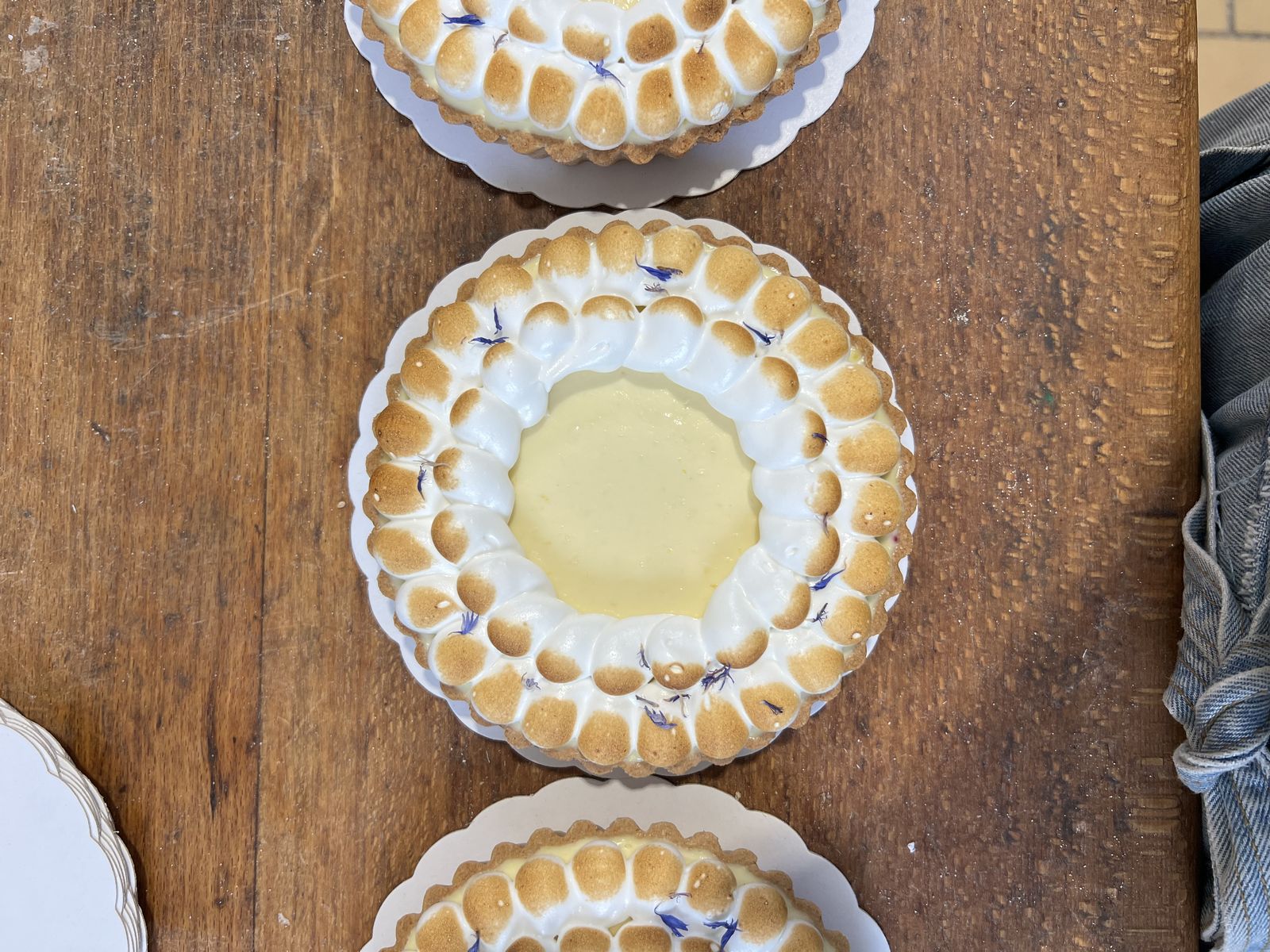
Another day she walks me through the art of pie filling. The process begins by painting pre-baked personal-pie crusts with melted coconut oil and placing them in the fridge. When cooled, I pipe in a layer of cream spirals, and immediately bury my artwork beneath a scoop of chunky blueberry jam. Other pie crusts get lemon-custard, scraped perfectly level like trowled plaster, to be adorned with onion-domed meringue. With a blowtorch Alix toast the tops. Together the composition looks like a self contained abstract artwork: like eastern citadels built atop a smooth sea of blonde custard. Tan on tan. Nothing can look as perfect. Joy can be purchased, and it looks like a personal lemon merengue pie. I am for an art that is brûléed with a pointy top. I am for an art that can be eaten with one hand.
Tao also does lots of hard work, but she's afraid of my English, and I'm afraid of the way she smacks dough, so we have a silent peace treaty.
Pierre tries to make baklava with dough they use to make wraps. Layer by layer he spreads sugar, ghee, pistachio, and walnut, crosshatched into faultless facsimile. Once baked golden, it's slathered in warm honey - perfect in all ways except for taste, the dough being incredibly chewy and slightly savory. Pierre is a great baker but I did not see him make any other pastries.
Baking:
More and more bread is baked, as it always is, and has always been, forever. Early in the morning, after a day of proofing, Pierre knocks six bannetons of dough onto the spatula end of a 3 meter bread-staff. He deftly shimmies them into orderly rows in the deep ovens, where they patiently sit, steaming and browning, until the alarm goes off to perform the same practice in reverse. The bread is then set aside to cool shoulder to shoulder with its brethren (at times conjoined), rolled off on racks to the front door to enjoy the pastoral scenery. All the loaves were risen to crusty perfection by bowls of well-bred bread-bacteria which lays subdued in the fridge, to be called upon next week to repeat their task, as it has always been.
Sourdough cultures are much like Peter Jackson's interpretation of the Army of the Dead in The Lord of the Rings, and Pierre is much like Aragorn, son of Arathorn, heir of Isildur. Every week he calls upon the army of yeast from their dark cave (the fridge) to fulfill their oath, made many moons ago, at which point they swarm over the new flour they've been provided. Once successfully colonized, digested, and fermented, Pierre, son of Jean-Marie, heir of Liège, speaks: "I hold your oath fulfilled. Go, be at peace." Their earthly bonds are released at 140°F, about 15 minutes in baking, at which point they join the big SCOBY in the sky. Little do they know some of their comrades have been kept behind to do Pierre's benevolent bidding the same time next week.
At one point I was tasked with dusting brownie-cookies with crushed hazelnut. The trays are stacked fifteen high on a cooling rack, I have an entire counter to myself and an effectively endless supply of mechanically pulverized hazelnut - everything in its place and space enough to sprawl. Contrast this to crushing hazelnuts in a plastic bag at home, on a too-small counter, with trays stacked atop books and trinkets, among blenders and napkin holders. Granola is made in a bathtub sized stand mixer, gallons at a time, the economies of scale dwarfing my now fruitless-seeming, single-pan home efforts: simultaneously burnt and undercooked, with cayenne confused for cinnamon, using every single bowl and measuring cup I own (and impossibly, even some I don't). The biggest lesson I learned from the bakery is don't bake at home. The most irrefutable proof of this can be found in the delicate layers and fickle disposition of croissants.
Pastrying:
Every day at the bakery I would gain a new responsibility. If I didn't spend every waking moment of my day by Pierre's side, I would have thought he planned it like this. In my last week I was called up to the big leagues: to roll viennoiseries. The canonical image of what baking as a classical art is (to the French, and therefore the world). Kilograms of chilled ghee were placed between layers of yeasted dough and then run under a laminator: a pastry treadmill with an overhead compactor, like a road-roller for preparing sweet treats. A giant lever changes the direction of the treadmill and a smaller, equally intense lever changes the roller height. It makes you feel like a 19th century factory worker, or what I imagine it felt like, minus all the horrors. The dough is folded and rolled and folded and rolled until you reach the magic number of layers, which I don't have legal clearance to share (I forget).
The now-laminated dough slab is transferred to a pre-chilled countertop and, working against the warmth of the kitchen, you measure, mark, cut, and roll the dough before moving them back to the freezer.
Pains au chocolate get rectangular cuts, of dimensions I forget, and croissants get pendant cuts, of dimensions I, once again, forget. Pains au chocolate receive two parallel chocolate sticks and then get rolled together. They reminded me of pigs in a blanket, or two logs of chocolate cozily rolled up for a long nights rest against a cold winter.
Croissants get rolled in much the same way, minus the chocolate and plus a gentle tug at their ears for reasons I unknown. Transferred to chilled and parchmented baking tray in alternating rows they give the appearance of freshly cast classical molding. Any architect would bow before the unquestionable, Ionic beauty of 40 croissants cuddled together on a frozen baking tray, as if ripped from the columns of the Temple of Athena. Perfection spawned from imperfect hands. Dramatic, you say? See picture for proof.
There's no truer ascension of Maslow's heirarchy of needs than a croissant: it's bread that got a perm, a pastry in a silk smoking jacket, raw dough that studied at the Sorbonne and came back with a French accent and a taste for the finer things in life. It's food elevated to art elevated to one's mouth. To steal from Claus Odenburg again, it's "an art that embroils itself with the everyday crap & still comes out on top." Butter, sugar, flour, yeast, vanilla, elegantly packaged. Part of this otherworldly status I allot them comes from the fact that I can still count how many croissants I've eaten in my adult life. As such, they're shaded by the same golden light as the forbidden fruit. I was honored to make them, marking an unplanned but complete traverse across the spectrum of baking, from rustic loafs to mythic pâtisserie.
As it is, I'm not crazy about the taste, but I appreciate its simple decadence and the way they can constitute a full and complete breakfast on this continent.
I googled the history of the croissant because I assumed it was created by God on the 8th day after they finished the rest of their to-do list, but it turns out it was first made by (Sylvain Claudius) Goy in 1915. In 1839, Austrian August Zang brought to France the kipferl, a crescent shaped rolled yeasted dough. Some 75 years later, Sylvain Claudius Goy published a version with butter layered into the dough (lamination!), and we've have the croissant ever since. So yes, it was a country bumpkin that went to france and got pampered.
End
I thought I'd be able to end it all here, but looks like there will be one more (short!) Belgium post, about beer and moms. I'm trying to make these more digestible, and part of that is cutting them off before they run on too long.
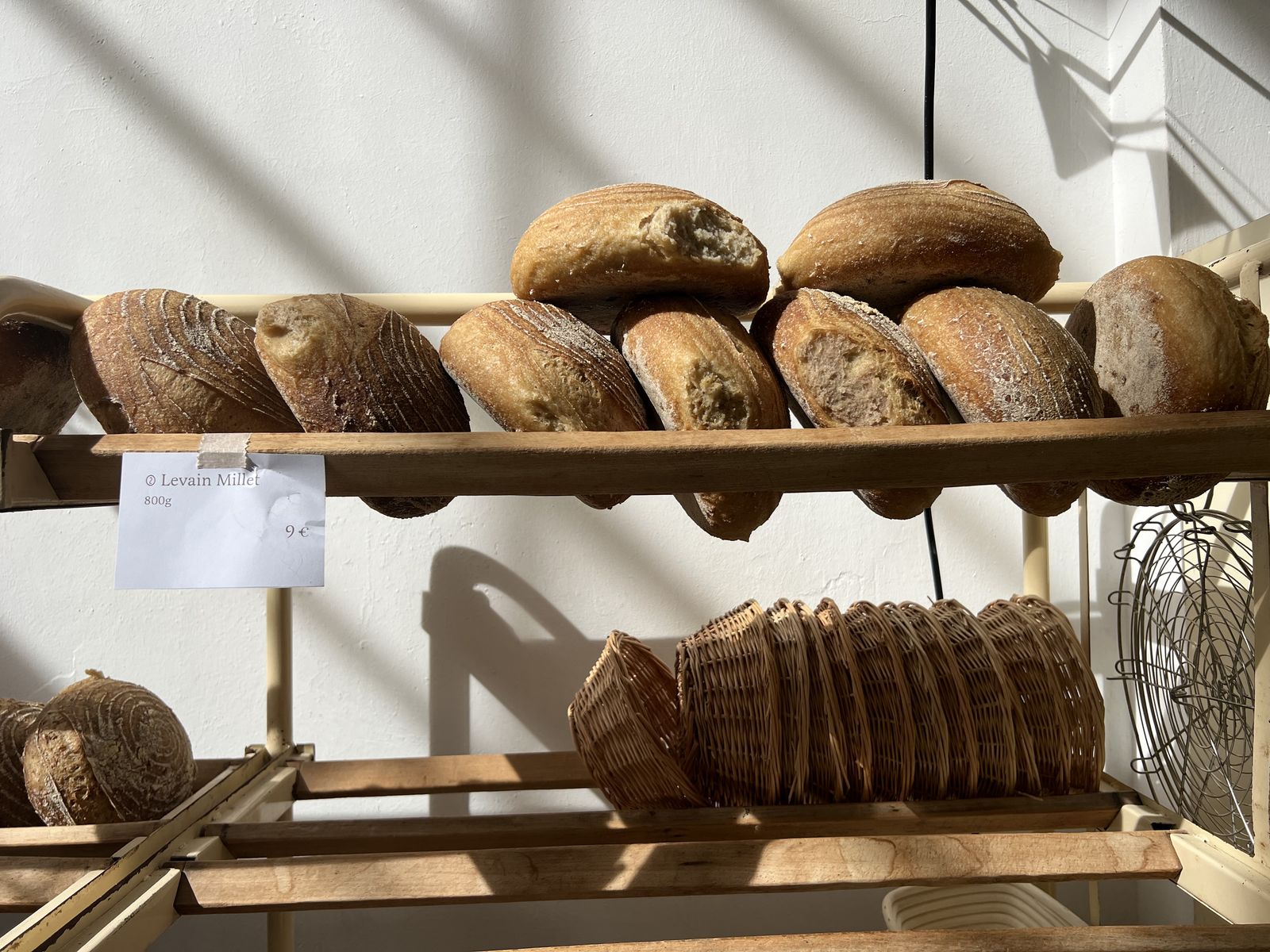
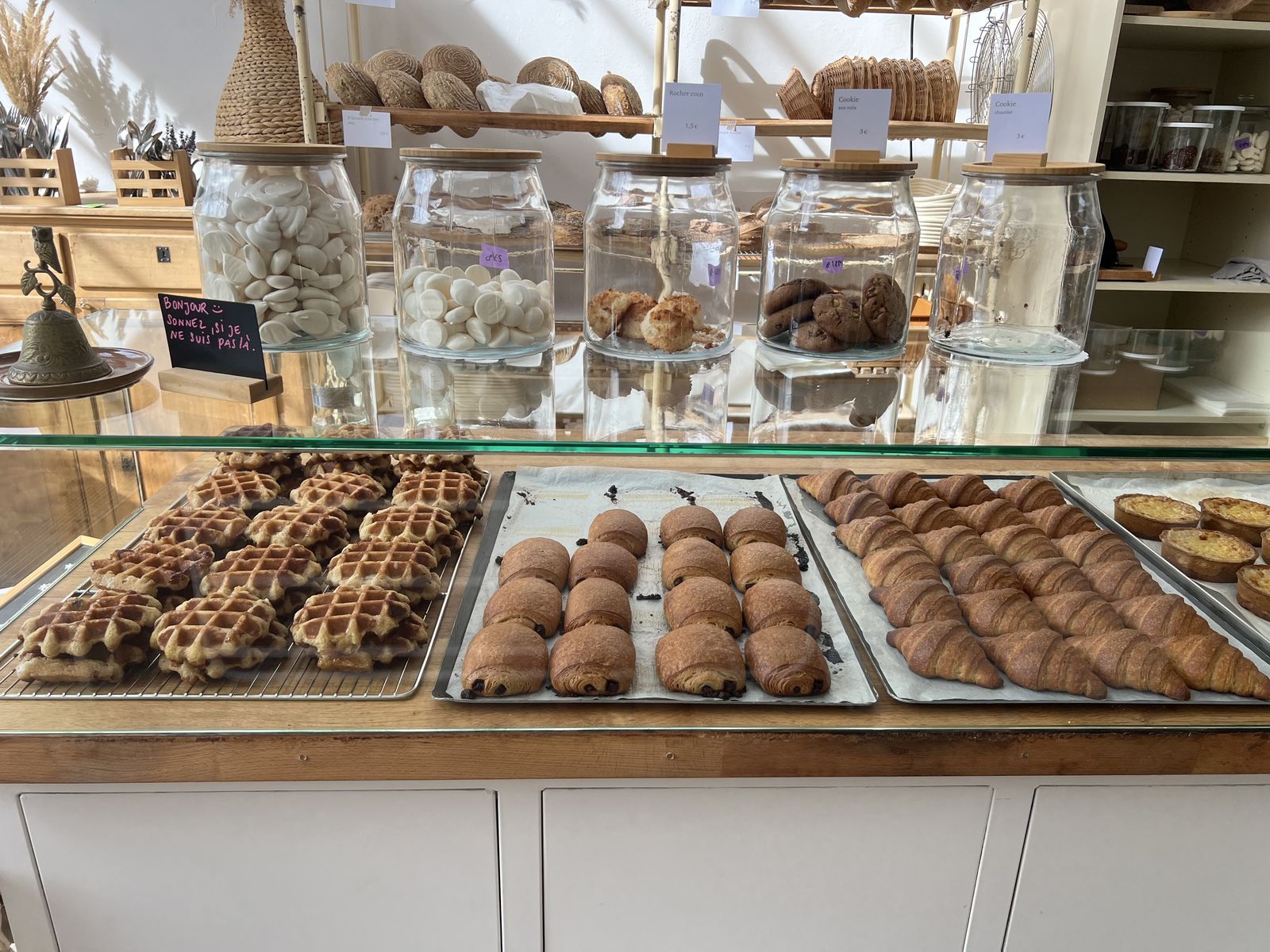
Surely this is the best of all possible worlds
To see a World in a Grain of Sand / And a Heaven in a Wild Flower / Hold Infinity in the palm of your hand / And Eternity in an hour - William Blake, also the epigraph in my high school physics textbook