Baking Bread in Belgium
Western cuisine is largely centered around the consumption of bread in its various forms. My diet, as a celiac, is largely centered around the avoidance of bread. From breakfast to dinner, from appetizer to dessert, every meal of the day is dominated by bread's hegemony. Pastries, cereals, and bagels in the morning, sandwiches and wraps for lunch, bread and pastas for dinner. No meal is safe from bread's doughy tentacles.
Except in Pierre's kingdom.
On finding the bakery
Breadmaking was not originally on my plan of things to do. Simply put, it didn't fit under my proposal's themes of globalization and climate change. Its existence is not threatened in a warming planet, its popularity has not dipped since we decided to stop hunting and gathering, and despite the rise of cheap wonderbreads, artisan bread can still be bought with relative ease. These statements, are riddled with caveats and half truths, but that was my thinking.
Despite all this, someone during the interview process framed this fellowship as: "if you had a year left to live, what would you do?" I had yet to see that on any official documentation, and haven't seen it since, but I took it as gospel all the same. In that framing, if I had a year left to live, I'd like to eat some good bread and learn to make it too.
Put more nobly, I wanted to see what I could learn by living fully within the elaboration of the oldest human-made food. How does the staff of life, the ancient, edible building block of civilization, retain a status of cultural importance in the modern day: what does it contribute to people's day to day lives, how has the technical process of baking accepted or rejected modernization, how does bread fit into, compliment, or subvert modernity, how does a global food express itself differently across cultures, what does it mean to 'break bread' in an increasingly secular individualistic world. I say all these things to justify my wanting to eat a croissant.
In pursuit of this very, very noble purpose I began my research of gluten-free bakeries in the deep archives of the modern Library of Alexandria: Instagram. I was looking for two things in particular: the bakery was 100% gluten free, and the bakery produced loaves that looked like bread. The first rule was simple, I didn't want to second guess if I accidentally put something in my mouth. The second rule was two-fold: to avoid places that only produced pastries, and to avoid places whose loafs looked more like bricks than bread, two surprisingly common features in the gluten-free universe. Going back and counting my instagram DMs, this turned out to be an exclusive group of around 10 bakeries spread out across Europe.
A testament to the solidarity within the gluten free community, I got a number of responses welcoming me in as an apprentice. None were as intriguing, or as beautifully photographed, as Boulangerie L'Alternative. Their portraits of bread looked like all the loafs I've never eaten and always wanted to: rippling tattoos of flour, golden crusts scored with craggy slits, an open and airy structure. Three months later, I was driving my car onto a ferry crossing the English Channel, eyes set on Belgium in search of the aforementioned Pierre and his beautiful breads.
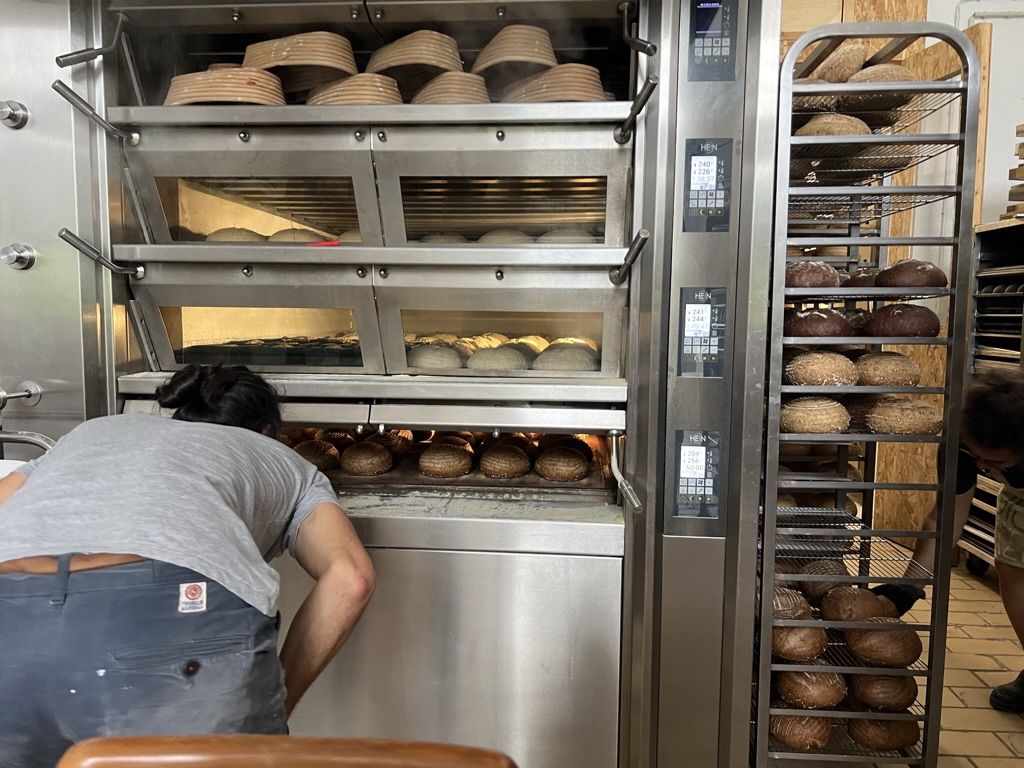
Pierre monitoring his breads
On finding excuses
Much like the open and airy structure of the bread, my planning for this section of the journey was also full of holes. I knew little to nothing about Belgium, how the work would go, what Pierre would be like, how I'd be sleeping, or how much French I'd need. This was all on me, and on paper I should have prepared more, but sometimes that's life.
During the interview process for this grant, I was asked about how my project would embody the quality of Stretch.
"Where's the stretch?"
"This is an opportunity to have your assumptions upended, and to stretch."
"Qualities for Composing a Successful Proposal: 1. Passion, 2. Vision..., 9. Stretch"
"Provided a project is realistic, applicants are encouraged to push the envelope. To stretch. Stretch will look different for everyone"
"Our selection process looks for a careful balance between a candidate's preparation (which makes the project feasible) and stretch (which makes the project challenging)."
I don't know why this adjective stuck with me and not something like "courage", but I like its confusing vagueness. former Secretary of State James Baker once said: "Proper preparation prevents poor performance." Makes sense. But wheres the stretttcchhh? That man sounds rigid as board (exactly how I like my secretaries of state).
This is how I retroactively justify to myself how little I prepared for Belgium. I wasn't unprepared, I was just embracing the strettcchhhh. At one point, I was asked by someone, "What do Americans think of Belgium?" To speak definitively for all Americans, we don't. I said something about chocolate and waffles, but that's because "we don't" is not a very nice answer, and I recognize that. I ask you, dear reader, what do you think of Belgium? I'm guessing that you're coming to the same conclusion that I am came to, in that it feels more like a name than a place.
Here's some quick facts so you can get up to speed if you're ever asked about it:
-
The country is split into three regions: Dutch speaking Flanders in the northern, French speaking Wallonia in the south, and French-Dutch-English speaking Brussels in the middle.
-
Brussels is the capital of the European Union and home to NATO and all the international organizations that aren't in Geneva
-
Despite being the center of European politics, the country holds the record for the longest time taken to form a government coalition (500 days!)
-
The country held colonial control over the Congo, where they did lots and lots of terrible things alongside growing cocoa, which helped bolster Belgium's chocolate reputation
-
Belgian beer culture is included on UNESCO's list of the intangible cultural heritage of humanity and is the only country to have contributed beer to the list. Other notable additions from Belgium include shrimp fishing on horseback and stilt jousting
-
This is a personal opinion, but chunky fries with homemade mayonnaise are the semi-official national dish.
Consider yourself now well educated in all things Belgian, book a flight to learn the rest. I was based in the southern end in a small town about 30 minutes south-east of Liege if you'd like to recreate my journey for yourself. Make sure to wipe any knowledge of the French language from your mind to get the full experience.
First Day at the Bakery
I arrived to Pierre's house and was greeted by two beautiful people who I learned were his mom and sister. I was led out to a table in a beautiful garden patio filled with more beautiful people (the rest of his family), fed a beautiful dinner, and peppered with questions, most of which I did not have good answers for. Pierre arrives out of thin air towards the end of dinner and so begins our beautiful courtship.
The bakers bake on Tuesday, Wednesday, and Thursday, which meant my first two days were free of labor. We went to the grocery store, went to the bakery, ate some leftover pastries, explored the gardens, and I was made acquaintance with the castle. On the night before our first working day Pierre tells me we are going to meet some of his friends for drinks in Liege. I tell Pierre that I'm *'*here for the ride', making me legally required to say yes to every opportunity offered, so we set off. I'm told as we're looking for parking that it might be a little difficult because it was Outremeuse, a folk festival and biggest night of the year in the city. According to the internet, there are parades with giant puppets of Liege's folk heroes as well as religious aspects where the Black Madonna is brought through the streets. The part I saw was the street party, where all of Liege comes out to the neighborhood of Outremeuse to drink colorful pékèt shots, dance to DJs in the plazas, and form lots of Conga lines. Having gone to only one of the these, I never asked if the conga lines were part of the tradition but that's what I'm telling myself it is. Peket is a brandy named after the Walloon word for juniper berries and is hyperlocal to Liege. You can find it sold in every color imaginable, flavored with local fruits and flowers, and during Ourtemeuse you can buy trays of them lined up in little rainbows. I was handed many, and, being there for the ride, I was legally required to say yes to every opportunity offered. My favorite was purple, whatever flavor that may be.
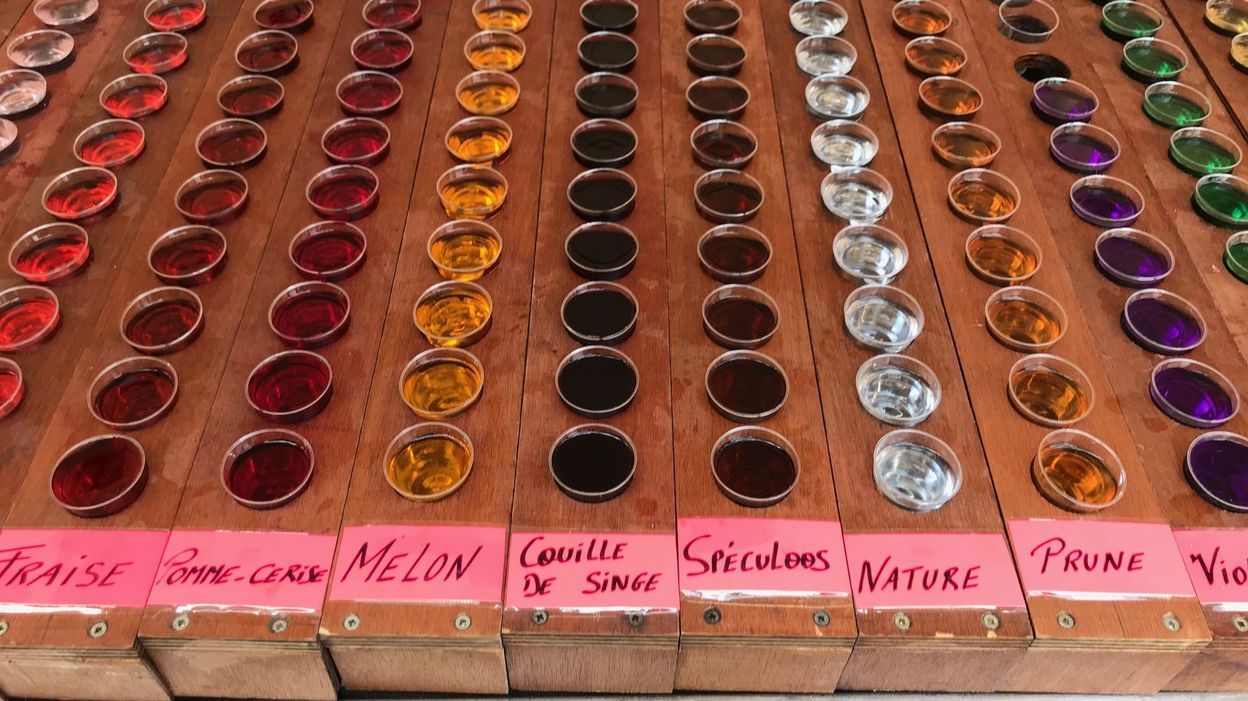
"It's inconceivable to open our brasserie during the Walloon holidays without being able to serve pékèt outside. Walloon festivals rhyme with peket" via Juliette Hariga
We arrive home a bit after 1am, giving us about 6 hours to rest before our first baking day begins. Come morning, I hop in Pierre's car at 7am and we drive over to the bakery. Pierre is the owner and head-baker: Sprightly youthful at 28, elegantly tall, elf-like, quick footed, bearded, man-bunned, with a bubbly jollyness. The rest of the team is composed of Alix and Tao, the pastry chefs: Deft and efficient, tirelessly working with infallible precision, impossible quickness, indefatigable strength, and irreverent humor. And me, trying my best and usually in the way.
Early in the morning I'm given my first task: make yourself breakfast and await further instructions. Eventually I'm put into position on one of the stainless steel counters, some dough is placed in front of me, and I'm told to scoop and plop. The dough is tacky, speckled with thick granules of sugar, and glistening in oozing coconut oil. Armed with a cookie scoop, I scoop cookie sized biscuits of dough and check to see that they each weigh 100g before placing them, shoulder to shoulder, on parchment lined baking sheets. After each scoop, the elasticity of the dough causes the remainder to pull back together, giving off the impression that you're pulling from an infinitely replenishing mixing bowl. Eventually, the illusion wears off and the mixing bowl returns to reality, empty at last, and in its place you're left with ~100 (hopefully) identical balls of dough.
Because I was given a cookie scoop, and because I like to jump to conclusions, I assumed I was making cookies that would be affectionately called waffles as a little joke. Wrong on a number of counts. The next day, early in the morning, I'd be put into position on one of the stainless steel counters, a waffle iron placed in front of me, and I'd be told to transform the ~100 identical balls of dough into ~100 waffles. I repeat that I didn't know much about Belgium, but I was already on a first name basis with their waffles through run ins on New England ski mountains. I thought it was really nice of Pierre to give me this opportunity to become so acquainted with the country's eponymous baked good on my first days. If Wallonia were to have a citizenship test, I'm sure making gaufres de Liege would constitute a majority of the exam. Neither of these last two thoughts are true, or even entirely accurate, but they're what passed through my mind in the moment. When doing these tasks you have about two hours of repetitive motion where you're free to think up progressively more unhinged thoughts: separate the dough (semi-conjoined after proofing), dust two squares of dough in powered sugar, place them on the griddle, start your timer, dip any waffles you have already made in chocolate, stop your timer, invariably leave them on a few seconds longer to brown some more, remove them from the griddle, curse the blackened sugar burning in the creases of the machine, fight the siren call of the freshly removed waffles, seductively inviting you to bite into their scalding sticky goodness, separate two new squares, dust them in sugar, rinse, repeat. With each waffle that you bring into this world you slip a smidge further into a universe totally consumed by waffle, where entirely unintelligible ideas and muddled thoughts masquerade as epiphanies. In front of that waffle iron I'm sure I cured world peace and saved cancer, it's a shame my hands were too sticky to write it all down.
Following my waffle dough scooping, I laid out some spicy turmeric cashews to be baked, admired the pastry chef's perfect cherry pies, ate an eclair, knocked old flour out of the bannetons, added new flour to them, and then was brought in to shape dough. As was the routine, I was position on one of the stainless steel counters, dough was thrown in front of me, precut and pre-measured, and I was told to make it into a ball. I was told I can do it through any means necessary, but Pierre offered up two techniques.
Pierre's 'scoop technique' involves a plastic dough scraper where you scoop and twist the dough in unison until it forms a ball. Tao's 'cat technique' involves violently beating the dough into submission with her hand, wrist, and forearm, like a cat swatting, if the cat had a bloody vendetta to settle with hundreds of innocent balls of dough.
My technique evolved into smacking the dough a few times, scooping it a few times, other semi-senseless, unjustified motions that eventually produced a rough ball-ish shape. I don't think Pierre will offer it as an option to his next protégée.
I grew quite fond of these weekly dough forming sessions because it felt like we were all a part of some greater purpose, a flour-coated team prepping with ruthless efficiency for some very mundane and eternal war. There is an end to the dough and the bottom of the mixing bowl, but there is never an end to the process. We prep our doughy soldiers for the battlefield, set them in the oven to gain their golden armor, and then release them to do our bidding of bringing joy to people's lives, or at the very least to combat their hunger (equally noble causes). They emerge from nothing, like Saruman's Urukhai from the mud of Isengard; A shapeless mound of wet flour transformed by nimble hands and the warmth of an oven to a golden-crusted loaf equally fit to sit on the mantle of Olympus or the kitchen table.
Their arrival into the world is celebrated with a parade in front of the bakery's front door, into the gentle breeze and early afternoon sunlight. Three hundred newborn loaves lazily sunbathing after their long, improbable, alchemical journey across the membrane of flour to food, natural to manmade, raw to complete, earthly to divine, finely ground grain powders to humankind's most storied comestible companion. What a long strange trip is bread.
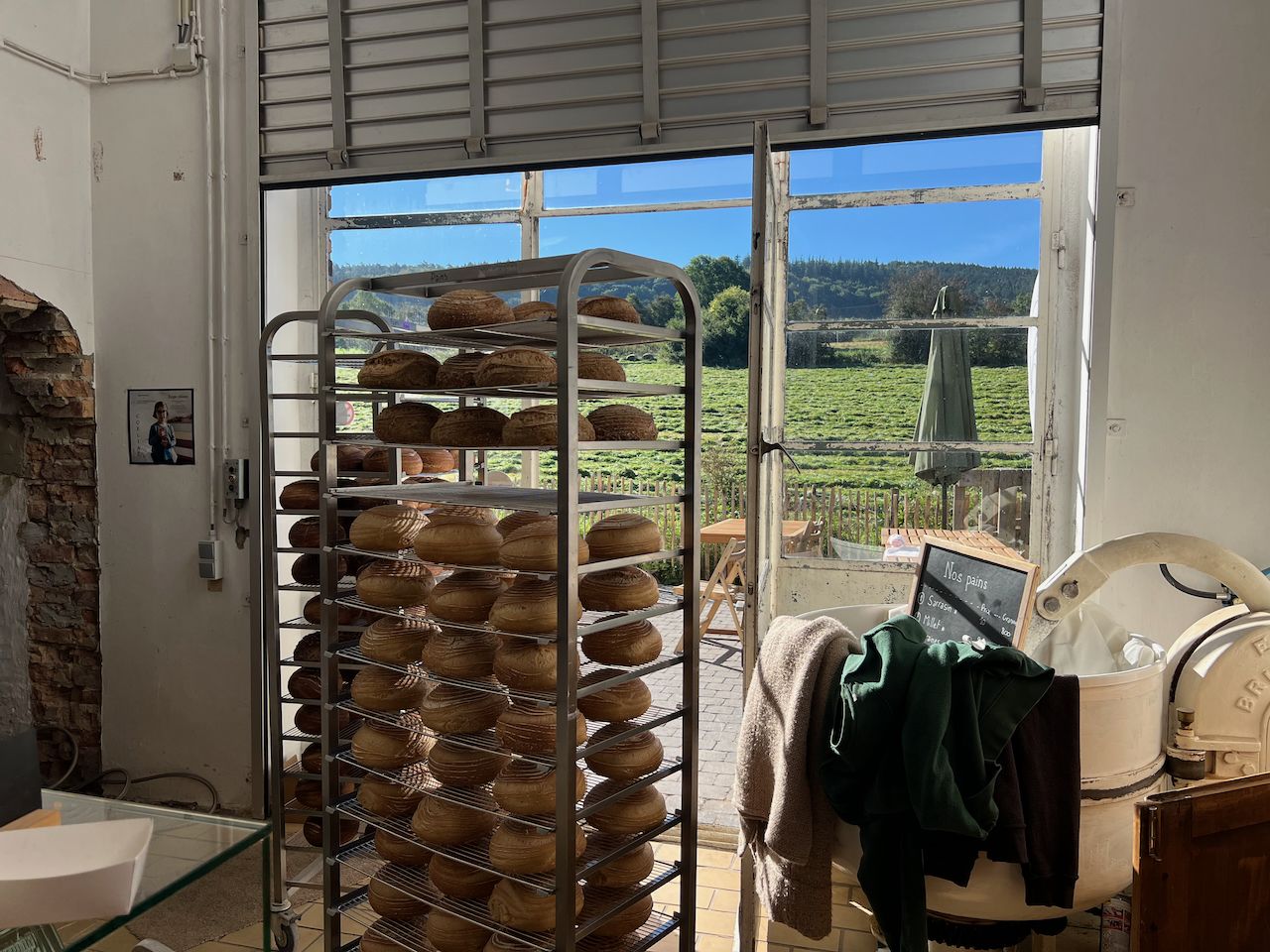
Bread, sunbathing
The Bakery
Each day in the bakery has a different routine. Tuesdays are for prep, Wednesdays are for delivery, and Thursdays are for customers. All days are for bread, and most days are for pastries. Tuesdays the dough is made, pie crusts are baked, and other important things occur which I forget. Wednesdays the first round of breads and viennoiseries are baked, new dough is prepped, pies are filled, waffles are ironed, bread is bagged, and orders going out to shops are packed for delivery and shipped. Thursdays the second round of breads and viennoiseries are baked, more waffles are ironed, more bread is bagged, orders are packed up, customer come in, and, if I've been a really good boy, I get sent home early. Granola, cookies, meringues, roasted cashews, macaroons, eclairs, and Madelines are all timeless, transcending a weekly schedule, brazenly flouting routine, being baked when demand dictates.
The bakery is located in the back of a semi-industrial, brick complex which includes a barber shop, a photovoltaic installation company, and an apartment or two. Tucked in the back, up a well rutted gravel slope, is Boulangerie L'Alternative. Opposite the entrance to the bakery is a grassy pasture where morning dew likes to settle and a horse paddock where two horses like to settle. The bakery, in the reconstruction I've built in my head, is half crumbling-brick plastered over and painted white, and half industrial steel-framed square windows. Inside it's furnished in vintage darkly stained wooden tables and chairs, and one faux-suede moss green arm chair on the third floor. A bathtub sized, mid-century dough machine stands by the door. There's no 'no-climbing' sign, but neither are there stairs nor a ladder nearby to help you climb in, so the official policy on sitting inside it is on a strict 'ask Pierre' basis. Steel beams and strings of homemade cloth pendants in neutral browns and blues stretch across the ceiling. On the first floor are both the kitchen and shop, one floor up is storage and and a large empty room, and on the top floor is an eating area and lounge where brunches and events are held. From the windows looking out you can choose to watch sheep grazing or to check that the town's castle is still standing. There's enough space, enough food, and enough booze to barracks a small army. On the odd occasion, Pierre does just that.
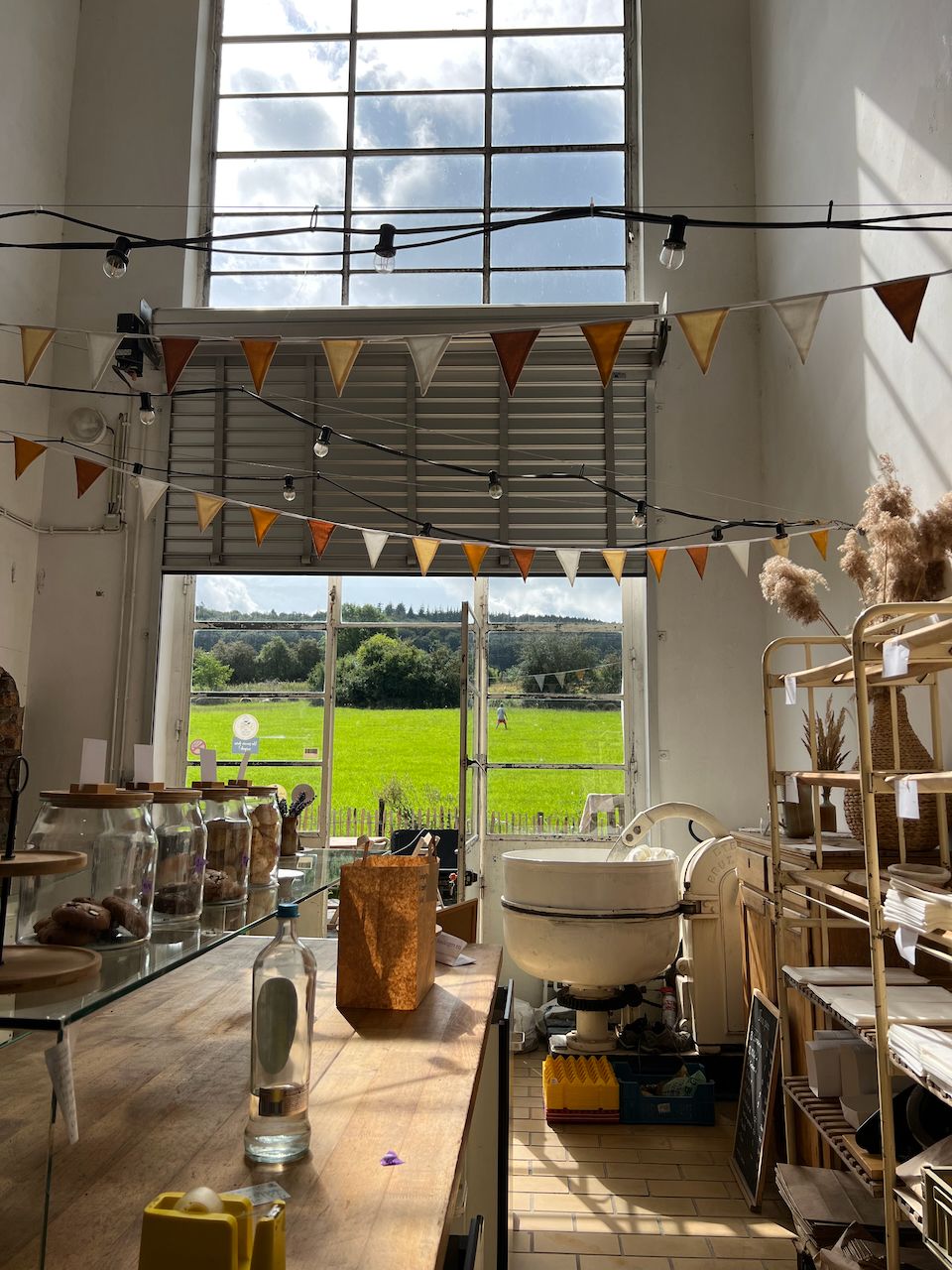
The bakery's shop
During working hours, the bakery is filled with noise, commotion, and heat. If an alien were to come to earth and visit this bakery, I reckon they'd come to the reasonable assumption that it's some type of incubation chamber for small, square digital timers. We get in early each day, turn on the oven to warm up the place for the digital timers, we each grab a one or two and set them up in their various perches, and then return to them every few minutes to check in on how they're doing. When they cry out with their shrill beeping, their loyal servants rush to quiet them down with some gentle tickling and button massaging. Invariably, they cry out again (in regular, pre-set intervals) and their servants never seem to tire of their calls. To these aliens, baking is just what happens in between moments of tending to timers. We are completely at their disposal, acting only when they bid us to. The bakery is a cacophony of Alix's indie-folk-pop playlists, the hum of the oven's fans, the mechanical churning of the dough mixers, French chitter chatter, and an untrained choir of timers signing out of time. A timer for proofing, a timer for baking bread, another for pastries, another for the cookies, one for the pot on the stove, one for reasons unknown, one or two that are lost in translation, a last one for the waffle iron, and probably one hidden, holy timer that I never got clearance to actually see.
I'm painting you this picture in such unnecessary detail for two reasons. First, being at, near, or in transit to the bakery exaggeratingly accounted for half my waking hours in Belgium. To me, however incorrect, Belgium and the bakery became the same thing. Second, Belgium, and therefore the bakery, and the bakery, and therefore Belgium, both felt surreal. The Belgium I saw had hilltop castles with moats, quiet roads shared between indifferent horses and barn cats, and rural vending machines selling potatoes, pizzas, and pansies. The bakery I saw was a place where vanished hours were kneaded into bread, minutes and days were piped into pie crusts, and where you slowly dissolved into its rhythms until rejected croissants and slices of broken cakes pieced you back together. I saw it in the golden early morning light, I felt it in the suffocating heat of August, I heard it in the singsongy French 'ooh la la's' and 'oufti's', I tasted it in its waffles and rice pies, mayonnaise and stinky cheeses. I set out on this year hoping to learn how people express themselves and their cultures through food and fermentation, and in the bakery I found a place that did just that. Tucked away in a quiet corner of an overlooked country is an enclave of devout doughy artisans bringing life to flour, reimagining and redefining the foods of their region, and having a very, very good time while doing it.
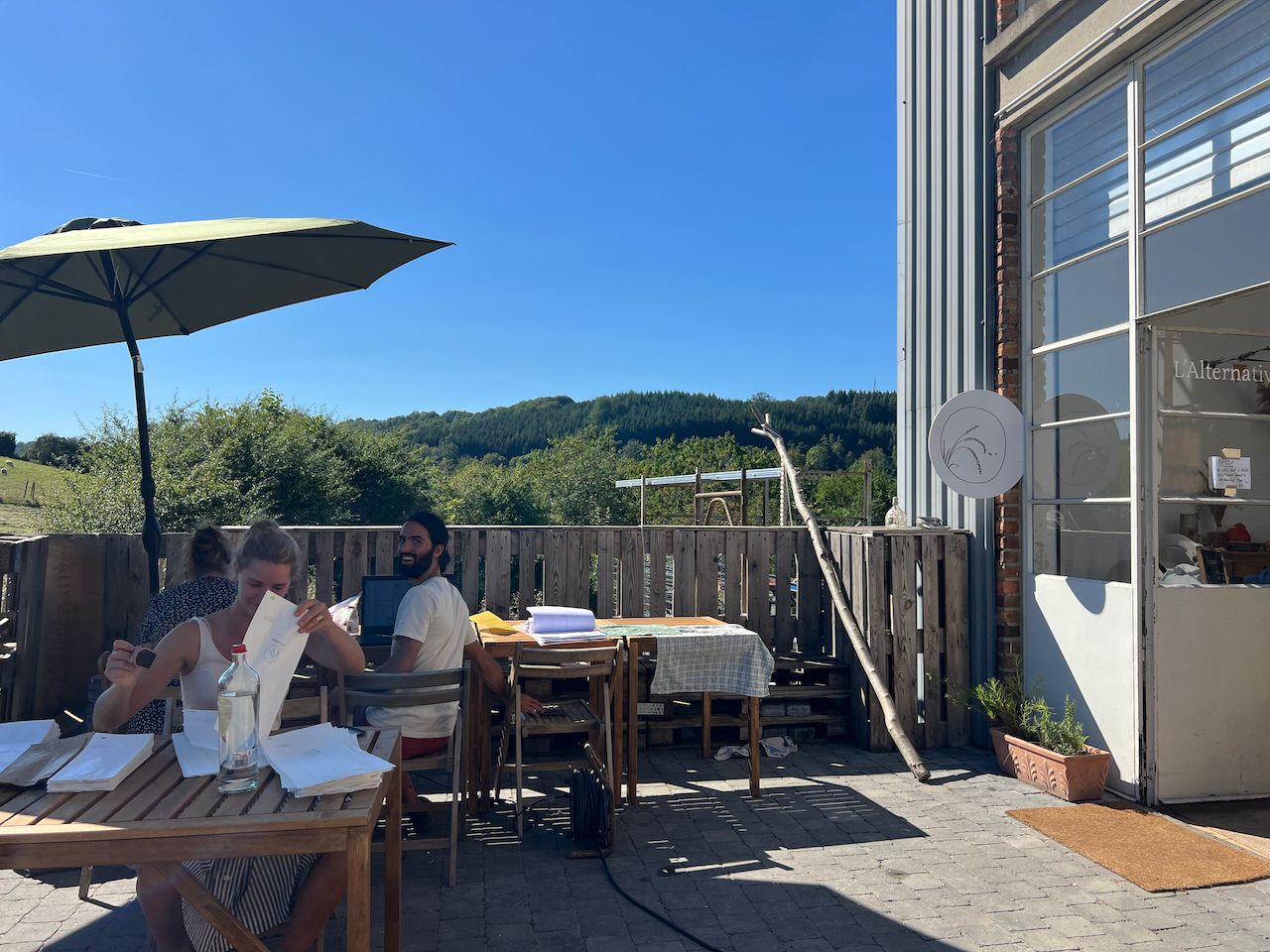
Pierre, Judith, working in the sunshine